
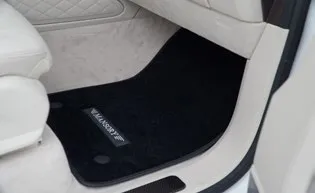
Velour floor mats - with leather edging for Mercedes G-class W463A Gronos


Velour Floor Mats with Leather Edging for Mercedes G-Class W463A Gronos
The floor mat's edging material defines the mat's character at its perimeter — the border that frames the velour pile face and presents the mat's programme identity at the visible seam line. Where the nubuck-edged variant uses buffed leather's soft nap texture for a warm, tactile border quality, the Velour Floor Mats with Leather Edging use smooth full-grain or semi-aniline leather for a border specification that is more formal and more aligned with the W463A G-Wagon's luxury-executive interior positioning. The Velour Floor Mats with Leather Edging from the Mansory Body Kit for Mercedes G-Class W463A Gronos provide the same deep-pile velour mat body specification as the nubuck variant with a smooth-leather border edging that coordinates with the W463A's Nappa leather seat and door card specification — creating a material-consistent footwell programme for leather-interior builds.
Construction & Materials
The Velour Floor Mats with Leather Edging share the same deep-pile velour body specification as the nubuck variant: 800–1,200 g/m² pile weight, precision W463A footwell geometry, heel pad reinforcement at driver and front passenger positions, non-slip underside backing, and OEM floor-hook retention clips. The border edging is smooth full-grain or semi-aniline leather — 1.0–1.2 mm hide thickness — stitched at a 15–20 mm seam allowance with the same contrasting-thread stitching specification as the nubuck variant. The smooth leather border can be supplied in the same hide specification and colour as the W463A's OEM seat leather for a seamless material match between the floor mat border and the adjacent seat surround leather.
- Face material: deep-pile automotive velour, 800–1,200 g/m² pile weight
- Border edging: smooth full-grain or semi-aniline leather, 1.0–1.2 mm thickness
- Border colour: matched to W463A OEM seat leather specification or custom — specify at order
- Stitching: contrasting thread — specify colour at order
- Heel pad: driver accelerator heel and front passenger footrest reinforcement
- Mat body: precision W463A footwell geometry, four positions
- Underside: non-slip backing, OEM retention hook clips
- Supplied: four-mat set (front LH/RH, rear LH/RH)
Design & Visual Function
Smooth leather edging on a velour mat creates a formal material contrast that nubuck edging does not. Smooth leather's surface is reflective at tangential light angles — a quality that reads as precision quality in the cabin's interior lighting, particularly on vehicles with the W463A's ambient lighting programme where low-angle LED illumination catches the leather border's surface at its most reflective. The leather border's colour matching to the OEM seat leather creates a material continuum from the seat's lower edge to the mat's border edge — when the door is open, the observer sees the same leather specification running from the seat surround, down the seat edge, and into the mat border in a continuous colour register that conveys an OEM-level material coordination standard.
Smooth leather's reflective quality under the W463A cabin's ambient lighting is particularly valuable in vehicles with the premium ambient lighting specification — the LED strips at the door pull channels and footwell zones cast low-angle illumination that catches the leather border's surface at its most reflective angle. At certain ambient lighting colour settings — blue or amber hues — the leather border's reflective surface takes on a complementary tonal quality that shifts the footwell's visual atmosphere toward a formal automotive-interior reading. This ambient-lighting interaction is a specification detail that the nubuck border, with its diffuse-reflection nap surface, does not produce — the smooth leather's reflective geometry is the specific material property that creates this low-angle ambient lighting effect.
The smooth leather border also ages differently from the nubuck edging. Well-maintained smooth leather develops a patina over years of use that nubuck, with its abraded-grain surface, does not develop in the same way. The leather border's patina is a long-cycle aesthetic quality that builds over 3–7 years of use under regular conditioning, giving the mat set a deepening material quality rather than the progressive wear-out profile of lower-specification synthetic edging. This long-cycle quality characteristic is appropriate for the W463A G-Wagon's ownership context, where vehicles are typically held for 5–10 years and the interior's long-term material quality matters more than a specification that peaks at new-delivery condition.
Compatibility & Fitment
Velour Floor Mats with Leather Edging fit the Mercedes-Benz G-Class W463A 2018 to present. LHD and RHD footwell geometries differ at the driver position — specify at order. Post-2024 facelift W463A compatible. Leather border colour matching to OEM seat leather: provide the W463A's interior specification code at order for colour matching.
Installation & Reversibility
Installation is identical to the nubuck variant — mat placement and retention-clip engagement at OEM floor hook positions. Confirm driver mat retention clip engagement after every removal for cleaning. The smooth leather border requires a wider stand-off from the door sill edge than nubuck during installation — do not fold the border at any point during placement, as smooth leather does not recover from hard fold marks the way nubuck does. Lay the mat flat from the front retention position rearward to avoid border fold contact with the sill edge.
Pairing within the Mansory Gronos programme
The leather-edged mats pair with the same footwell and boarding programme elements as the nubuck variant. The Aluminium Pedals above the mat surface in the driver footwell and the Entrance Panels at the sill above are the companion footwell elements. The leather-edged mats are most appropriate for W463A builds with a Nappa or semi-aniline leather interior specification where the mat border can be colour-matched to the dominant interior leather. For W463A builds with alcantara or mixed-material interiors, the Velour Floor Mats with Nubuck Edging may provide a better tactile material match to the soft-surface interior programme.
Maintenance & Durability
The smooth leather border requires a regular conditioning programme distinct from the velour face maintenance. Apply a dedicated automotive leather conditioner to the border every 4–6 weeks during regular use, using a soft applicator pad. The conditioner prevents the leather from drying and cracking at the border's flexion zones — the seam line where the border meets the pile face is a point of concentrated flexion when the mat is removed for cleaning, and unconditioned leather at this seam will develop micro-cracks at the flexion point within 2–3 years. The conditioner should be a pH-balanced automotive leather cream without silicone — silicone in leather conditioners can transfer to the velour pile face and reduce the pile's natural grip against the occupant's footwear.
The smooth leather border's stitching at the seam line should be inspected annually for any thread fraying or seam opening resulting from the mat's repeated folding and laying during cleaning cycles. The seam stitching is typically a polyester or nylon thread that is chemically inert and resistant to the cleaning products used on the mat face and border. However, if the mat is subjected to forceful folding — for example, when a large mat is forced into a compact storage bag for transport — the seam thread can be cut by the fold radius. Always fold leather-bordered mats gently along their natural fold axis, which follows the heel-pad zone, and avoid folding against the border seam. If any stitching shows fraying or gaps, have the seam re-stitched by a leather goods specialist before the gap propagates along the border seam.
The smooth leather border is more susceptible than nubuck to liquid-absorption staining events — a liquid spill on the mat border that is not immediately blotted can penetrate the grain surface and leave a permanent dark water-mark ring as the moisture evaporates from the leather boundary. Keep a dry microfibre cloth accessible in the cabin for immediate response to border liquid contact events. A leather protector spray on the border every 6 weeks provides a barrier against liquid penetration at the grain surface and reduces the severity of any liquid-contact staining event that reaches the leather border before it can be blotted.
Lead Time & Warranty
Lead time for Velour Floor Mats with Leather Edging is 3–4 weeks from order including colour specification. 12-month warranty against pile delamination, leather border stitching failures, and retention clip failures. Leather surface wear at the direct footwear contact zones of the border is normal use patina and not covered under warranty.
FAQ
Q: Can the leather border colour be different from the seat leather colour for a contrast specification?
A: Yes — specify the desired border leather colour independent of the seat colour at order. Contrasting border specifications are available across the standard automotive leather colour palette.
Q: Which mat variant — nubuck or smooth leather — is more appropriate for off-road use?
A: For vehicles used frequently off-road, the nubuck variant's textured surface hides minor contamination better and is more forgiving of wet-contamination contact events. Smooth leather shows contamination and water-mark events more prominently and is more appropriate for predominantly on-road executive use.
Specify leather colour, stitching colour, and LHD/RHD configuration with the Hodoor Mansory team: Contact us via WhatsApp +44 7488 818 747 or [email protected].