
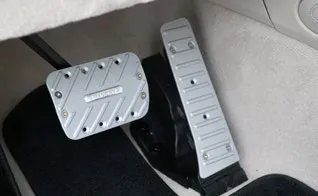
Aluminium pedals for Mercedes G-class W463A Gronos


Aluminium Pedals for Mercedes G-Class W463A Gronos
The brake and accelerator pedals — and the footrest dead pedal on the driver's left — are the driver's three primary foot-contact points in the W463A's footwell. They are surfaces the driver's foot contacts under high load during braking and acceleration, under high-frequency cycling during urban stop-start driving, and at a critical control-input interface during emergency braking where pedal slip or misidentification has direct safety consequences. In OEM AMG specification the W463A's pedals are stainless-steel-faced or rubber-faced units that provide adequate slip resistance and durability. The Aluminium Pedals from the Mansory Body Kit for Mercedes G-Class W463A Gronos replace the OEM pedal faces with precision-machined aluminium covers that bring the Gronos programme's precision-engineering aesthetic to the driver's footwell, while providing a pedal surface specification aligned with the programme's overall premium engineering standard.
Construction & Materials
The Aluminium Pedals are precision-machined from 6061-T6 or 7075-T6 aluminium billet at the driver's accelerator, brake, and dead-pedal positions. The machined aluminium face is treated with an anodising process — hard anodise to 25–35 microns or type III hard-coat anodise — that provides a surface hardness exceeding 400 HV, sufficient to resist the scuff loading from normal shoe sole contact under heavy use over the vehicle's service life. The pedal face carries a machined raised-rib anti-slip pattern in the aluminium surface — typically a grid or bar pattern with 1–2 mm raised ribs at 8–12 mm centres. The machined ribs' edges are radiused at 0.5–0.8 mm to avoid sharp-edge contact with the shoe sole that would cause rapid sole wear. Retention at the OEM pedal positions is via machine screws at the OEM pedal arm mounting holes or over-pedal clip-fit at the OEM pedal rubber position.
- Material: 6061-T6 or 7075-T6 aluminium billet, CNC machined
- Surface treatment: hard anodise 25–35 micron, or type III hard-coat — 400+ HV surface hardness
- Anti-slip pattern: machined raised-rib grid at 8–12 mm centres, ribs radiused at 0.5–0.8 mm
- Pedal positions: accelerator, brake, and dead pedal (driver footrest)
- Finish: natural anodised silver, black anodised, or titanium anodised — specify at order
- Retention: OEM pedal arm screw positions or over-pedal clip retention
- Supplied: full driver footwell set (accelerator + brake + dead pedal)
Design & Visual Function
Aluminium pedals are a foundational sports-car and performance-car interior element — they appear in high-specification production vehicles and in racing-derived interiors as a signal of engineering precision at the driver's operational interface. On the W463A Gronos programme, the aluminium pedals bring this engineering-precision signal to the G-Wagon's footwell, where the OEM pedal faces are adequate but not programme-identified. The machined billet surface quality of the Mansory aluminium pedals — with its toolpath-straight rib geometry, precise rib pitch, and uniform anodise finish — communicates the same precision manufacturing standard as the Gronos programme's exterior carbon components at the driver's footwell level.
The visual presence of the aluminium pedals in the W463A footwell also creates a material contrast reference point that reinforces the Gronos interior programme's precision-engineering message at the driver's functional interface. When the driver glances into the footwell during a high-performance driving moment — checking pedal position before a heel-toe shift manoeuvre or during a high-speed approach to braking point — the CNC-machined billet surface of the aluminium pedal face is the last detail they register before the braking or shift input. This sub-second visual contact with a precision-engineered surface is one of the most psychologically effective endorsements of the Gronos programme's engineering quality — the driver's immediate pre-input perception is of a precision-machined contact surface, which reinforces confidence at the control interface.
The hard anodise finish's deep black or silver surface absorbs and reflects light differently from painted or rubber pedal surfaces. Hard-anodised aluminium presents as a matte-metallic surface with a fine crystalline surface structure visible at the 0.3–0.5 m viewing distance typical of the driver's downward footwell glance — a surface quality that reinforces the precision-engineering message at the tactile-contact distance where the driver is most aware of material quality. The rib pattern's shadow at this close range creates a strong geometric visual on the flat pedal face that is one of the Gronos interior programme's most visually distinct detail elements.
Compatibility & Fitment
Aluminium Pedals fit the Mercedes-Benz G-Class W463A 2018 to present driver footwell pedal positions. The G63 AMG and G500/G550 share the same pedal arm positions. LHD and RHD: left-right mirror configuration — specify at order. Post-2024 facelift W463A compatible.
Installation & Reversibility
Installation time is 15–25 minutes for the full driver footwell set. For screw-mount pedals: remove OEM pedal covers, position aluminium pedal at OEM screw positions, and tighten to OEM torque specification. For clip-mount over-pedal fitment: clean the OEM pedal face with IPA and fit the aluminium cover at the OEM pedal perimeter clip positions. Confirm each pedal's operating travel is unaffected by the installed cover before the first drive — the pedal covers must not reduce the brake pedal's free-travel or contact the footwell tunnel at full pedal depression. Fully reversible at OEM screw or clip positions.
Pairing within the Mansory Gronos programme
The aluminium pedals pair with the velour floor mats that define the footwell surface. The Velour Floor Mats with Nubuck Edging and Velour Floor Mats with Leather Edging complete the driver's footwell specification with premium surface mats that frame the aluminium pedal faces. For the door-sill level between the footwell and the entrance panel, the Entrance Panels continue the Gronos programme from the sill face to the footwell zone where the pedals are positioned.
Maintenance & Durability
Hard-anodised aluminium pedals require minimal maintenance compared with rubber or painted pedal faces. The 400+ HV surface hardness is effectively scuff-proof under normal shoe-sole contact — the anodise layer will outlast the vehicle's service life under normal driving conditions. Clean the pedal faces with a damp cloth to remove mud and road salt from the rib surfaces at each weekly interior clean. Do not use abrasive pads or wire brushes on the anodise surface — even though the anodise is hard, aggressive abrasion can mark the surface. A pH-neutral interior cleaner applied with a soft brush effectively clears the inter-rib rib bases of accumulated grit and salt without abrasion risk.
The driver's footwell pedals are subject to a contamination cycle that is unique among interior programme elements: the contamination is abrasive — road grit transferred from the shoe sole's tread under full pedal-depression force creates a grinding action between the grit particle, the shoe sole, and the pedal face rib surfaces. Hard-anodised aluminium is highly resistant to this abrasion mode, but the rib edges can accumulate embedded grit particles in the root valleys between the ribs that are difficult to remove with a cloth alone. At each monthly interior clean, use a stiff nylon brush (not metal) to clear the inter-rib valleys on the accelerator pedal face, which receives the highest-frequency foot contact of any pedal. The brake pedal accumulates less grit because it receives only periodic high-force foot contact rather than the accelerator's sustained light-pressure contact throughout urban driving.
The screw or clip retention at the OEM pedal positions should be checked annually — pedal cover retention hardware is exposed to foot-impact loads at every braking event that can work fasteners loose over many thousands of pedal cycles. Re-torque mounting screws to specification at each annual check. For clip-mount over-pedal covers, verify clip engagement by pressing the pedal face firmly from the top face of the cover at each annual check — any movement exceeding 1 mm indicates a clip has released and requires re-engagement before the cover can slide on the pedal face during a brake application, which is a safety risk.
Lead Time & Warranty
Lead time for Aluminium Pedals is 2–3 weeks from order. 12-month warranty against anodise delamination, machining defects in the anti-slip rib geometry, and retention hardware failures under normal pedal use loading.
FAQ
Q: Are the aluminium pedals compatible with sports driving boots and racing footwear?
A: The machined rib pattern and anodised surface are compatible with all standard shoe sole materials including rubber racing boot soles. Smooth-soled formal footwear may experience slightly reduced grip on the rib pattern compared with textured sole driving shoes — this is inherent to aluminium pedal surfaces and is mitigated by the rib pattern's edge geometry.
Q: Do the pedal covers interfere with the W463A's brake-pedal switch?
A: The brake-pedal cover mounts at the pedal face, not at the pedal arm or switch mechanism. The brake-pedal switch at the arm pivot is unaffected by the face cover. Confirm full pedal travel is maintained after installation as described in the installation section.
Specify finish anodise colour and LHD/RHD configuration with the Hodoor Mansory team: Contact us via WhatsApp +44 7488 818 747 or [email protected].