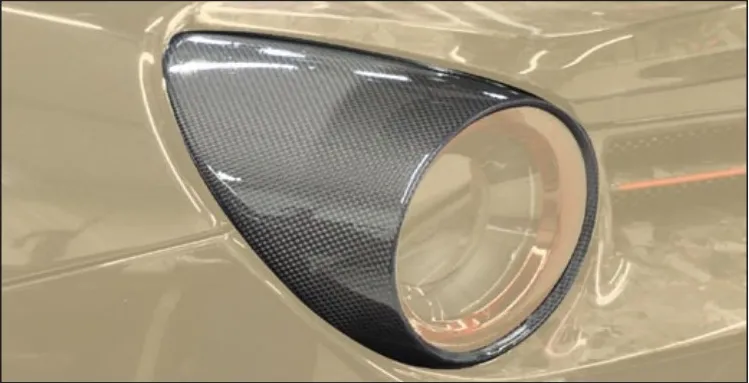
Rear lights carbon cover Mansory Carbon for Ferrari 488 Siracusa 4XX


Rear Lights Carbon Cover — Mansory Carbon for Ferrari 488 Siracusa 4XX
The rear lights carbon cover is the panel that sits between the OEM tail-lamp clusters and the rest of the rear bumper, framing each round lamp with visible weave. Within the wider Mansory Carbon Fiber Body kit set for Ferrari 488 Siracusa 4XX programme it works as a finishing part rather than an aero one — its job is to extend the carbon language across the back of the car so the rear-three-quarter view reads as a single co-ordinated carbon surface. Without it, the rear bumper carbon stops short of the lamps and the eye picks up a body-colour break either side; with it, the carbon runs continuously from the rear flap up across the lamp surround and into the engine bonnet.
Construction & Materials
This is one of the more thermally challenging trim parts in the kit. The tail-lights sit directly above the rear engine bay vents and the cover is exposed to two heat paths simultaneously — radiated heat from the LED clusters themselves during long night drives, and convected heat lifting up out of the V8 bay after a hard run. The lay-up is therefore biased toward thermal margin rather than weight. A second consideration is water management: the cover's inner edge butts against the lamp seal, and spray driven by motorway speed will find any micro-gap, so the tool is set up with a precise step at the lamp aperture and the trim line is finished with a mating bead of polyurethane sealant.
- Outer ply: 3K 2x2 twill prepreg, weave centred horizontally on the lamp axis
- Backing ply: 200 gsm bias carbon to add stiffness around the lamp aperture without print-through
- Cure: full autoclave cycle, 125 °C, 6-bar consolidation, post-cure free-stand at 80 °C
- Resin: high-Tg automotive epoxy, 150 °C continuous service rating, chosen for the rear-bay heat plume
- Wall thickness: 1.8–2.2 mm across the panel, stepped to 2.6 mm around the lamp aperture rim
- Mounting: reuses the OEM bumper clip locations and two M5 nutserts already present on the lamp frame — no drilling
- Edge sealing: polyurethane bead at the lamp aperture, applied on installation, weather-rated for repeated wash cycles
- Finish: gloss 2K UV-stable clearcoat as standard, satin matte on request
Design & Visual Function
Because the lamps are round, the cover's inner edge has to follow a true circle rather than a polygonal cut. That is harder than it sounds: a hand-trimmed carbon edge tends to want to follow a series of short straight cuts, and any flat between cuts shows up against the lamp lens as a slight chord. The aperture is therefore CNC-trimmed against a fixture rather than scribed by hand, which gives a true-arc cut and lets the lamp seal seat evenly around the full circumference.
Light reflectivity is the second visual driver. The lacquer here is laid down heavy because the panel is in constant view from anyone following the car at night — headlamp light from a tailing vehicle reflects off the carbon, and a thin clear coat shows up as flat and patchy under those angles. The 2K cut-and-polish system gives a deeper apparent gloss that holds up under direct beam reflection, which is the angle the cover most often gets photographed from at evening events.
Visual integration with the rest of the rear of the car is the reason most customers add the part. The OEM bumper sweeps from black diffuser up through body-colour lamp bezels into the carbon engine bonnet — a tonal staircase that breaks the carbon flow. Replacing the bezels with matched 3K twill removes the staircase: from the rear, the eye now reads diffuser carbon, lamp-surround carbon, bonnet vent carbon as one continuous tone. The shift is subtle in photographs and very obvious in person.
One detail that catches buyers off-guard is how much the cover changes the apparent depth of the rear of the car. The OEM body-colour bezels reflect the same paint tone as the rest of the bumper, which flattens the rear-three-quarter view — the lamps appear to sit on a single plane with the bumper. The carbon surround introduces a tonal break that the eye reads as a recess: the lamps now appear set deeper into the bodywork, even though their physical position has not moved a millimetre. That depth illusion is the visual reward for an otherwise small and unglamorous trim part, and it is the reason the cover sells well even on builds that have otherwise stayed conservative on bumper aero choices.
Compatibility & Fitment
The cover fits both the 488 GTB coupé and the 488 Spider — the rear bumper geometry is shared between body styles even though the rear roof differs — across model years 2015–2020 with the 3.9-litre twin-turbo V8. It is supplied as a left-and-right pair. If the rear bumper has been replaced with a non-OEM unit during prior repair, the lamp aperture geometry should be checked against the cover step before installation; send a photograph before ordering and we will confirm fit. Cars that have been retrofitted with non-OEM tail-lamps may also need the aperture profile verified — the cover is cut for the original lamp diameter and seal channel.
Installation & Reversibility
Fitment uses the OEM lamp-frame nutserts and bumper clip locations, so the panel is mechanically fixed rather than purely bonded — clip-located, screw-secured, then sealant-beaded around the lamp aperture. Tools needed: a torx bit set, a small ratchet, isopropanol for surface prep, and a sealant gun. Bench time is around 30–45 minutes per side. Reversibility is total: unscrew, peel the polyurethane bead with a plastic pick, and the OEM bezel can be refitted using its original fasteners. Because no drilling is involved and the original mounts are retained, returning the car to factory specification for resale or warranty work takes under an hour for both sides.
Pairing within the Mansory Ferrari 488 Siracusa programme
The most common pairing is with the rear air outtake grills cover because the two parts share the rear-three-quarter sightline and customers who order one almost always order the other. Owners building toward the high-aero spec usually add the rear kit high flap so the bumper, lamp surrounds and rear flap all read as one carbon composition. Coupé builds often complete the rear with the engine bonnet air outtake, which sits directly above the lamp surrounds in the eyeline.
Maintenance & Durability
Wash care is identical to other exterior carbon parts. Avoid solvent-heavy degreasers around the lamp seal — they soften polyurethane bead sealant over time and can encourage water ingress. A pH-neutral car shampoo and a soft microfibre wash mitt are the right tools. UV exposure is heavy because the panel sits high on the rear of the car, but the 2K UV-stable clearcoat is specified for that environment and will not yellow over the warranty period. If the lacquer is scuffed by a careless wash brush, it can be flatted and re-cleared without disturbing the laminate. Expected service life is well beyond ten years of normal exterior ownership.
Lead Time & Warranty
Lead time is 2–4 weeks from confirmed order. The lead time skews longer than a small trim piece because the lamp aperture is CNC-trimmed against a fixture, which adds a setup pass before the autoclave run. Each cover ships with a 12-month warranty against manufacturing defects — laminate voids, delamination, clearcoat lift, sealant primer failure. Damage caused by incorrect installation, by chemical attack from aggressive cleaners, or by collision impact is not covered.
FAQ
Q: Will the carbon discolour from the heat coming up out of the engine bay?
A: No. The lay-up uses a high-Tg automotive epoxy rated to 150 °C continuous service, comfortably above the panel temperature reached by the rear-bay heat plume even after sustained hard driving.
Q: Will water ingress past the lamp seal cause problems?
A: No, provided the polyurethane bead is laid correctly during installation. The cover is designed to mate against the OEM lamp seal channel, and the supplied sealant fills any micro-gap between carbon and bumper.
Q: Does it require any drilling?
A: No. The cover uses the OEM bumper clip positions and the existing M5 nutserts on the lamp frame. Reversibility is therefore total.
Q: Can I order satin matte to match the rest of my matte exterior carbon?
A: Yes. Specify satin matte at order and the part is finished with a flatted 2K clear rather than a wax overlay, so the matte stays consistent over time.
Q: How long does installation take?
A: Around 30–45 minutes per side for a competent fitter, plus a 24-hour cure window for the sealant bead during which the car should not be pressure-washed.
Q: Will the lacquer yellow under heavy sun exposure?
A: No. The 2K clearcoat used here is UV-stable, with a stabiliser package specified for high solar load. Through the 12-month warranty period and well beyond, expect no measurable shift in lacquer tone — the rear deck stays neutral against the rest of the car's carbon.
Order the rear lights carbon cover alongside the rear grills cover so the rear-three-quarter view reads as a single continuous carbon surface. CTA: WhatsApp +44 7488 818 747 or [email protected].