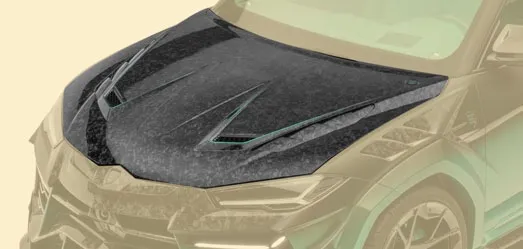
Front bonnet V - visible carbon Mansory for Lamborghini Urus Venatus


Mansory Front Bonnet II — Visible-Carbon (Raw-Weave) Finish for Lamborghini Urus Venatus
The front bonnet II in visible-carbon finish is the third corner of the Mansory Mansory Body Kit for Lamborghini Urus Venatus S bonnet matrix. It carries the same generation-II clamshell geometry as the lacquered II-carbon panel — the raised power-dome over the twin-turbo 4.0 V8, the sharpened crease that lines up with the Y-pattern LED DRL, and the relocated heat-extractor outlets — but the surface treatment is deliberately reversed. Where the II-carbon variant disappears under several layers of deep, liquid-glass lacquer, the visible-carbon variant leaves the weave raw, sealed only under a thin UV clear so the actual carbon fibres are what the eye reads. This is the bonnet for owners who want the engineered, technical-aesthetic look on the most prominent visual area of the Urus and Urus Performante.
Construction & Materials
The visible-carbon bonnet is laid with the same prepreg architecture as its lacquered sibling — autoclave-cured aerospace prepreg over a Nomex honeycomb core, with localised UD reinforcement along the bonnet edges and around the strut-rod boss — but the cosmetic top ply is selected and oriented specifically for visual cleanliness, because that ply is what the customer will look at every day. Surface finishing is the inverse of the deep-lacquer route: the panel is cleaned, blocked flat, sealed with a UV-stable clear, and that is essentially all. There is no lacquer build, no orange-peel polish stack, no liquid-glass effect.
- 3K twill 2/2 cosmetic top ply (default) or 2K plain weave on request — the plain weave reads more technical, the twill reads more decorative
- Aerospace-grade epoxy prepreg, autoclave-cured at controlled ramp and dwell
- Nomex honeycomb core through the central span; UD carbon stiffeners along edges and around the bonnet-strut boss
- Wall thickness ~2.0–2.4 mm at face, ~6 mm with core
- Mass ~6–8 kg fully trimmed (substantially below the OEM steel-and-aluminium hood)
- Finish: thin UV-stable clear coat over raw weave — no deep-lacquer build, no liquid-glass effect; the carbon weave is the cosmetic surface
- Hardware: OEM hinges, OEM hood-strut geometry, OEM latch and safety-catch — no chassis modification
- Heat-extractor outlets and power-dome integrated into the layup, not bonded-on appliques
Design & Visual Function
The Mansory bonnet line for the Urus Venatus is a four-way matrix, and visible-carbon is the corner that explicitly puts the fibre on display. The other three corners answer different briefs. The II-carbon variant uses identical generation-II geometry but builds a deep, glassy lacquer stack on top of the weave so the panel reads as a polished black sculpture with the fibre slightly recessed under the optical depth. The II-primed variant supplies the same shell ready for body-colour paint, hiding the carbon entirely under the car's paint scheme. The V-primed variant uses the alternative generation-V geometry — different dome line, different vent placement — also primed for paint. The visible-carbon answer sits at the "maximum honesty" corner: gen-II shape, raw weave on display, no paint hiding, no lacquer flattering.
Visually the consequence is significant. Under sunlight a deep-lacquered bonnet behaves like glass — it picks up reflections, it hides the weave under highlights, and the eye reads "black panel." A visible-carbon bonnet under the same sun reads as "woven fabric" — the eye picks up the cross-hatch of the 3K tows or the over-under rhythm of the 2K plain weave, and the panel announces what it is made of. This is the look favoured by owners whose other carbon parts on the car are also raw-weave, because consistency across panels matters: a raw C-pillar panel, raw mirror caps, and a raw bonnet read as a coherent technical-aesthetic theme. A raw bonnet next to a deep-lacquered C-pillar reads as inconsistent and is the most common mistake on this car.
There is also a functional honesty point. The bonnet sits in the most prominent visual real-estate on the Urus — directly under the driver's eyeline at every approach to the car, framed by the Y-pattern DRL signature. Whatever finish goes on this panel will be the dominant carbon impression of the entire vehicle. Visible-carbon makes the panel say: this is a structural carbon component, oriented and laid for engineered reasons, not a cosmetic decal applied to a metal hood. For owners drawn to the engineered-component aesthetic over the jewel-like lacquered aesthetic, this is the right answer.
Compatibility & Fitment
The visible-carbon bonnet fits the Lamborghini Urus, Urus S (post-2022 facelift), and Urus Performante (2018–present). The Mansory Venatus parts programme retrofits across the Urus line, which is why the slug uses the generic Venatus naming. The bonnet preserves OEM hinge geometry, OEM hood-strut mounting, OEM latch and secondary safety-catch, and clearance for the strut-tower brace and the underbonnet wiring loom. No modification is required to the chassis, the front clip, or the engine bay, and the panel does not interfere with adaptive air-suspension self-levelling, with rear-wheel-steering geometry, or with the six driving-mode aero state of the car (Strada / Sport / Corsa / Sabbia / Terra / Neve).
Installation & Reversibility
Installation is reversible and takes a competent body shop roughly four to six hours. The OEM steel-aluminium bonnet is removed, the new carbon panel is offered up to the OEM hinges, gap and shut-line are dialled in across the front clip and the leading edges of the front fenders, and the strut and latch geometry are checked. With visible-carbon the bodywork side of the install is actually slightly faster than with primed bonnets because there is no painting stage, no body-colour blend into the front fenders, and no clear-coat cure dwell — once the gaps are right and the safety-catch operates correctly, the car can be released. Reversibility is total: hinge bolts back to the OEM bonnet whenever desired, with no chassis trace.
Pairing within the Mansory Urus Venatus programme
The most important pairing is matrix-internal. The visible-carbon bonnet is the raw-weave answer to the question "what carbon do I want on the front of my car?" — and the most useful comparison is against its lacquered sibling front bonnet II in II-carbon (deep-lacquered) for the deep-gloss alternative on the same shell, and against front bonnet V (primed) for the alternative generation-V geometry under paint. Outside the bonnet matrix, the panel pairs naturally with other raw-weave parts on the car: the C-pillar panel in matching visible-carbon keeps the technical-aesthetic theme reading consistently from the front mask all the way to the D-pillar, and the mirror housing II in raw weave continues the same logic at the door line.
Maintenance & Durability
A raw-weave panel is more vulnerable to ultraviolet exposure than a deep-lacquered panel, because the deep-lacquer stack itself acts as a sacrificial UV barrier. The thin UV clear over a visible-carbon bonnet works, but it is thinner, and on a daily-driven Urus that lives outside it deserves extra-careful protection. The recommended care regime is a high-quality ceramic coating applied at delivery, refreshed every twelve to eighteen months depending on climate and storage, and kept clean with pH-neutral shampoo only. Carnauba waxes are acceptable as a top-up between ceramic refresh cycles. Avoid alkaline traffic-film removers, ammonia glass cleaners that overspray onto the panel, and abrasive sponges — all three will haze the UV clear and let UV start to fade the resin under the weave. The Urus is also a school-run / long-distance / occasional-gravel SUV, and the front of the car catches rock chips; PPF over the leading edge of the bonnet is strongly recommended, and clear PPF lets the weave read through. If a panel chips or cracks, Mansory-trained carbon repair workshops can do a localised fibre-and-clear repair without needing to replace the whole bonnet.
Lead Time & Warranty
Production is bespoke, build-to-order at the Mansory carbon facility, with a typical lead time of four to eight weeks from order confirmation. Each panel ships with a 12-month manufacturer warranty against manufacturing defects (delamination, resin failure under normal conditions, hardware defects). The warranty does not cover impact damage, abrasion damage, or damage from non-recommended chemicals.
FAQ
Q: What exactly is the difference between visible-carbon and the lacquered II-carbon bonnet?
A: Same shell, same geometry, same fibre layup. The difference is the topcoat. II-carbon builds a thick deep-lacquer stack that gives the panel a liquid-glass, jewel-like surface with the weave slightly recessed under optical depth. Visible-carbon uses only a thin UV-stable clear, leaving the raw weave on the surface — the panel reads as fabric rather than as glass. It is purely a finish choice; structurally the panels are identical.
Q: How much weight does it save versus the OEM bonnet?
A: Roughly 8–12 kg depending on Urus model year and the OEM panel spec the car was built with. The visible-carbon variant is marginally lighter than the deep-lacquered II-carbon, because it skips the lacquer build — but the delta is small (a few hundred grams) and is not the reason to choose this finish.
Q: Will the raw weave fade or yellow under UV?
A: With the supplied UV-stable clear the weave is well protected, but the clear layer is thin compared to a deep lacquer build, so it works the panel harder. Ceramic coating at delivery and PPF over the leading edge are both strongly recommended on a daily-driven Urus, especially if the car lives outdoors. With sensible care the finish stays stable for many years.
Q: Does it fit Urus, Urus S, and Urus Performante?
A: Yes — all three. The Mansory Venatus bonnet retrofits across the Urus line, OEM hinges, strut, latch and safety-catch are preserved.
Q: If a stone chips the visible-carbon panel, can it be repaired without replacing the whole bonnet?
A: Yes. Mansory-trained carbon workshops can do a localised weave-and-clear repair. Because there is no thick lacquer stack to blend, repair on a visible-carbon panel is in some ways simpler than repair on a deep-lacquered II-carbon panel — the new clear can be feathered into the surrounding clear without colour-matching paint.
Pair the visible-carbon bonnet with a matching raw-weave C-pillar panel and mirror housing II for a coherent technical-aesthetic theme across the entire silhouette of the Urus. To configure the bonnet to your Urus model and finish preference, contact WhatsApp +44 7488 818 747 or email [email protected].