
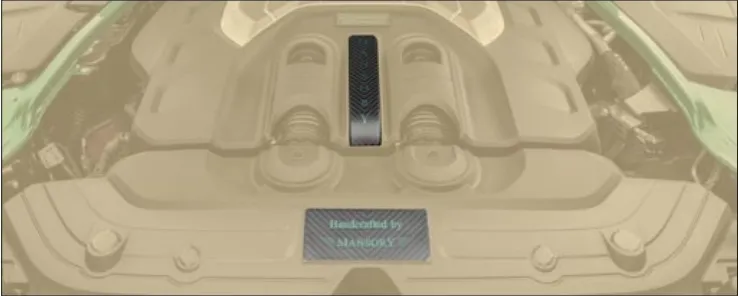
Engine carbon cover for V8 Mansory Carbon for Bentey Continental GT


Mansory Carbon Engine Cover for V8 4.0L — Bentley Continental GT
The 4.0L twin-turbo V8 (engine code CST) arrived in the Bentley Continental GT as a late-cycle powertrain option, giving facelift-era 3W chassis owners a 500–521 hp unit with a more compact, upright underhood layout than the broader W12. Mansory developed this carbon engine cover specifically for the CST bay, accounting for its distinct mounting topology, ancillary routing, and dimensional envelope. The result is a 3K twill carbon shell that sits flush without gaps or pressure points — part of the broader Mansory Carbon Fiber Body Kit Set for Bentley Continental GT, giving V8 owners a route into the same visual programme without fitting a component calibrated for the wider W12 bay.
Construction & Materials
The cover is hand-laid using 3K twill carbon fibre on a precision mould pulled from V8 bay geometry data. Each ply is oriented at 45 degrees to the principal stress axis. Wall thickness runs 2.2–2.8 mm across the panel with a reinforced 3.4 mm perimeter lip where mounting brackets engage. Total weight is approximately 0.9 kg — around 62 % lighter than the OEM composite unit. Curing is carried out at 135 °C in a calibrated autoclave, eliminating voids and ensuring consistent fibre volume fraction throughout. The outer surface receives three coats of UV-stable clear lacquer, wet-sanded to 2000 grit and machine-polished. Heat resistance is rated to 210 °C sustained, comfortably exceeding the thermal envelope of the V8 twin-turbo bay.
- Weave: 3K twill (2×2 pattern), 200 g/m² fabric weight
- Cure: 135 °C autoclave, 6-bar consolidation pressure
- Wall thickness: 2.2–2.8 mm main panel; 3.4 mm perimeter lip
- Weight: approx. 0.9 kg (vs ~2.4 kg OEM composite)
- Finish: 3-coat UV-stable gloss lacquer; satin available on request
- Heat resistance: 210 °C sustained; 240 °C peak short-duration
- Mounting hardware: stainless M6 socket-head bolts + heat-resistant EPDM grommets supplied
- OEM bracket compatibility: reuses factory V8 mount points; no drilling required
Design & Visual Function
The V8 engine bay in the Continental GT facelift is noticeably more compact than the W12 counterpart. The CST unit sits lower and closer to the firewall, so a cover designed for the W12 would stand proud at the rear edge or bridge bay sections that do not exist in the same location. Mansory's V8-specific cover hugs that geometry exactly — the forward section follows the intake manifold profile, the lateral edges drop cleanly to the bay liner, and the rear lip terminates precisely at the firewall seal strip. There are no bridged gaps and no shimming required.
The 3K twill pattern produces a classic diagonal weave that reads well from the 60-degree angle at which most observers approach an open engine bay. The gloss lacquer ensures the panel reads as a deliberate upgrade rather than a repair item. Owners who pair this cover with Mansory's vented bonnets (engine-bonnet-ii) will find the combination creates a coherent visual column of woven carbon visible through the bonnet vents when the car is observed from elevated positions at events.
Compatibility & Fitment
This cover is designed exclusively for the 4.0L twin-turbo V8 (engine code CST) fitted to late 1st-gen and facelift Bentley Continental GT and GTC models on the 3W platform (2003–2011, V8 trim). The V8 was introduced as a late-cycle addition and was not available from the start of 3W production — verify that your chassis carries the CST engine code before ordering.
This cover is not compatible with the 6.0L W12 twin-turbo (engine code CWB). The W12 bay is wider, the front crossmember is positioned further forward, and the intake geometry differs substantially. Fitting a V8 cover to a W12 car produces visible panel gaps at the lateral edges and interference with W12-specific ancillaries. For W12 cars, refer to the dedicated Mansory Carbon Engine Cover for W12. Both Continental GT coupé and GTC convertible variants with the V8 are supported — the open-top GTC shares the same engine bay and fitment is identical.
Installation & Reversibility
Installation requires a 5 mm hex key, a trim clip removal tool, and approximately 25–40 minutes on a cold engine. Remove the OEM cover by lifting its rear edge and pulling it forward off the factory grommets — no tools needed for that step. The Mansory cover then drops onto the factory V8 mount points using the supplied stainless hardware. The EPDM grommets isolate the carbon from direct metal contact, preventing galvanic interaction and micro-vibration scoring of the lacquer. Allow the engine to cool for a minimum of 90 minutes after driving before beginning work — the twin-turbo V8 retains significant bay heat and handling carbon in a warm bay risks lacquer thermal shock. The OEM cover and all original hardware can be retained, making this a fully reversible modification with no permanent changes to the engine bay.
Pairing within the Mansory Continental GT 3W Programme
The V8 engine cover is most effective when paired with components that share the same carbon language in the visible surfaces above and around it:
- Engine Bonnet II — vented variant with a forward-facing duct creating a visual column of carbon from bonnet surface through the vents to this engine cover. The most cohesive pairing for V8 builds.
- Engine Bonnet I — clean vent-free bonnet option. Best when the engine bay itself is the centrepiece at shows.
- Rear Bumper with Diffuser I — extends the carbon programme to the rear, creating front-to-rear visual consistency for open-display builds.
W12 owners who have arrived at this page should visit the W12 engine carbon cover listing instead.
Maintenance & Durability
The V8 twin-turbo runs a slightly lower sustained bay temperature than the W12 under equivalent road conditions, but the thermal gradient during a cold-start cycle is comparably steep, and the autoclave-cured lacquer is specified for repeated heat cycles. Avoid abrasive cloths, ammonia-based cleaners, solvent aerosols, and fuel splash — fuel contains aromatic compounds that attack lacquer within seconds of contact. The recommended routine is a spray-on waterless wash between deep cleans, followed by carnauba or synthetic wax applied no more than twice per year. Over-waxing traps particulates and hazes the gloss. For longer-term protection, a professional ceramic coating rated for under-bonnet temperatures (minimum 230 °C) eliminates the need for periodic waxing and markedly slows lacquer yellowing. Without coating, lacquer on an exposed engine bay panel typically begins amber toning after 10–14 years in temperate climates. The carbon substrate itself is structurally unaffected by heat cycling within the normal V8 use range.
Lead Time & Warranty
Production lead time is 2–6 weeks from order confirmation, depending on queue position and finish specification. The satin finish option adds 3–5 working days to the lacquer schedule. All covers are shipped in foam-lined, double-walled cartons with corner protection. A 12-month warranty against manufacturing defects — including delamination, lacquer adhesion failure, and hardware corrosion — is included with every order. Warranty does not extend to mechanical impact damage, chemical exposure, or fitment on non-compatible engine variants.
FAQ
Q: How is the V8 engine bay physically different from the W12 bay, and why does that matter for fitment?
A: The W12 bay is wider by approximately 38 mm at the firewall and has its front crossmember set around 22 mm further forward. Intake runners and ancillary belt routing follow different lateral paths. A cover moulded for the W12 will sit proud at its lateral edges in a V8 car and may contact ancillary hoses. The V8-specific cover accounts for the narrower bay width, lower intake manifold profile, and distinct grommet spacing of the CST mount points.
Q: How do I verify my Continental GT has the CST V8 and not the W12?
A: The engine code is stamped on the cylinder block and listed on the vehicle identification plate on the passenger-side strut tower. CST denotes the 4.0L twin-turbo V8. If in doubt, send the last six digits of your VIN via WhatsApp +44 7488 818 747 and the team will confirm compatibility before processing your order.
Q: Does this cover fit the GTC convertible as well as the coupé?
A: Yes. The GTC and coupé share the same engine bay structure on the 3W platform. The cover mounts identically in both body styles. Some GTC builds have an optional thermal blanket on the passenger-side firewall — this cover clears it without modification or removal of the blanket.
Q: Is a satin finish available, and is it as durable as gloss?
A: Yes. Satin lacquer is available on request and tends to read as a more understated choice in the engine bay, reducing reflective competition between the cover and polished metal components. The lacquer chemistry and heat resistance rating are identical between satin and gloss options.
Q: What is the visible difference between the OEM V8 cover and this carbon version?
A: The OEM cover is a moulded thermoplastic composite with a smooth painted surface and no texture depth beyond paint sheen. The Mansory carbon version introduces visible 3K twill weave texture, a dimensional surface that shifts under directional light, and substantially lower mass. For owners who open the bonnet at events or use the car in an environment where the engine bay is observed, the distinction is immediately apparent and communicates deliberate development rather than a functional replacement.
To order or confirm fitment for your CST V8 build, reach the team directly via WhatsApp +44 7488 818 747 or [email protected].