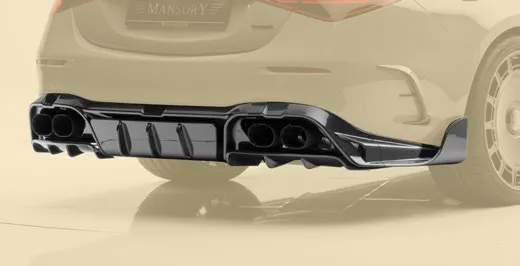
Diffuser Mansory for Mercedes-AMG S63E


Mansory Diffuser for Mercedes-AMG S63E
The diffuser is the carbon part that closes the underbody loop at the back of the car — it accelerates the airflow under the floor through a controlled expansion ratio and gives the air a defined exit angle as it leaves the rear of the car. On a long-wheelbase W223 saloon weighing 2,510 kg with the AMG biturbo V8 + e-motor PHEV drivetrain, 802 hp / 1430 Nm peak, 4MATIC+ AWD, MCT 9-speed automatic, and the AMG quad-tip exhaust geometry the diffuser is also the visual anchor of the rear bumper — it is the part that decides whether the rear of the car reads as a flagship saloon's traditional surface or as a performance-saloon's mechanical surface. Mansory's diffuser carves a multi-fence Venturi geometry into a single autoclave-cured carbon part that registers on the OEM AMG bumper-skeleton with no chassis modification. It is one of the load-bearing aero parts of the parent Mansory Carbon Fiber Body kit set for Mercedes-AMG S63E.
Construction & Materials
A diffuser is a structural part. It carries lateral load from the air mass moving through it, and the fences are subject to fatigue cycling at autobahn speeds. Mansory's layup uses a stiffer resin system than the cosmetic body panels and a co-cured fence skeleton.
- 3K 2×2 twill A-side cosmetic skin, biased for a kinetic rearward weave
- Co-cured Venturi fences in unidirectional carbon — no glue line at fence root
- Pre-preg autoclave cure at 130 °C, multi-axial fibre orientation
- Wall thickness 2.6–3.2 mm in the exit panel, 4.5–5.5 mm at the fence-to-bumper interface
- Net dry weight 4.2–5.0 kg
- Stainless threaded inserts at OEM AMG bumper-skeleton mount points
- Heat-resistant 2K clear lacquer (gloss / satin / matte) — exhaust-tip area uses high-Tg topcoat
- Substrate prep: solvent wipe, 3M Cleaner-Primer 94, low-tack masking on bond pads
Design & Visual Function
The Venturi principle the diffuser exploits is straightforward: as the underbody airflow enters the diffuser, the section expands, the velocity increases, and the static pressure drops, which pulls more air through the entire underfloor and reduces the rear-axle lift coefficient. On a ~2,510 kg saloon the diffuser cannot generate the kind of single-number downforce a track car would, but the rear-axle lift reduction is felt as a calmer chassis above 200 km/h — the AIRMATIC's rear-axle damping behaviour reads as steadier, and the 4MATIC+ system's torque distribution to the rear axle is more consistent because the rear-axle vertical load is more stable.
The fence geometry is set so that incoming air separates into four nominal channels — two outboard channels follow the rear quarter line and shed cleanly off the trailing edge, while two inboard channels accelerate around the AMG quad-tip exhaust pipework and release downward. The fence heights are graduated so the inboard pair clears the OEM exhaust catalytic block and heat-shield while the outboard pair extends slightly closer to the road.
Visually the diffuser ties the rear bumper into the underbody. It is the single part that most decisively transforms the saloon's rear from a surface-driven luxury statement into an aero-driven performance statement. The 3K twill is biased so the diagonals point downward and rearward, suggesting the air's exit trajectory; this is the first piece of carbon a viewer notices when walking around the car from the side.
Compatibility & Fitment
Engineered for the Mercedes-AMG S 63 E PERFORMANCE (W223), 2023+, saloon. The diffuser uses the OEM AMG rear bumper-skeleton studs and respects the OEM AMG four-exit quad-tip geometry — there is generous clearance around each exhaust tip and around the inner heat-shield. AMG Night Package and AMG Carbon Package cars are supported. Factory AIRMATIC ride heights are the design target. The lower fence row extends roughly 30 mm below the OEM rear-bumper plane, so cars set permanently to AIRMATIC's lowest fixed-height mode or running aftermarket lowering kits should verify ramp-clearance angle before final bonding. The rear parking sensors and reverse camera are not disturbed. Cars with AMG Carbon Ceramic Brakes will benefit from the steadier rear-arch airflow the diffuser supports, but no direct rear-brake cooling is performed by this part.
Installation & Reversibility
Plan 90–150 minutes on a hoist with two technicians. Required tools: 8/10/13 mm sockets, plastic trim picks, isopropyl alcohol, 3M Primer 94, low-tack masking, torque wrench (8 Nm M6, 22 Nm M8). Workflow: remove the OEM AMG diffuser-blank trim, wipe and prime the bumper-skeleton bond pads, dry-fit the diffuser to verify exhaust-tip clearance at all four pipes, mate the part to the studs, torque the M6 and M8 fixings, press the VHB seam home with a roller and allow 24 hours cure before any pressure-wash exposure. Reversibility is full — the OEM diffuser blank reseats on the original clips, and the bumper-skeleton studs are reusable. No chassis modification, no drilling, no exhaust modification.
Pairing within the Mansory Mercedes-AMG S63E programme
The diffuser pairs naturally with the Air outtake splitter for rear bumper directly outboard so the rear-arch hot column does not pollute its inlet, with the Rear decklid spoiler performance for a coherent rear-aero programme top-and-bottom, and with the Side skirts lip to keep the underbody pressure zone sealed end-to-end.
Maintenance & Durability
The diffuser is the second-most-loaded carbon part for road grime after the side-skirt lip. It collects salt, brake dust, and tyre-spray water all at once. Wash twice as often as the upper body in winter, with pH-neutral shampoo and a separate soft mitt. Avoid acid wheel cleaners drifting onto the diffuser — the local concentration around the rear arch is the highest on the car. A quarterly ceramic spray sealant is the simplest preventative step. Stone chips on the lower fence edges should be sealed with clear UV epoxy within seven days; any deep gouge that exposes the structural fence should go to a carbon repair shop rather than a body shop. The exhaust-tip area carries an additional high-Tg topcoat that resists heat blistering at the AMG quad-tip blast zone, but a yearly inspection of the inner cone for any heat-tinge is recommended on cars driven hard. Expected cosmetic-finish lifespan is 7–10 years given the part's exposure profile.
Lead Time & Warranty
Lead time 4–6 weeks. The diffuser is one of the larger structural carbon parts in the kit and demands an extended autoclave cycle for dimensional stability and a separate fence-cure stage. Custom finishes (matte, satin, forged-look) add roughly one week. Warranty: 12 months against manufacturing defects — delamination, voids, fitment, fence-bond integrity, clear blistering — counted from delivery. Damage from kerb impact, ramp scrape, stone propagation, or chemical staining is not covered. Each diffuser ships in a custom plywood crate with internal foam blocks under the fences and the bumper-skeleton interface; the crate dimensions are specified to clear a domestic doorway because the part is one of the wider items in the kit.
FAQ
Q: Does the diffuser require any modification to the OEM AMG quad-tip exhaust?
A: No. The diffuser is geometric-clearance designed around the OEM AMG four-exit layout; no exhaust modification is performed.
Q: What ground clearance does the lower fence row need?
A: Roughly 30 mm of clearance below the OEM rear-bumper plane, so factory AIRMATIC settings are fine. Aftermarket lowering kits or permanent lowest-mode AIRMATIC settings should be verified statically.
Q: Is the part safe to leave on the car for a winter season?
A: Yes. The layup, the clear lacquer, and the stainless inserts are all rated for winter salt exposure. The recommendation is a quarterly ceramic spray sealant rather than removal.
Q: Does the diffuser affect rear visibility or rear lighting projection?
A: No. The diffuser sits below the rear-bumper plane and does not interfere with the OEM AMG rear-light cluster, fog lamp, or reverse-camera housing.
Q: Will it pair with the diffuser-with-race-brake-light variant?
A: Owners should choose one or the other. The race-brake-light variant is a different SKU with an integrated centre LED brake light; this standard variant has no LED hardware.
Q: Does the part change the rear bumper crash structure?
A: No. The crash structure is in the rear-bumper-skeleton beam and rear longitudinals; the diffuser is a closure panel that does not carry crash load.
Pair the diffuser with the rear-bumper outtake splitter and the decklid performance spoiler for a complete rear-aero programme. To configure your build, message WhatsApp +44 7488 818 747 or write to [email protected].