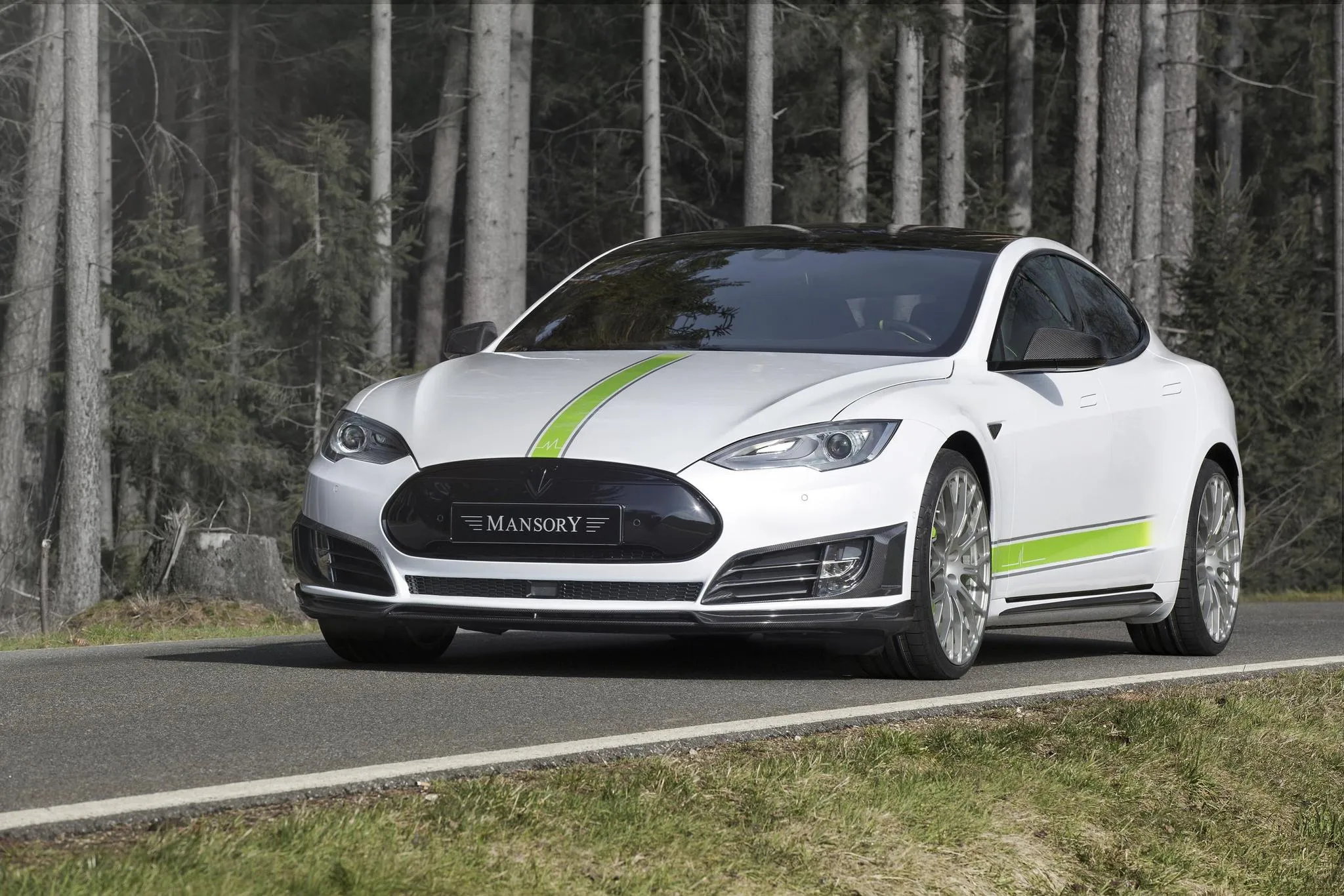
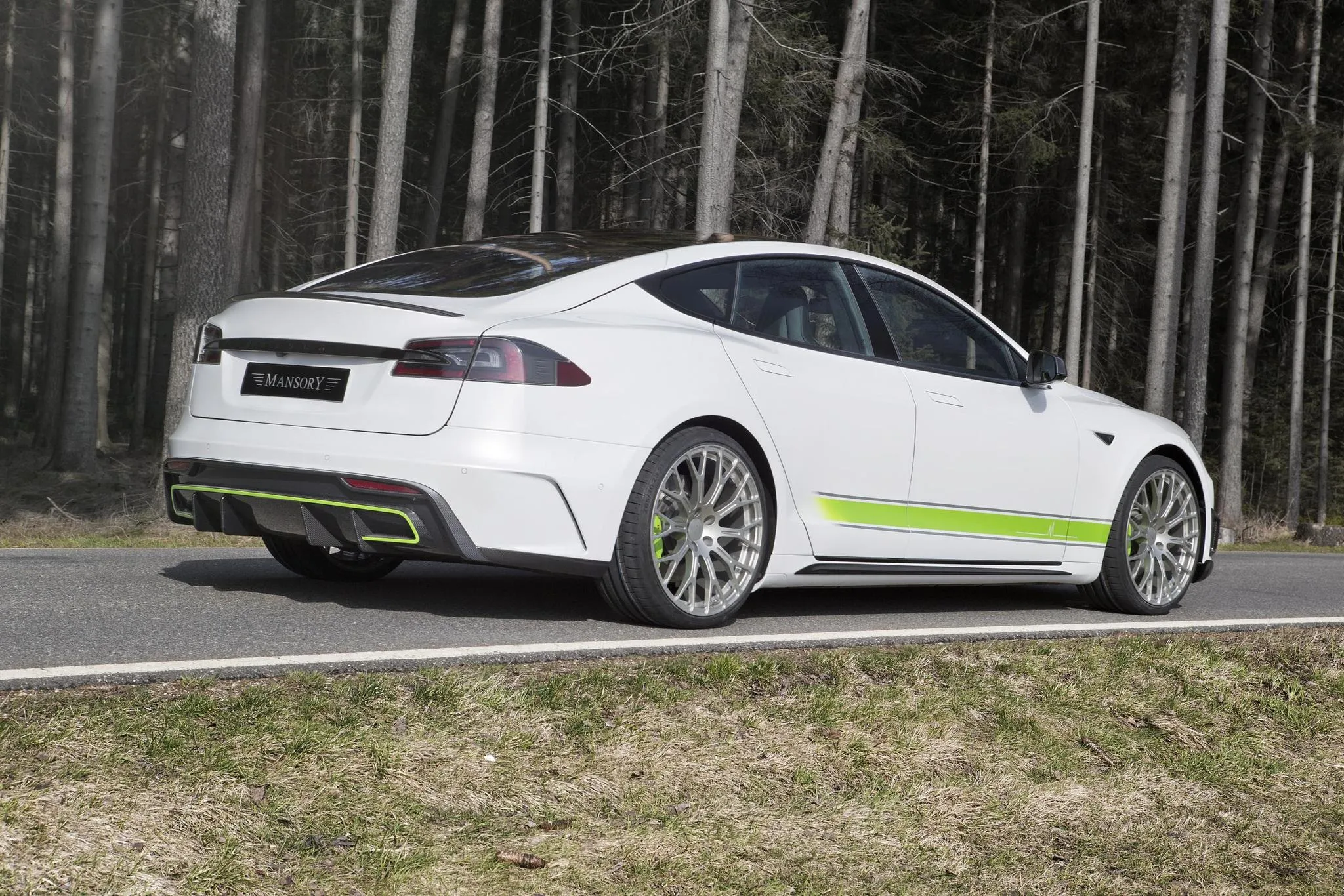
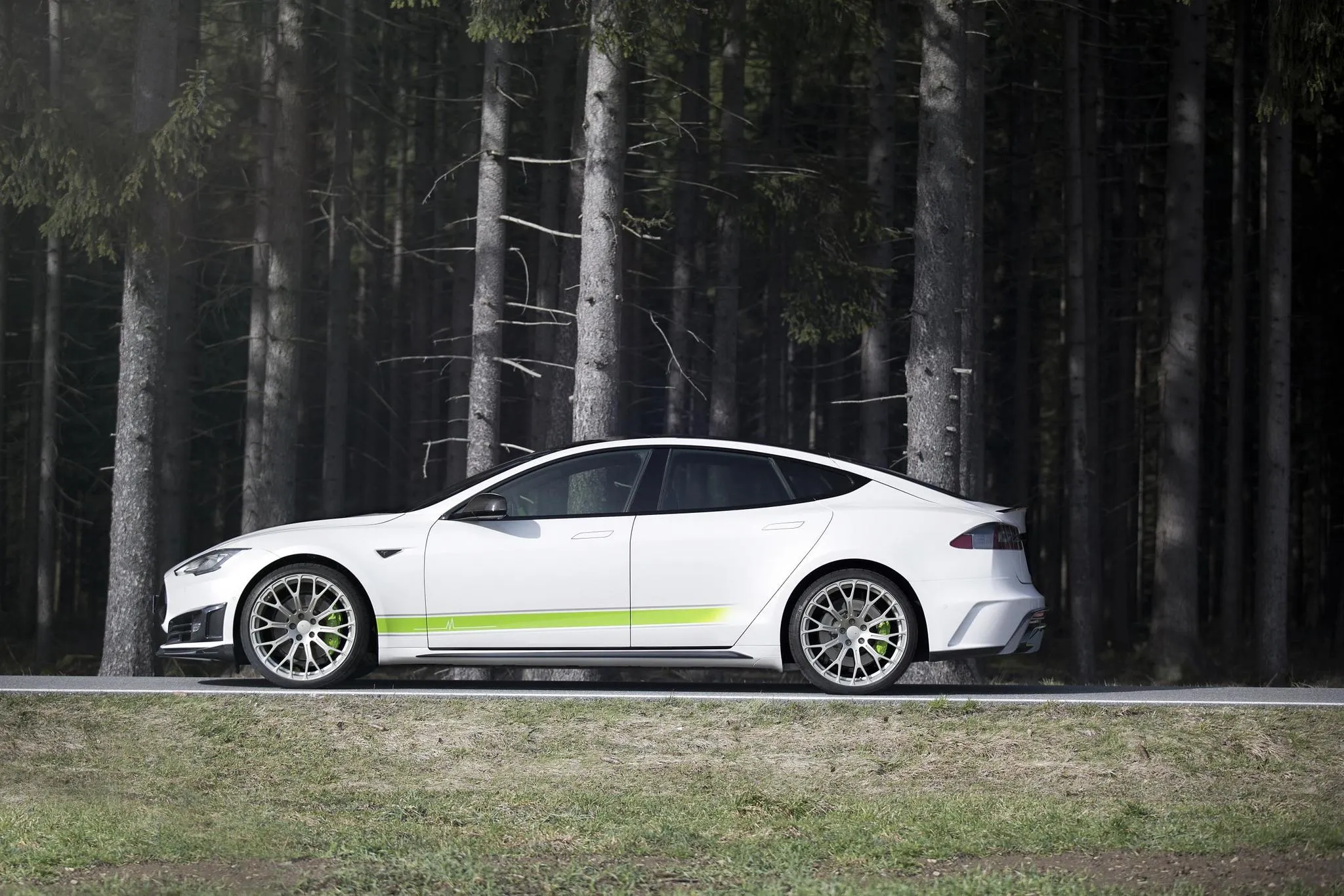
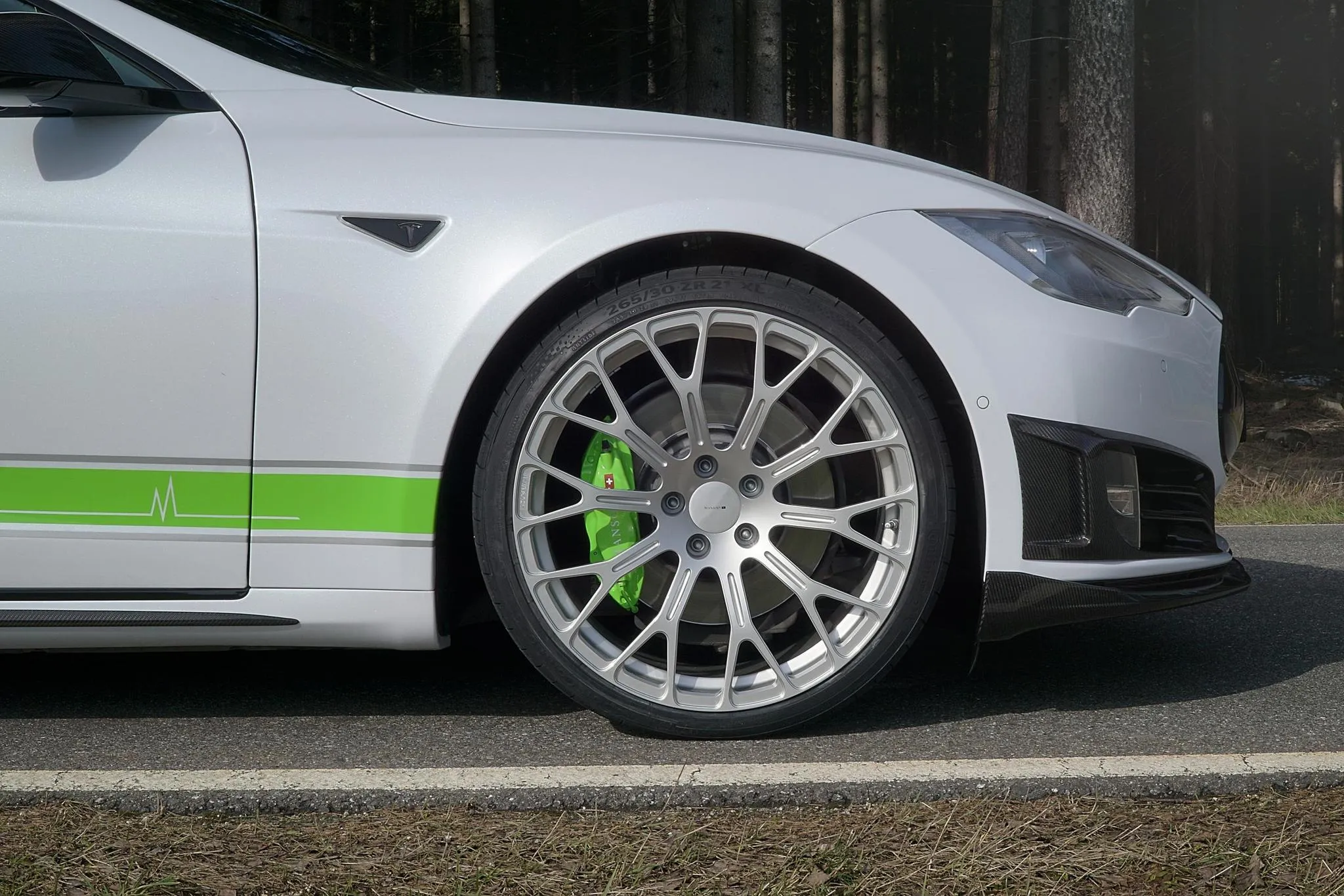
Mansory Carbon Fiber Body kit set for Tesla Model S


MANSORY Carbon Fiber Body-Kit for the TESLA MODEL S — the Only Tesla Programme in Mansory's Catalogue, and a Deliberate One
Scroll the Mansory model list and you will find Ferraris, Lamborghinis, Rolls-Royces, G-Wagens, Bentleys, McLarens, Aston Martins, a Maserati or three — and exactly one Tesla: the Model S. That is not an accident of demand. Mansory is fundamentally a carbon-and-combustion tuner; the Tesla Model S programme exists because the firm wanted a documented electric-vehicle carbon build on the record before Porsche Taycan, Lucid Air, Mercedes EQS, and the inevitable BMW i-series sedans arrived to define what premium-EV aftermarket even is. The Model S was the obvious donor in 2015-2017 when this decision was made. It had been on sale since 2012, it had already established the full-size premium EV sedan category single-handed, and it was — then and now — the only electric sedan whose client profile overlapped meaningfully with Mansory's existing buyer list.
The anomaly — why Mansory built for Tesla
The Mansory Model S programme is an anomaly and should be read as one. The usual Mansory logic — take a combustion flagship, widen it, carbon-wrap it, extract more horsepower from an already-potent engine — does not apply. A Plaid is already faster, 0-100, than every Mansory-tuned combustion car in the portfolio except the Ferrari SF90. There is no engine to retune, no turbo system to upgrade. What Mansory offers the Model S owner is narrower: a carbon body-kit and forged wheels. The Model S was the bet — if a premium-EV aftermarket segment emerged at scale, Mansory wanted to be first on record. That segment still has not fully arrived, which makes this kit a rare document of the early-era EV carbon moment.
EV carbon logic — range, drag, weight
The obvious question: why carbon on an electric car at all? Carbon panels on a combustion supercar are largely a weight-and-aesthetic argument with a marginal performance kicker. On an EV the argument is different and stronger. Two variables dominate EV range: aerodynamic drag at motorway speed, and mass at every other condition. The Tesla Model S Plaid achieves a drag coefficient of Cd 0.208 — among the lowest of any production car ever made — and that figure is load-bearing for Tesla's EPA range claims. Any aftermarket kit that visibly adds drag directly costs the owner kilometres of range. Mansory's Model S kit therefore had to be engineered to a tighter aero brief than any combustion donor in the catalogue: no bluff spoilers, no drag-adding front lips without compensating underbody smoothing, no fender extensions that disrupted the tail-end flow separation point that Tesla's designers tuned to four decimal places. Mass is the second lever. Factory Model S body panels are stamped aluminium, already light by sedan standards. Replacing them with hand-laid pre-preg carbon components saves kilograms per panel — not transformative on a 2 160 kg Plaid, but directionally correct for range and cornering inertia. The logic is coherent: carbon on an EV is a range argument first and a styling argument second.
Carbon kit components
Mansory Model S carbon inventory: front lip with underbody-smoothing profile engineered to preserve the factory front splitter's negative-lift balance; front bumper air-intake inserts — Tesla's front fascia has minimal functional grilles because EVs do not need combustion-air or radiator airflow at the same volume as ICE cars, so the intake trim is largely visual and carbon-wrapped accordingly; side-skirt stripe panels for the lower rocker flanks; replacement carbon rear bumper with integrated diffuser section; rear deck-lid spoiler tuned flat and low to maintain rear-axle airflow attachment through motorway speeds; carbon mirror-mask housings. The kit deliberately stops short of widebody fender extensions. Widebody carbon on a Model S would add frontal area and track width, increasing drag meaningfully — Mansory's aero engineers chose not to compromise factory range claims, which is unusually restrained for a firm known for visible widebody language. Hidden mounting uses FRP substrate bonded with structural adhesive plus mechanical fixings into factory trim threads. Finish options: glossy pre-preg or satin-matte.
Plaid vs Long Range — preservation of drive-unit envelope
The Tesla Model S has two major eras and, within the current era, two powertrains. The pre-refresh era (2012-2020) covers early P85, P85D, P90D Ludicrous, P100D Ludicrous-Plus, Performance and Raven-update cars. The post-refresh era (2021 onwards) covers the redesigned interior with horizontal touchscreen and yoke / optional round steering, plus Plaid and Long Range powertrains. Plaid: tri-motor (two rear, one front), 1 020 hp, 0-100 km/h in 2.1 s on the rolling start figure (closer to 2.4 s on a true static launch), top speed 322 km/h with the Plaid track package, 560 km EPA range on 19" fitment. Long Range: dual-motor AWD, roughly 670 hp, 0-100 km/h in 3.2 s, top 250 km/h, approximately 600 km EPA range. Mansory's kit fits both powertrains because carbon body components are drive-unit agnostic — no air-intake re-routing is required, no exhaust cut-outs, no heat-extraction louvres. The only Plaid-specific consideration is the cooling-system inlet geometry behind the lower front fascia: the Plaid's front-motor thermal load is higher than a Long Range, and Mansory's front lip is profiled to preserve full cooling airflow to the front drive-unit radiator and to the battery chiller intake.
Wheels — 22" forged for the Model S
Factory Model S wheel options: 19" Tempest (range-optimised), 21" Arachnid (Plaid aesthetic). Mansory fitment: 22" forged. Patterns available: M.7 multi-spoke deep-concave and FD.16 dual-spoke concave, both engineered for the Model S bolt pattern and factory brake-caliper clearances (including Plaid carbon-ceramic brake option). Tyre fitment: 265/35 R22 square or 265/35 R22 front / 285/30 R22 rear staggered. Low-rolling-resistance tyre compound is strongly advisable on any EV — rolling resistance has an outsized effect on EV range relative to combustion, because there is no parasitic engine load to mask it — and both Michelin and Pirelli offer EV-specific compounds in these sizes. Finishes: matte-black, gunmetal, glossy-black, bronze, satin-silver, full paint-to-sample. The 22" fitment will cost range versus factory 19" Tempest — real-world delta is typically 5-8% depending on tyre choice — which is a trade the owner chooses to make. Catalogue: https://hodoor.world/collection/forgedwheels.
EV-friendly markets
Mansory ships Model S kits worldwide, concentrated where EV adoption is high and charging infrastructure supports premium-EV daily use. The United States is the largest single market for the Model S by volume and Mansory-kit deliveries track California, Florida, Texas and New York metro. The Netherlands combines high per-capita EV uptake with the discretionary-spend client profile that commissions Mansory carbon — see Netherlands. Norway has the highest EV penetration on earth and a meaningful Model S installed base from the pre-refresh era — Norway. Switzerland pairs mountain-route charging density with the premium-sedan buyer profile — Switzerland. Australia's long-distance driving culture plus expanding Supercharger network make the Plaid a sensible ownership proposition; RHD kits ship where VIN supports it — Australia.
Commission
Commission requires: Model S VIN, generation confirmation (pre-refresh 2012-2020 or refresh 2021+), powertrain (Plaid vs Long Range), current paint code, wheel pattern and finish choice, steering-wheel variant on record (yoke or round — relevant only for interior-retrim add-ons, not for the body-kit itself), destination country. Typical lead time: 8-12 weeks carbon and wheels production; installation 1-2 weeks at a workshop familiar with Tesla high-voltage service protocol. Contact: [email protected] or +44 7488 818747 (WhatsApp).
Related Mansory upgrades
Within the Mansory portfolio, the most natural cross-references for this build are Elongation Carbon Fiber Body kit for Tesla Cybertruck, Lamborghini Aventador and Mercedes G-class W463A. All three are listed on the Hodoor.World catalogue with the same Mansory factory routing.
FAQ — Model S programme
Which Model S generation does this kit fit — pre-2021 or 2021+ refresh? Both, but as two separate part sets. The pre-refresh car (2012-2020) and the refresh car (2021+) have different front fascia geometry, different rear bumper contours, and different headlight cut-lines; Mansory stocks generation-specific carbon parts accordingly. VIN confirmation at order stage tells the factory which set to cut.
What is the real-world range impact of the full kit plus 22" wheels? On a Plaid going from factory 19" Tempest to 22" forged plus carbon kit: expect a 6-9% range reduction under mixed-use conditions, dominated by tyre choice and wheel diameter rather than the carbon panels themselves. If the owner runs a dedicated low-rolling-resistance EV tyre compound in 22", the loss compresses toward the lower end. The carbon-panel contribution alone is under 1% — effectively neutral — because mass is directionally helpful and the aero profile is engineered not to add drag.
What are the thermal implications of the kit on Plaid tri-motor cars? The Plaid runs a more aggressive thermal envelope than Long Range because of the tri-motor front assembly plus high-power battery operation. Mansory's front lip was profiled specifically to preserve full airflow to the front drive-unit radiator inlet and to the battery chiller intake behind the lower fascia. There is no measured thermal penalty versus stock under track-day or motorway-cruise conditions. Sustained Plaid-mode launch cycles are limited by battery thermal state regardless of body kit.
What is the Tesla dealer / service-centre stance on aftermarket body-kits? Tesla does not operate a franchised-dealer warranty-revocation model the way some legacy OEMs do. Body-kit installation does not void the drivetrain, battery, or high-voltage warranty on Tesla's published policy, provided installation does not damage structural mounting points or disable safety systems. Front-camera and ADAS sensor positions are preserved by Mansory's kit. Service-centre visits for unrelated issues proceed normally.
Is the kit compatible with both yoke and round steering-wheel cars? Body-kit compatibility is independent of the steering-wheel variant — the kit is exterior only. Mansory offers a separate interior-retrim commission for Alcantara and carbon cabin elements; that programme is specified against the yoke or round-wheel layout at order stage.
Installation duration and required facility? 1-2 weeks at a workshop experienced with Tesla high-voltage service protocol. Any workshop removing bumpers on a Model S should follow Tesla's 12V-disable and HV-isolation procedure; Mansory-recommended installers are documented with this training.