
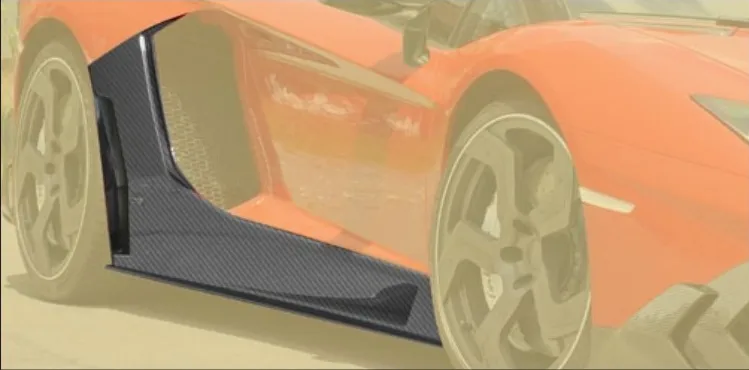
Side skirts Mansory Carbon for Lamborghini Aventador Competition


Mansory Carbon Side Skirts for Lamborghini Aventador Competition
The rocker is the longest uninterrupted line on an Aventador, and the Mansory Competition side skirts treat it as a dedicated design canvas rather than a passive sill cover. They run from the trailing edge of the front wheel arch to the leading edge of the rear arch, hugging the CFRP monocoque flank and threading neatly under the scissor-door cut so the door can open through its full arc. As part of the broader Mansory Carbon Body Kit for Lamborghini Aventador Competition programme, this skirt set adds a vented mid-section, a sharper underside lip, and a clear visual link between the front splitter line and the rear diffuser fence. The rocker is also where airflow visibly transitions from front-arch wash to the side-pod intakes feeding the V12 NA airbox and oil cooler, so the skirt geometry is shaped to keep that flow attached, not stalled.
Construction & Materials
The skirts are laid up as long, single-piece carbon shells rather than multi-section sills, so the eye reads one continuous weave from arch to arch. The Competition profile adds a step-and-vent cluster ahead of the rear wheel and a tucked underside lip along the lower edge that the OEM Lamborghini sill never had.
- 3K twill prepreg CFRP outer skin with optional 2K plain-weave or forged-look facelayer for the vented insert.
- Autoclave cure at 6-7 bar for void-free laminate; supplementary RTM prepreg on the lower lip where stone-chip exposure is highest.
- Wall thickness 2.4-3.0 mm along the visible flank, ramped to 3.5-4.0 mm at the underside lip and around the vent louvres.
- Per-side weight 3.4-3.9 kg depending on finish; the pair replaces OEM sills with a modest net mass change.
- Stainless studs and pre-bonded threaded inserts at OEM mount locations; supplied with butyl seal strip and methacrylate primer for the bonded sections.
- Surface options: high-gloss UV-stable lacquer, satin matte, or raw oil-finished weave for owners who want a tactile texture break against painted bodywork.
- Internal heat-reflective foil on the rear third near the side intake throat to protect resin from V12 thermal soak.
- Edge-radiused inner skin so the OEM jack point and underbody panels remain accessible without trimming.
Design & Visual Function
Because the rocker spans roughly two metres on the Aventador, every shape decision reads from a long way off. The Competition skirts deepen the lower body shadow line by a few millimetres, then break that depth with the vented step ahead of the rear arch. That step is where the eye lands when you walk past the car at three-quarters angle, and Mansory pulls it slightly outboard so the louvre array catches direct light rather than disappearing into the rocker shadow.
Functionally, the underside lip is the more interesting element. It sharpens the corner between the body flank and the floor, encouraging cleaner attached flow along the lower side of the car as it heads toward the rear diffuser. It is not a downforce-rated splitter element, but it does reduce the pressure recovery losses you get with the OEM sill's softer transition, and it visually ties the front add-on lip into the diffuser fence line. Owners who run the SVJ ALA 2.0 system see a coherent story from front splitter to side skirt to diffuser, and the skirt never crowds the central rear-wing channel that ALA needs clean air for.
The third design axis is the relationship with the scissor-door cut. The Aventador door swings up and slightly outboard, and its lower trailing edge passes very close to the rocker line. Mansory shapes the upper edge of the skirt with a precise step that aligns to the door cut so the closed-door shadow gap reads as a single sharp line rather than a stepped one. Owners often spec the skirt in raw oil-finished weave with body-colour bodywork above so the rocker reads as a deliberate paint break along the car's longest axis.
Compatibility & Fitment
The skirts fit Lamborghini Aventador LP700-4, LP750-4 SV, S, SVJ, and Ultimae in both coupe and Roadster bodies. SVJ and Ultimae cars use slightly different mounting tabs at the rear arch interface to clear the SVJ-spec rear bumper and high-mount central twin-exhaust thermal envelope; pre-SVJ LP and S cars use the earlier tabs. Both variants share the same outer shell, vent geometry, and underside lip, so visual continuity is identical across model years. OEM Lamborghini parking sensors, jack points, and underbody panels are retained without modification, and the skirt does not touch the side intake throat that feeds the V12 airbox and oil cooler. Roadster compatibility is full - the skirt mounts to body-side hardpoints, not to the targa roof structure, so soft-top and roof-panel stowage are unaffected.
Installation & Reversibility
Plan 4-6 hours per pair in a Lamborghini-certified body shop or with a Mansory-trained installer. The OEM sill removes via clip releases and a small number of bolts at the arch interfaces; the new carbon shell uses the same mount points plus a methacrylate adhesive bond along the upper edge to lock the long span against flex. Substrate chemistry matters here - the Aventador monocoque uses methacrylate-bonded panels, and the side-skirt adhesive must be compatible with that chemistry, which is why the kit ships with a primer keyed to Lamborghini's surface system. Paint or lacquer prep is straightforward: scuff, wipe with a panel-wipe solvent, apply a 2K epoxy primer to the painted sections, and the lacquered carbon needs no additional clear over the supplied UV layer. Reversibility is full: removing the skirts and reinstalling OEM sills returns the car to factory configuration without monocoque damage if the bond line is parted with the recommended thermal-release protocol.
Pairing within the Mansory Aventador Competition programme
The side skirt is a hub piece - it touches the front splitter line, the side intake, and the diffuser line, so it pairs naturally with several siblings. The most common owner specification adds the Air outtake cover (side skirt) to dress the vented step in the same weave family, and the Air intake - side window to tie the upper-flank intake into the same vertical line. Owners who also commission the Front add-on lip get a continuous lower-body line from front splitter through skirt to diffuser, which is the cleanest visual story for the Competition programme. Each of those parts is autoclave CFRP from the same lay-up family, so weave alignment and gloss level match across the assemblies.
Maintenance & Durability
Lacquered carbon along a rocker is the most stone-chip-exposed surface on the car, so durability planning starts with a chip-resistant strategy: a clear paint protection film over the lower 100 mm of the skirt is the simplest hedge, and the supplied UV layer underneath ensures the weave colour stays stable for many years. Wash with pH-neutral shampoo and a soft mitt; avoid alkaline traffic-film removers, ammonia-based wheel cleaners that drift onto the lower skirt, and abrasive sponges that micro-scratch the lacquer. A ceramic coating refreshed annually keeps water-spotting and brake-dust etching off the surface; carnauba is a softer alternative but needs more frequent reapplication. If a stone chip cracks the lacquer, the part is repairable - sand the affected zone, recoat with a matched 2K UV-stable lacquer, and flat-back to gloss. The internal heat-reflective foil on the rear third protects the resin from V12 thermal soak in stop-and-go driving and should be inspected at major services.
Lead Time & Warranty
Lead time is 4-8 weeks from order confirmation, in line with Mansory bespoke production windows. The skirts ship with a 12-month warranty against manufacturing defects - delamination, resin starvation, lacquer adhesion failure - and Mansory documentation that confirms autoclave cure batch and weave lot for full provenance.
FAQ
Q: Will the skirts foul the scissor-door arc when the door swings up?
A: No. The upper edge step is shaped to follow the OEM door-cut line so the door swings through its full arc with the same shadow gap as factory.
Q: Are the LP and SVJ versions visually different?
A: The outer shell, vent cluster, and underside lip are identical. Only the rear-arch mounting tabs differ to clear pre-SVJ vs SVJ bumper geometry, so the visual story is the same across all model years.
Q: How much weight do the skirts save versus OEM?
A: Net change is small - typically within a few hundred grams per side - because the OEM sills are already light. The gain here is visual and aerodynamic-trim, not mass.
Q: Can I have raw weave on the skirt and lacquered carbon elsewhere on the car?
A: Yes. Owners often order the skirt in oil-finished raw weave to create a deliberate paint break along the rocker, while lacquering the front and rear pieces. We match weave roll and orientation across both finishes.
Q: Does the skirt affect the SVJ ALA 2.0 channel?
A: No. ALA's central rear-wing channel sits above and inboard of the skirt mount line. The skirt's role is rocker airflow and visual integration only, and it never crowds the ALA mast or rear-wing channel.
Pair the skirts with a side-window air intake and the front add-on lip for a continuous lower-body line. To configure finish, weave family, and mounting variant for your Aventador, message WhatsApp +44 7488 818 747 or write to [email protected].