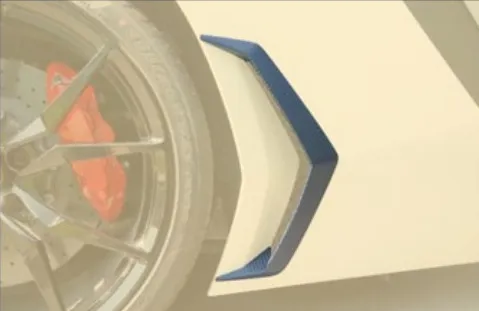
Air outtake cover - side skirt Mansory Carbon for Lamborghini Aventador Competition


Mansory Carbon Air Outtake Cover (Side Skirt) for Lamborghini Aventador Competition
This rocker-line louvre belongs to the Mansory Carbon Body Kit for Lamborghini Aventador Competition — the SVJ-derived carbon programme for the LP-series and SVJ V12 supercar. The cover sits where the side-skirt meets the lower flank, replacing a closed cosmetic insert with a vented, louvred carbon panel. Its job is mechanical, not decorative: bleed engine-bay heat sideways at the rocker, away from the sill and behind the front wheel arch. Aventador owners specify it because the 6.5-litre naturally-aspirated V12, with its dry-sump scavenge and side-mounted oil cooler, dumps real wattage into the lower bay. A louvred outflow at the rocker turns that wattage into airflow rather than soak.
Construction & Materials
The piece is laid as a single autoclave-cured carbon shell. Mansory's louvre vanes are not bonded-on plastic — they are part of the carbon laminate, formed against a multi-piece tool that replicates the negative-draft of each blade. That matters: bonded vanes loosen, integrated vanes do not. The visible face uses a 3K twill warp aligned with the rocker chord; the inner face is laid with a backing scrim that prevents print-through where the louvre roots meet the main panel.
- 3K 2x2 twill prepreg on the visible face, weave bias parallel to rocker chord
- Autoclave cure, 2.0 bar, 125 deg C, controlled ramp to suppress micro-voids around the louvre roots
- Wall thickness 1.6 mm at the panel field, ramped to 2.4 mm at the louvre tongues
- Mass approximately 0.65 kg per side, two-side set roughly 1.3 kg
- UV-stable two-part lacquer, gloss as standard, satin and matte to order, raw-weave option without lacquer for track owners who refresh the surface seasonally
- Stainless A2 fasteners and adhesive-bonded studs land in the OEM skirt datums — no chassis drilling
- Edge profile finished by CNC trim, then hand-filleted to remove laminate witness lines along the louvre slots
- Nano-ceramic primer between weave and lacquer where painted finish is requested over the substrate
Design & Visual Function
The Aventador's side silhouette is built around the diagonal scissor-door cut and the shovel that runs from the door bottom into the rear quarter. A blank skirt panel terminates that shovel into a flat wall. The Mansory louvre cover gives the shovel a destination — air enters at the front of the rocker, accelerates through the side-skirt section, and exits sideways through the louvre rather than tumbling under the floor. Visually, the slats break up an otherwise long carbon plane and add depth to the rocker shadow line. Photographed at three-quarter, the louvre catches body-side light and prints horizontally, reinforcing the car's longitudinal stretch.
Functionally, the V12 NA architecture matters here. Aventador's engine bay packs the 6.5 unit longitudinally with the gearbox forward of the block; oil cooler ducts and exhaust manifolds radiate sideways into the rocker volume. A closed skirt forces that heat down and forward, where it can wash over the front-tyre sidewall and inflate carcass temperature. The louvred outflow short-circuits the path: hot air leaves at the rocker line, before it can reach the front-arch. On SVJ trim with ALA 2.0, the louvre's exit vector is intentionally rearward-canted by about 6 degrees so the outflow does not contaminate ALA's central rear-wing channel. Scissor-door geometry is untouched — the louvre sits below the door swing arc.
There is also a paint-break decision to make. The standard car runs body-coloured skirt over a dark sill cap; the Mansory cover lets owners terminate paint at the louvre seam and continue in lacquered weave, or invert it — paint the louvre, leave the skirt main panel raw. The most-spec'd combination on Carbonado-influenced cars is body-colour main skirt with bare lacquered louvre cover, which reads as an inset detail rather than a contrasting panel.
Compatibility & Fitment
Fits the Lamborghini Aventador across LP700-4, LP750-4 SV, S, SVJ and Ultimae, in coupé and Roadster bodywork. Pre-SVJ rocker geometry differs slightly from SVJ rocker geometry around the rear corner radius — the cover ships with two-position datum holes to absorb the discrepancy without trimming. OEM mud-flap brackets, parking-sensor harness on cars equipped with the side-park option, and the factory rocker drainage path are all retained. The louvre exit aperture is sized so the SVJ central twin-exhaust thermal field does not back-feed through the slot at idle. On Roadster cars the cover does not affect soft-top stowage or the buttress hinge.
Installation & Reversibility
Plan around 60 to 90 minutes per side for a competent installer. The factory cosmetic insert lifts after four Torx fasteners and two adhesive tabs are released with a heated plastic spatula. The Mansory cover lands on the same datum stack, with the addition of two bonded studs that take a methacrylate adhesive — substrate chemistry on the Aventador's CFRP-aluminium hybrid sill demands methacrylate rather than urethane, so do not substitute. Surface prep is isopropyl wipe, abrade with red Scotch-Brite at the bond zone, second IPA wipe, then bond. Torque sequence on the four Torx is 6 Nm, criss-cross. Reversibility is full: removing the cover and refitting an OEM insert leaves no chassis trace, only a cleanable adhesive footprint on the sill substrate. DIY-feasible for an experienced owner with a torque driver and a heat gun set to 80 degrees C; certified body-shop labour is recommended where the cover is being painted in to body colour, since the colour blend along the door shut-line is unforgiving.
Pairing within the Mansory Aventador Competition programme
The natural neighbour is the matched Mansory carbon side skirts — the louvre cover was tooled against the same rocker datum as the full skirt, so the two share their seam line and weave-bias direction. Owners who want a coordinated lateral airflow loop add the Mansory carbon side-window air intake: it pulls fresh air down past the C-pillar to feed the airbox, and the rocker louvre exits hot air a beat later — together they create a documented inboard-out pattern across the engine compartment. Round out the rear thermal management with the Mansory carbon rear bumper air outtake cover, which handles the upper-rear exit while the rocker handles the side exit.
Maintenance & Durability
Lacquered carbon at the rocker height takes the brunt of road salt, brake-pad fines and stone chips. Wash with pH-neutral shampoo only — alkaline traffic-film removers will haze the lacquer in a single contact, ammonia glass cleaners will craze it across two seasons. After wash, dry with a plush microfibre, then apply either a carnauba paste for warmth and depth, or a Si-O-2 ceramic for chemical resistance — pick one, do not stack. Stone chips on the louvre tongue should be addressed within a fortnight: the tongue's edge is the stress riser, and a chip there can wick moisture into the laminate. A polyurethane stone-chip patch matched to lacquer thickness handles 90 percent of cases without paint blending. Engine-bay heat shielding behind the louvre is built in — a thin aluminium-faced heat felt is bonded to the inner skin where the louvre roots sit closest to the V12's lower exhaust run. Expected service life of the lacquered finish is 8 to 10 years before a recoat is sensible; the carbon substrate itself outlasts the car.
Lead Time & Warranty
Production runs 4 to 8 weeks at the Mansory atelier, depending on finish queue and weave-bias options. Bare-weave lacquered ships fastest; body-colour blended ships at the long end of the window. Warranty is 12 months against manufacturing defects covering delamination, lacquer blistering and louvre-root cracking; impact damage, contact with abrasive cleaners and after-market repaint are excluded.
FAQ
Q: Will it fit a pre-SVJ LP700-4 with the older rocker corner?
A: Yes. The cover ships with dual-position datums; the older rocker corner uses the inner pair, SVJ and Ultimae use the outer pair.
Q: Does the louvre create wind noise at speed?
A: No measurable cabin-noise increase below 220 km/h. The louvre vanes sit at a low-incidence angle that biases towards low-frequency flow rather than whistle-band resonance.
Q: Can it be fitted without the matching Mansory side skirts?
A: Yes. The cover lands on OEM rocker datums and works as a standalone retrofit on the factory skirt — no skirt swap required.
Q: Bare lacquered weave or body-colour paint?
A: Bare lacquered weave reads better on darker body colours and on Carbonado-style spec; body-colour-blended works best on lighter pearls where a black insert at the rocker breaks the panel awkwardly.
Q: Does it interfere with ALA 2.0 on the SVJ?
A: No. Exit vector is canted 6 degrees rearward; the outflow rejoins the underbody wake well ahead of the central rear-wing channel and does not load ALA's stall logic.
Q: How much weight is saved over the OEM cosmetic insert?
A: The OEM insert weighs about 0.95 kg per side; the carbon louvre cover weighs about 0.65 kg. Saving is roughly 0.6 kg across the pair, plus thermal benefit.
Pairs with the matched Mansory side skirts and the side-window air intake to complete the lateral airflow loop. To configure finish, weave bias and order: WhatsApp +44 7488 818 747 or [email protected].