
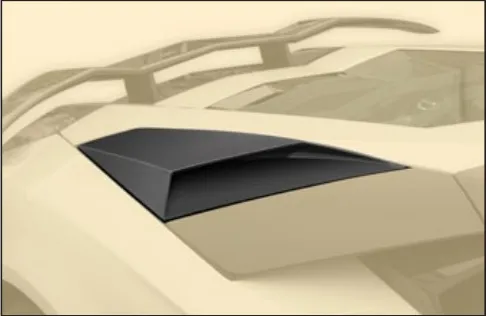
Replacement Big Air intake - rear Mansory Carbon for Lamborghini Aventador Competition


Mansory Carbon Replacement Big Air Intake Rear for Lamborghini Aventador Competition
This is the oversized rear-quarter intake panel of the Mansory Aventador Competition wardrobe — the visibly larger, deeper-throated cousin of the standard-shape replacement rear intake. It slots into the same flank position behind the door, where the body necks down and channels rushing air toward the naturally aspirated 6.5-litre V12 airbox feed and the engine-bay extraction zone. Specified as part of the wider Mansory Carbon Body Kit for Lamborghini Aventador Competition programme, this big-mouth variant is what Aventador owners reach for when they want the side profile to read motorsport rather than restrained — a wider aperture, a deeper duct, more shoulder presence next to the scissor-door cut and the SVJ-derived stance.
Construction & Materials
The big intake panel is laid up from prepreg carbon textile and cured under heat and pressure, the route Mansory uses for visible-weave outer skins where dimensional repeatability matters more than raw cycle time. Compared with the smaller-aperture sibling, this oversized version carries a deeper draw and a wider mouth, which forces the laminator to manage compound curvature carefully — twill drapes around the inlet lip, plies are staggered behind it, and the shoulder where the panel meets the side-skirt termination is reinforced so the larger throat does not flutter at speed.
The piece is a panel, not an induction kit — it replaces the OEM cosmetic intake module on the body and feeds existing OEM ducting behind it. The owner is buying enlarged geometry and visible weave, not a re-engineered runner length.
- Skin layup: 3K twill prepreg outer ply with woven backing layers oriented for stiffness across the throat opening.
- Cure cycle: autoclave under elevated temperature and pressure to lock fibre alignment around the deeper draw.
- Wall thickness: roughly 1.6–2.1 mm, locally thicker on the inlet lip and at the rear shoulder where the duct flares.
- Mass: a few hundred grams under the OEM analogue once trimmed and finished — the gain is shape, not headline kilos.
- Inlet aperture: visibly larger than the standard-shape replacement, with a deeper internal pocket reading further into the body line.
- Mounts: OEM hard-points are reused — locating pins, threaded bosses and clip channels mirror the factory side-vent module.
- Finish menu: high-gloss UV-stable lacquer, satin matte, or naked weave with a sealing flow-coat — pick one in the order step.
- Optional cosmetic mesh: powder-coated open-cell mesh inlay can be specified to dress the deeper opening without choking flow.
Design & Visual Function
Visually this is the part that decides whether the Aventador's flank reads like a road super-GT or like something rolled out of a privateer paddock. The bigger mouth pulls the eye downward and rearward, lengthening the apparent dash-to-axle and emphasising the shoulder line that already curves into the rear haunch. Where the standard sibling sits flush and disciplined, this oversized variant punches a deeper shadow into the panel — a black-on-carbon negative space that catches headlamp glare from the car behind and frames the side-skirt termination in motion.
Functionally the panel still does what an Aventador side intake exists to do: present a clean inlet area to the engine bay and the airbox-feed plenum behind it. The wider opening reduces apparent restriction at the body face, and because the duct cross-section is held more generous further inboard, the path toward the V12's induction tract sees a more relaxed local geometry. Owners who track-day their cars and care about engine-bay extraction at sustained high oil temperatures often pick this variant for that reason — the bigger window simply trades a touch of side cleanliness for more breathing area into the hot zone.
One acoustic note often raised by spec-conscious owners: a wider, deeper intake throat tends to transfer slightly more induction roar back through the side of the cabin, especially with the windows cracked or the Roadster top stowed. It is a panel, not an open-induction conversion, so the difference is subtle, not violent — but next to the quieter standard-aperture sibling the bigger version is audibly more present, which most Mansory clients view as a feature rather than a side-effect. On SVJ cars the part respects the ALA 2.0 architecture entirely; ALA's central rear-wing duct and rear-deck routing are untouched by a flank panel and remain free to do their active-aero job under load.
Compatibility & Fitment
Designed for Lamborghini Aventador in LP700-4, LP750-4 SV, S, SVJ and Ultimae trims, coupé and Roadster. Pre-SVJ shells and SVJ shells share the relevant flank module pocket, and the panel is contoured to drop into either. Where the surrounding bodywork carries OEM proximity sensors, the carbon panel respects their locations; the larger aperture is achieved by extending the cosmetic throat, not by encroaching on sensor real estate. Scissor-hinge swing geometry is unaffected, since the panel sits well below the door cut.
The standard-aperture sibling and this oversized variant are mutually exclusive — pick one or the other, not both. Owners going for the most aggressive side stance routinely combine this big intake with the deeper-shoulder Mansory side-skirt and the rear bumper outtake covers to keep the rear quarter visually consistent.
Installation & Reversibility
Plan on roughly 45–75 minutes per side at a competent body shop. The OEM cosmetic intake module is released, its fasteners and clips transferred or upgraded, the new oversized carbon piece located on the factory hard-points, gaps are checked against the door shut-line and the side-skirt termination, then it is bonded and torqued. Because the deeper draw of the bigger throat amplifies any panel misalignment, gap-and-flush should be set with the door closed and the wheel arch liner in its final position before final fixing.
The job is fully reversible — the OEM module can be re-fitted later with no scarring of the surrounding paintwork, provided the original adhesive footprint is respected and the mount points are kept clean. Use the methacrylate adhesive family that suits the Aventador's CFRP monocoque substrate where the panel touches structural carbon, and torque metal fasteners only into OEM threaded bosses. Lamborghini-certified or Mansory-trained installers handle the alignment best, especially on cars that already wear the matching front bumper and side skirts.
Pairing within the Mansory Aventador Competition programme
This panel is one of four sibling pieces in the rear-side-induction family, and they are designed to layer together. The most common pairings:
- Replacement Air intake — rear (standard aperture) — the calmer, OEM-shape sibling for cars where the owner wants only one flank to scream and the other to whisper, or for a build that prefers restraint elsewhere.
- Designed big air intake (replacement aesthetic) — the sculpted-styling counterpart to this functional oversized version; pick the designed variant for a more graphical, fin-led look, or this one for a cleaner motorsport throat.
- Air intake middle part — the centre infill that bridges the side aperture into the rear quarter; choosing it in matching weave keeps the visual rhythm of the flank coherent rather than busy.
For owners going full kit, the big intake reads strongest alongside the matching side skirts and the rear bumper in the same weave specification.
Maintenance & Durability
Lacquered weave responds best to pH-neutral car shampoo and a soft mitt. Avoid alkaline traffic-film removers, ammonia-based glass sprays drifting onto carbon, and abrasive sponges — any of those will dull a glossy clear and, given enough cycles, etch into the resin matrix. A modern ceramic coating is the cleanest long-term protection here; carnauba-style waxes work but need refreshing more often, particularly at the front edge of the throat where airborne grit lands at speed.
Heat is the other consideration. The rear quarter sits adjacent to the V12 hot zone, and oil-cooling and engine-bay air all migrate around this part of the body. The composite layup tolerates the underlying ambient envelope with no issue, but a stone chip on the outer lacquer should be sealed promptly so moisture does not creep under the clear and lift it. Chip repair is a localised re-flat-and-clear job at any competent paintless-and-polish specialist familiar with lacquered carbon.
Lead Time & Warranty
Each panel is built to order at Mansory bespoke production, so allow roughly 4–8 weeks from confirmed spec to dispatch — slightly more in peak season or where unusual finishes (dyed weave, tinted clear, mixed twill orientations) are requested. The piece carries a 12-month manufacturer warranty against laminate and finish defects, with the usual exclusions for stone-chip damage, kerb impact, alkaline-cleaner abuse and improper installation.
FAQ
Q: How is this different from the standard-aperture rear intake?
A: It is the bigger-throat variant — wider mouth, deeper duct, more shoulder presence on the side of the car, and slightly more induction-side acoustic transfer. Same mounting footprint, more aggressive geometry.
Q: Will this fit my pre-SVJ Aventador, or is it SVJ-only?
A: It fits LP, S, SV, SVJ and Ultimae shells in coupé and Roadster. The flank pocket geometry is consistent across the family for this module.
Q: Does it boost horsepower?
A: It is a cosmetic and inlet-area replacement panel, not an induction kit. It enlarges the visible throat and feeds the same OEM ducting behind it. Treat any quoted gain as marginal at best — the value here is shape, presence, and a touch more induction transparency.
Q: Will it interfere with ALA on my SVJ?
A: No. ALA 2.0 routes its active-aero airflow through the rear deck and central wing channel, not the rear-quarter side intake. A flank panel does not touch ALA's working surfaces.
Q: Can I run one big and one standard side?
A: Mechanically nothing stops it, but it reads odd from rear three-quarter. Almost every order spec runs the same variant on both flanks for symmetry.
Q: Naked weave or lacquered?
A: Naked weave with a sealing flow-coat looks rawest in person, lacquered gloss reads sharper in studio lighting and is friendlier to long-term ownership. Both are offered.
Pair this panel with the matching side skirts and rear bumper for a flank that genuinely reads Mansory Competition. Order or spec via WhatsApp +44 7488 818 747 or [email protected].