
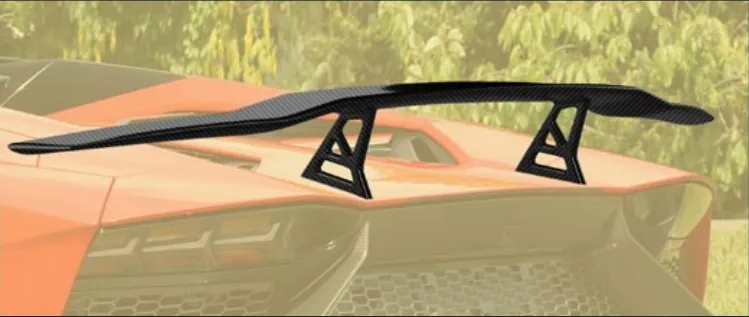
Rear high performance wing Mansory Carbon for Lamborghini Aventador Competition


Mansory Carbon Rear High-Performance Wing for Lamborghini Aventador Competition
The Rear High-Performance Wing is the apex aerodynamic statement of the Mansory Carbon Body Kit for Lamborghini Aventador Competition — the largest, most aggressive single-element wing offered for the SVJ-derived Carbonado programme. Where the standard rear-performance wing aims at street-balanced downforce and the biplane variant splits load across two stacked planes, this flagship piece commits fully to motorsport intent: a single, oversized aerofoil with the deepest chord and widest span in the catalogue, suspended from twin swan-neck pylons that mount to the upper surface of the airfoil rather than its underside. Owners specify it when the Aventador is being prepared for trackdays, photo programmes, or static show duty where the silhouette must read as race-bred at fifty paces. On SVJ chassis it is engineered to clear the ALA 2.0 central channel; on LP and S cars it bolts to reinforced anchor zones in the engine deck.
Construction & Materials
The wing is laid up entirely in aerospace-grade pre-impregnated carbon fibre, processed under autoclave heat-and-pressure cure. Its single-plane geometry permits a thicker internal box section than either of its siblings, which is exploited to embed an aluminium torsion rib down the chordline — this rib carries flutter loads at terminal velocity without demanding extra wall thickness on the visible carbon skin.
- Outer skin: 3K twill carbon, surface-aligned for pylon-to-tip continuity
- Inner laminate: 2K plain weave with unidirectional spar tapes along the chord
- Cure schedule: autoclave prepreg at 120 degC, 6 bar
- Wall thickness: 2.4-3.1 mm at trailing edge, 4.5 mm at leading edge
- Internal stiffener: bonded aluminium torsion rib, methacrylate-bonded
- Mass: approximately 7.8 kg complete with pylons and hardware
- Hardware: titanium M8 fasteners, anodised pylon shoes, stainless inserts
- Finish: high-gloss UV-stable lacquer standard; matte and raw weave optional
Design & Visual Function
This is the largest wing in Mansory's Aventador Competition wing line and the silhouette tells you so before any spec sheet does. The chord is roughly thirty per cent deeper than the standard rear-performance wing, and the span fills the rear deck almost out to the haunch shoulder line. That extra plan area is deployed at a noticeably higher angle of attack, biased for downforce-dominant operation rather than the drag-balanced compromise of the smaller siblings. The element is held aloft on two swan-neck pylons rather than the more familiar pedestal supports — the swan-neck routes the structural load over the top of the wing, leaving the pressure-side underside aerodynamically clean. That choice is borrowed wholesale from prototype racing thinking and is the single biggest reason the part outperforms its siblings on a track stopwatch.
Beneath the wing the Aventador's V12 NA architecture continues to breathe through its standard channels: the rear hexagonal intakes, the high-mount central twin-exhaust on SVJ trim, the lower side outlets on LP and S. The pylon footprint sits inboard of the engine cover louvres so the V12 thermal management zone draws ambient air without obstruction, and the wing's leading edge is positioned forward enough to capture a slug of clean air before the rooftop boundary layer thickens. On SVJ specifically the central rear-wing channel that ALA 2.0 controls is preserved — the pylons straddle, never bridge, that aperture, so the active aero system retains its full open-and-close authority.
Visually the piece commits to a motorsport-leaning aesthetic: the trailing edge is squared rather than tapered, the endplates carry a vertical knife-edge fence, and the swan-neck pylons read as engineered hardware rather than styling jewellery. It pairs with the SVJ scissor-door geometry at rest — the rear deck silhouette stays low so the wing reads as floating above the bodywork, and when the doors are raised the rear three-quarter framing places the wing as the visual anchor of the composition.
Compatibility & Fitment
Direct fit on Lamborghini Aventador LP700-4, LP750-4 SV, S, SVJ and Ultimae, coupe variants. Roadster fitment requires confirmation of soft-top stowage clearance under load — full datasheet on request. SVJ-specific clearances around the ALA 2.0 actuator housing and the high-mount central twin-exhaust are accommodated by the standard pylon footprint; pre-SVJ engine decks may require a thin spacer plate to centre the wing visually. OEM reversing-camera wiring, ALA loom, and engine-bay vent geometry are all retained.
Installation & Reversibility
Installation is a four to six hour job at a Mansory-trained installer or Lamborghini-certified body shop. The pylons mount through factory anchor zones in the engine-deck shear panel — these are the same zones used by the Lamborghini SVJ rear wing, so there is no fresh drilling required on SVJ and Ultimae cars. Pre-SVJ installations introduce two reinforcement plates which are bonded with methacrylate adhesive into the CFRP monocoque section behind the engine cover; this respects the substrate chemistry of the chassis and preserves crash-load paths. The piece is fully reversible on SVJ and Ultimae; on pre-SVJ chassis the reinforcement plates remain bonded after wing removal but are flush, paint-ready, and not visible with the OEM wing reinstalled. Tooling: torque wrench to 22 Nm, 5 mm and 6 mm hex sockets, plastic trim wedge, isopropyl wipe pack. Paint and primer prep is required only if a body-colour finish is specified.
Pairing within the Mansory Aventador Competition programme
This is the apex item of a three-wing family and the trade-offs are worth spelling out before specification.
The rear performance wing is the entry point — smaller chord, lower angle of attack, pedestal mounts. It adds visible motorsport intent without imposing the drag penalty or the parking-garage clearance issues of a full single-plane element. Owners who drive the Aventador daily on twisty mountain roads, or who dislike the visual mass of a large wing, choose this one. It is also the sibling that pairs most easily with the rear-bumper-air-outtake-cover and designed-diffuser without overpowering them.
The biplane performance wing sits between — twin stacked planes split the downforce load across two smaller elements. The biplane wins on visual drama and on per-element flutter behaviour at very high speed, but its total downforce ceiling is lower than this flagship single-plane and its aggregate drag is higher. It is the show-and-go choice rather than the lap-time choice.
This Rear High-Performance Wing wins on outright downforce ceiling and on the cleanness of underside airflow, courtesy of the swan-neck mount. The penalty is honest and worth stating: aggregate drag is the highest of the three, top-speed runs lose a small handful of km/h compared with the standard wing, and the silhouette is unmistakably committed. There is no street-only-mode here — if you specify this part you are accepting that the car now reads as a track-leaning machine in every lighting condition.
For owners who want the visual mass of a full-width device but read closer to a ducktail than a wing, the rear spoiler is a separate route entirely — a subtler integrated lip rather than a free-standing aerofoil. It is not a competitor to this wing so much as an alternative philosophy.
Maintenance & Durability
Lacquered carbon care is straightforward but unforgiving of shortcuts. Wash with neutral pH shampoo and a clean lambswool mitt; rinse before the panel dries. Avoid alkaline traffic-film removers, ammonia-based glass cleaners, and any abrasive sponge — these strip the UV-stable lacquer and leave the underlying weave exposed to oxidation. A ceramic coating extends the lacquer's solar-UV life noticeably; carnauba waxes are gentler but require reapplication every six to eight weeks if the car lives outdoors. Inspect the leading edge twice yearly for stone-chip ingress; chips that have penetrated past the lacquer should be repaired by a carbon specialist within thirty days to prevent moisture wicking under adjacent layers. Engine-bay heat shielding is not a concern for this part — the wing element sits well above and behind the V12 hot zone — but the swan-neck pylon roots receive radiated heat from the engine cover, so a thin reflective barrier is bonded into the pylon shoe at production. Lifespan with reasonable care is fifteen years plus; full repolish to factory gloss is possible at any point in that window.
Lead Time & Warranty
Lead time is four to eight weeks from order confirmation to ready-to-fit, reflecting Mansory bespoke production and the autoclave cure cycle for prepreg parts of this scale. A twelve-month warranty against manufacturing defects covers the laminate, the bonded torsion rib, and the pylon hardware. Finish-related warranty applies to the standard high-gloss lacquer; matte and raw-weave finishes carry the same coverage with care-instruction caveats.
FAQ
Q: Is this the largest of the three Mansory wings for the Aventador?
A: Yes. It has the deepest chord and widest span of the three Competition-line wings. Both span and chord exceed the standard rear-performance wing measurably, and the angle of attack is set higher.
Q: Does it work on SVJ without disabling ALA 2.0?
A: Yes. The swan-neck pylons straddle the ALA central channel and the actuator retains full authority. ALA continues to operate exactly as Lamborghini engineered it.
Q: Will it fit my pre-SVJ Aventador LP or S?
A: Yes, with two reinforcement plates bonded into the engine-deck shear zone. The bonding agent respects the methacrylate chemistry of the CFRP monocoque. Roadster fitment requires soft-top stowage clearance verification.
Q: How much downforce does it generate compared with the smaller siblings?
A: This wing's plan area is roughly thirty per cent larger than the standard rear-performance wing, run at a higher angle of attack. Real-world downforce gain depends on speed and trim, but the ceiling is meaningfully above either sibling. Drag also rises — that is the trade-off.
Q: Why a swan-neck mount instead of pedestals?
A: Swan-neck pylons route the structural load over the top of the wing, leaving the pressure-side underside aerodynamically clean. That preserves the wing's full pressure differential at high angles of attack, which is where this part operates. Pedestals would interrupt the underside flow and bleed efficiency.
Q: Can I switch back to the OEM wing later?
A: On SVJ and Ultimae chassis, yes — full reversibility, no bonded reinforcement. On pre-SVJ chassis the reinforcement plates remain bonded after removal but sit flush and are paint-ready under the original wing.
Pair it with the designed diffuser for a balanced front-to-rear aero programme. Order or specify finish: WhatsApp +44 7488 818 747 or [email protected].