
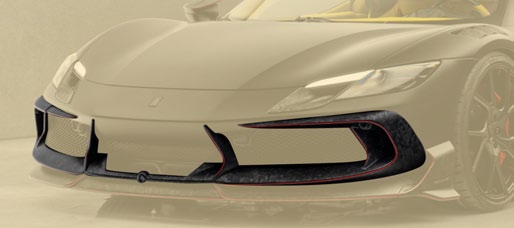
Front splitter Mansory for Ferrari 296 GTB


Front splitter Mansory for Ferrari 296 GTB
Where the front lip draws the lower boundary of the 296's nose, the front splitter projects that boundary into three-dimensional flow management. This carbon fibre horizontal plane, part of the Mansory Carbon Fiber Body kit set for Ferrari 296 GTB, sits beneath the lower bumper ahead of the flat floor section and creates a high-to-low pressure differential across its chord. High pressure builds on the blade's upper stagnation surface; the underside draws the floor-bound boundary layer forward at accelerated velocity, reducing static pressure in the sub-floor region. That pressure reduction cascades rearward, increasing the flow velocity reaching the rear diffuser's throat. On the Ferrari 296 GTB — 2.992 L F163 twin-turbo V6 in a 120° hot-vee layout, 165 hp axial-flux electric motor, 830 hp combined, 740 Nm, 8-speed dual-clutch transaxle — the front axle carries less mass than the rear because the PHEV battery pack and electric motor both sit rearward of the ICE. Managing front-axle aerodynamic load is the primary high-speed calibration challenge, and a properly engineered splitter addresses it without compromising road-use ground clearance. Pair it with the Mansory front lip for the complete lower-nose aero treatment.
Construction & Materials
The splitter blade uses 2K plain-weave prepreg carbon fibre — a tighter orthogonal braid than 3K twill — selected because the plain weave's 0°/90° fibre orientation resists the in-plane shear loads a cantilevered blade experiences at highway speed. The blade section undergoes compression-mould cure for dimensional accuracy; the rearward mounting flanges are autoclave-cured at 120 °C under 5 bar for maximum fibre-volume fraction at the structural attachment zones. The underside of the blade receives a polished gelcoat-equivalent clear finish that reduces micro-roughness at the boundary layer — turbulent transition on the underside degrades the pressure-differential performance the splitter is designed to exploit.
The blade tapers from 5 mm at the root to 3 mm at the leading edge — graduated stiffness prevents leading-edge flutter above 200 km/h while minimising the stone-strike shadow area. Mansory pre-applies a 3M edge PPF strip to the leading edge, absorbing the majority of stone-chip impact energy before it reaches the carbon laminate.
- Blade weave: 2K plain — orthogonal fibre orientation maximises in-plane shear resistance against tip deflection
- Flange weave: 3K twill — matches programme weave pattern at visible attachment zones
- Blade cure: compression mould (blade) + autoclave 120 °C / 5 bar (flanges)
- Blade thickness: 5 mm root tapering to 3 mm leading edge
- Blade projection: 60 mm ahead of bumper's lowest geometric point
- Mass: ~1.4 kg including hardware
- Mounting: 4 × M8 stainless hex + 2 × M6 countersunk into OEM captives — no drilling
- Leading-edge protection: factory-applied 3M PPF strip
Design & Visual Function
The splitter's 60 mm projection creates a stagnation region on its upper surface at speed, generating a net downforce vector from the pressure differential across the blade. Mansory's CFD and physical testing on the 296 GTB's bumper geometry confirms meaningful incremental front-axle downforce at 200 km/h when the splitter is combined with the front lip, improving high-speed understeer margin and steering precision. On the 296's PHEV layout, where the battery and electric motor shift the aerodynamic neutral point rearward compared to a pure-ICE Ferrari mid-engine car, the splitter relocates the aerodynamic load distribution forward — matching the aero balance to the car's mechanical behaviour. The F163 hot-vee intercooler radiators, fed by the front bumper side intakes, also receive marginally higher ram pressure when the splitter accelerates the low-level freestream approaching the car, improving charge-air cooling throughput at sustained track speeds.
The trailing edge incorporates a 5° downward diffuser ramp that expands the flow slightly before it enters the underbody gap. This controlled expansion prevents the abrupt velocity transition that can produce separation bubbles in the floor-bound boundary layer — bubbles that would otherwise reduce the rear diffuser's efficiency. Visually, the blade reads as an architectural plane cantilevered from the bumper's lowest face, creating a high-contrast shadow line that emphasises the car's width. Combining it with the Mansory race flaps and Mansory front light air vents produces a front end that communicates aerodynamic intent from every viewing angle.
Compatibility & Fitment
Designed for the Ferrari 296 GTB coupé (2022+), 296 GTS spider (2023+), and 296 Assetto Fiorano. The OEM bumper captive nut positions are shared across all 296 configurations. AF factory floor extensions are fully compatible — the splitter mounts to the bumper shell above the AF floor panel line. The front axle lift system is not obstructed by the blade at any lift position. Ground clearance of the blade's leading edge: ~70 mm at Comfort-mode ride height, ~55 mm in Sport mode.
Installation & Reversibility
Requires a two-post lift. Four M8 hex bolts (13 mm socket) and two M6 countersunk bolts (Torx T30) into OEM captive nuts. Trim pry-tool for undertray access. Fitting time: 45–60 minutes. Fully reversible with no trace on the bumper shell.
Pairing within the Mansory 296 GTB programme
The splitter stacks with the Mansory front lip — lip handles the lower chin boundary-layer seal, splitter manages the pressure differential above it. Adding the Mansory race flaps creates a three-element front aero package mirroring GT3 race car architecture. The Mansory front light air vents increase upper-bumper flow volume feeding the intercoolers, complementing the splitter's underbody acceleration effect.
Maintenance & Durability
The blade's underside is the highest-risk zone for stone strike — it faces the road surface at a shallow angle throughout every journey. Mansory's 3M PPF strip on the leading edge absorbs the worst impact energy. Inspect the underside after each track session; any penetrations to the carbon should be sealed with clear lacquer touch-up within 48 hours to prevent moisture ingress between laminate plies. The upper surface requires standard lacquered-carbon care: pH-neutral shampoo followed by carnauba or ceramic sealant. Avoid high-pressure washing directly beneath the blade at close range — the jet can wedge between plies at any micro-crack. Road salt should be flushed off promptly after winter driving; it is inert to carbon but will corrode the stainless bolt heads if left to accumulate. Annual anti-corrosion treatment on exposed bolt hardware is recommended for cars driven in cold-weather conditions.
Lead Time & Warranty
Lead time: 2–4 weeks reflecting the dual-process cure schedule and pre-delivery fitment verification. 12-month manufacturer's warranty covering delamination, surface voids, and dimensional deviation preventing correct fitment. Stone strike, abrasion, and chemical damage are excluded.
FAQ
Q: Will the splitter blade crack if it grounds at low speed?
A: The blade tolerates low-speed incidental contact — a 5 km/h grounding will flex and spring back. A severe grounding at speed will chip the leading edge; the 3M PPF strip absorbs the worst of this, limiting damage to the strip and the carbon edge rather than the mounting root.
Q: Is the splitter compatible with the 296 Speciale?
A: Pre-production Speciale geometry confirms compatibility at bumper mounting points. Final verification against production Speciale cars is recommended before ordering.
Q: Does the splitter affect the front lift system's operating range?
A: No. The lift actuators connect to the front subframe and operate entirely independently of the bumper-mounted splitter.
Q: What is the visual difference between 2K plain and 3K twill weave?
A: 2K plain has a tighter checker-board pattern; 3K twill has a diagonal flow. The blade underside uses plain weave in polished clear — it appears uniform in texture. The upper face matches the 3K twill lacquer of the front lip for visual programme coherence.
Q: Can the splitter be used for daily road driving across all seasons?
A: Yes. The laminate and lacquer are weather-resistant. Flush road salt promptly in winter and apply ceramic sealant seasonally. The 3M PPF strip on the leading edge should be inspected annually and replaced if it develops lifting edges that could catch debris.
Build the definitive front aero package for your 296 GTB. Contact our team via WhatsApp +44 7488 818 747 or email [email protected] to discuss specification and schedule delivery.