
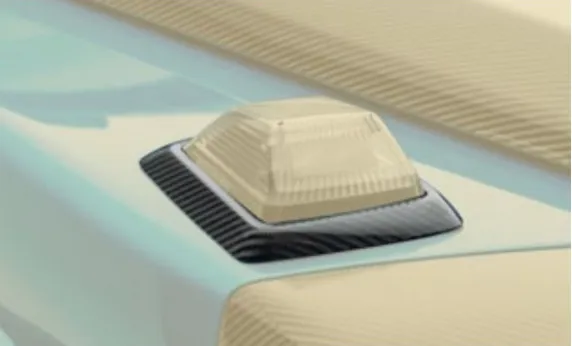
Front flasher protection cover Mansory Carbon for Mercedes G-class G500 / AMG G63 W463A


Front Flasher Protection Cover Mansory Carbon for Mercedes G-class G500 / AMG G63 W463A
On the W463A, the front turn-signal assemblies are set at the outermost corners of the front wing — proud of the body line and fully exposed to whatever the trail, the car park, or the roadside presents. The factory amber lens housing is an injection-moulded polycarbonate unit with no mechanical protection beyond the surrounding sheet metal. Mansory developed the carbon front flasher protection cover to address this vulnerability directly: a rigid CFRP shield that encloses the lens perimeter on three sides without blocking light output, adding functional protection in a form consistent with the broader Mansory Carbon Body Kit for Mercedes G-class W463A G500/G63 exterior language. One important catalogue note: a parallel entry exists at slug front-flasher-proection-cover (the typographical error "proection" rather than "protection") which represents the same physical part under a corrected-URL re-listing. Part number, geometry, and specification are identical across both catalogue entries — only the product URL differs.
Construction & Materials
The cover is produced by resin-transfer moulding (RTM) — a closed-mould process in which dry carbon fabric is placed in a two-part CNC-machined aluminium tool, the mould is sealed, and catalysed epoxy resin is injected under pressure to fully wet-out the fabric before cure at 80 °C. RTM produces tight dimensional tolerances on both inner and outer surfaces simultaneously, which is critical for this part: the inner profile must replicate the flasher housing perimeter to ±0.3 mm for reliable spring-clip engagement, while the outer face carries the forged-look carbon aesthetic consistently across all units. The forged-look outer surface results from randomly oriented short-strand carbon fibre in the outer ply — a swirling texture visually distinct from the twill weave used on panel-scale parts.
Post-mould operations include CNC trimming of the open-face aperture to finished geometry, installation of two stainless steel spring-clip retainers pressed into recesses on the inner face, and application of satin or gloss two-part lacquer over the outer carbon surface.
- Moulding process: resin-transfer moulding in CNC aluminium tooling
- Outer face: forged-look carbon (randomly oriented short-strand face ply)
- Inner profile tolerance: ±0.3 mm for spring-clip engagement with OEM housing
- Nominal wall thickness: 5 mm
- Weight per cover: 85 g; pair weight: 170 g
- Mounting: 2× stainless steel spring clips per cover, pressed into moulded recesses
- Finish: 2K lacquer, satin standard; gloss available on request
- Resin system: catalysed epoxy, injection-cured at 80 °C
Design & Visual Function
The guard wraps the flasher lens on three sides — top, outboard, and bottom — while the inboard face and forward aperture remain fully open. This geometry preserves the complete 180° angular spread of the amber signal in the forward and lateral arcs mandated by type-approval regulations, while providing physical protection precisely where the housing is exposed. The open-face design also ensures the carbon guard is visible at close range as a distinct carbon-framed feature without obscuring the operational lamp — an important distinction from headlight covers, which carry different regulatory implications.
From the front three-quarter angle, the cover reads as a precision surround to the turn signal, its 5 mm wall thickness giving the flasher area a jewelled, framed quality absent from the unguarded OEM housing. Satin lacquer was chosen as the standard specification to coordinate with the generally matte-satin finish of adjacent Mansory front-end components, though gloss is available for owners following a full-gloss carbon scheme. The forged-look outer texture provides visual variation against the twill-weave panel parts, distinguishing the guard as a functional protective element rather than a continuation of the flat-panel aesthetic.
The guard terminates flush with the wing surface on the inboard edge and does not extend to the rear of the flasher housing, which is recessed into the front wing metal and requires no protection. This boundary maintains a clean transition to the surrounding paintwork without any step, shadow line, or interference that could read as imprecise fitment. The open-forward aperture also facilitates natural drainage so that water does not pool inside the guard during washing or rain.
Compatibility & Fitment
Designed for the W463A platform produced from 2018 onward. The spring-clip inner profile is machined to the W463A OEM flasher housing perimeter dimensions. Compatible trims: G500 with M256 inline-six turbocharged engine, G550, G400d, G350d, and AMG G63 with M177 4.0-litre twin-turbocharged V8. The pre-2018 W463 carried a different flasher housing position and geometry and is not compatible with this cover. Regarding drive configuration: the flasher housing is positioned identically on LHD and RHD W463A variants — the cover pair is not configuration-specific and fits both without modification or re-orientation. Sunroof specification and AMG Package trim level have no bearing on front flasher housing geometry or cover fitment.
Installation & Reversibility
Installation requires no tools, no adhesive, and no drilling. Compress the two stainless spring clips on the rear of each cover with thumb pressure, align the cover over the flasher housing with the open aperture facing forward, and release — the clips engage the housing lip with a tactile click. The cover is held securely at all road speeds without rattle. Removal is equally immediate: press the clip-release tabs from the inboard edge and the cover lifts clear without marking the housing or surrounding paint. Installation time per side is approximately five minutes, making this among the fastest-fitting parts in the Mansory W463A programme. No professional installer is required; the engagement is self-evident and tactile. The OEM housing is untouched throughout and returns to factory condition in the same five-minute operation.
Pairing within the Mansory G-class W463A G500/G63 programme
The flasher cover was developed as part of the forward lighting protection suite. It works alongside the Mansory carbon headlight covers with air intake, which protect and style the main headlight assemblies positioned inboard of the flashers — together they address the entire front lighting cluster in matched carbon. The Mansory low front protective frame provides underbody protection at the front apron and shares the functional protection philosophy of the flasher cover, making the two natural companions for owners using the W463A on unsurfaced or rural roads. The companion entry under the legacy SKU references the same part for historical order continuity.
Maintenance & Durability
The RTM epoxy matrix and two-part lacquer are resistant to the full range of road chemicals encountered in normal use: fuel splash, brake fluid, engine oil, and the alkaline compounds in automated car washes. The forged-look random-strand surface conceals minor contact scratches more effectively than a mirror-finish panel because the texture provides visual camouflage for fine surface abrasion. Regular detailed polishing attention is therefore less demanding for this part than for the larger flat-panel pieces in the exterior programme.
The stainless spring clips should be examined once per year for fatigue cracking at the bend radius — unlikely in normal use but the single mechanical wear item in the assembly. Replacement clips are available through Hodoor separately. The open-face aperture should be cleared of accumulated insects and debris at each wash to prevent trapped moisture from contacting the OEM lens surround. Avoid pressure-washing directly into the aperture from close range; standard car-wash pressures and angles are appropriate.
Lead Time & Warranty
Lead time is 2–6 weeks from order confirmation. RTM tooling cycles and clip assembly are completed at Mansory's facility; each unit undergoes dimensional inspection for clip-engagement force and inner-profile tolerance before dispatch. Hodoor provides a 12-month warranty against manufacturing defects including clip failure under normal load, lacquer adhesion defects, and moulding voids affecting structural integrity. Impact damage to the cover from the hazards it is designed to intercept — stone strikes, branch contact — is a service condition rather than a manufacturing defect and is outside warranty scope.
FAQ
Q: What is the difference between this listing and the "proection" (typo) SKU?
A: Both entries — this corrected-URL listing and the legacy entry at front-flasher-proection-cover (missing the "t") — refer to precisely the same physical part with identical geometry, part number, and specification. The legacy slug was retained for historical order reference. Either listing results in the same product being dispatched; this corrected-URL entry is the current primary reference for new orders.
Q: Does the carbon cover affect flasher beam pattern or legal turn-signal brightness?
A: No. The open-face design leaves the full forward and lateral emission arc unobstructed. The cover contacts only the housing perimeter; no carbon material sits in the optical path of the signal lamp. Type-approval compliance for turn-signal visibility is unaffected.
Q: Is the mount asymmetric — are there separate LHD and RHD versions?
A: No separate versions are required. The W463A flasher housing geometry and wing position are identical on LHD and RHD variants. A single pair covers both configurations without re-orientation or modification.
Q: How much impact protection does the 5 mm carbon wall provide?
A: The CFRP wall at 5 mm nominal thickness exceeds 400 MPa flexural strength. It absorbs without fracture the low-energy contacts from light brush, thin branches, and car-park nudges that represent the primary threat to the OEM lens. Against high-energy impacts such as substantial rock strikes at speed, the cover will absorb and distribute the load — potentially sacrificing itself to protect the housing, which is the intended function, since a carbon cover is considerably less expensive to replace than an OEM flasher assembly.
Q: Can the cover be fitted without any other Mansory front-end components?
A: Completely. The flasher protection cover is a self-contained accessory that requires no other Mansory part to function or mount correctly. Many owners install it independently as a practical protective measure rather than as part of a full carbon styling programme.
For ordering, stock enquiries, or technical fitment detail on the front flasher protection cover, reach the Hodoor team on WhatsApp +44 7488 818 747 or write to [email protected] — availability and lead-time queries are answered within one business day.