
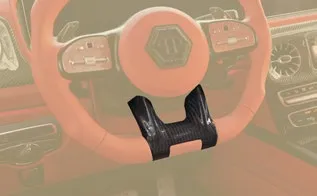
Steering wheel panel Mansory for Mercedes G-class G500 / AMG G63 W463A


Steering wheel panel Mansory for Mercedes G-class G500 / AMG G63 W463A
The steering wheel panel is the carbon piece that lives at the centre of the wheel — a slim surround that frames the airbag cover and dresses the lower spoke where the driver's eyes naturally land every time they glance at the speedometer. On the W463A widebody program by Mansory Carbon Body Kit for Mercedes G-class W463A G500/G63, this panel is what closes the loop on the cabin: once you have a carbon steering frame and a carbon airbag cover, the surround panel is the connective tissue that makes the three pieces read as one continuous weave instead of three loose carbon parts. Owners specify it last, almost as a finishing trim, but it is the part that decides whether the steering hub looks production or hand-built.
Construction & Materials
This is a small part with a disproportionate amount of geometry — the surround wraps the airbag cap, follows the lower spoke radius, and has to clear the multifunction switch cluster on either side. Mansory builds it in 2K plain-weave carbon rather than the more common 3K twill, because at this physical scale a 3K weave reads as visual noise. The 2K plain weave is finer, the squares are smaller, and the pattern stays calm even under direct sunlight reflecting off the lacquer. The panel is laid up over a precision OEM-cut buck so the airbag aperture and the spoke transitions land within tenths of a millimetre of the original plastic.
- Weave: 2K plain-weave carbon (finer than 3K twill — chosen specifically for small-part visual scale)
- Cure: vacuum-bagged + post-cure cycle for void-free surface under the lacquer
- Wall thickness: ~1.6 mm — slim enough to keep clip geometry intact
- Weight: ~80 g (a few grams heavier than the OEM plastic surround it replaces)
- Mounting: OEM clip locations on the wheel hub — no adhesive, no drilling
- Finish: high-gloss UV-stable two-component lacquer; matte option on request
- Airbag clearance: original deployment volume preserved — surround sits outboard of the cap seam
- Edge treatment: chamfered and polished where the panel meets the airbag cover plane
Design & Visual Function
Why plain weave on a part this small? Because perception of weave scale is a function of viewing distance and part size. A 3K twill works on a bonnet at three metres and on a roof wing at two metres — at that scale the diagonal twill lines give the carbon its characteristic motion. On a 90 mm tall steering wheel surround viewed from 60 cm away, the same 3K twill would feel busy, almost camouflaged, and you would lose the architectural calm the rest of the carbon programme is reaching for. The 2K plain weave at the same viewing distance reads as a delicate checkerboard — present, recognisable, but visually quiet. It also catches the lacquer differently: plain weave reflects in two clean orthogonal directions, twill reflects diagonally, and on the steering hub where ambient lighting comes from the windscreen above, the orthogonal reflection sits more naturally.
The geometry has been cut to the W463A AMG steering wheel — every cutout for the multifunction switches, every clip pocket, the airbag cover witness line — all of it is dimensioned off the production part rather than approximated. When you sit in the car after the panel is installed, the eye sees three things that used to be one: the carbon airbag cover, the carbon surround, and the leather of the lower spoke. The surround is what stops the airbag cover from looking like an awkward island floating in plastic.
Lacquer chemistry matters here more than on body panels. Dashboard plastics see direct sunlight through the windscreen at angles a bonnet never experiences, and most cheap lacquers will yellow within a few summers. Mansory uses a UV-stabilised aliphatic clear that holds optical clarity for the life of the car — important on a steering wheel, where any yellowing reads instantly against the matte airbag cover.
Compatibility & Fitment
Fits Mercedes-Benz G-class W463A generation (2018+ 4th-gen platform, the squared-off but modern G that replaced the 1979–2018 boxy original). Compatible with G500, G550, G400d, G350d, and AMG G63 with the M177 4.0 V8 biturbo. Specifically dimensioned for the AMG-style multifunction wheel that ships standard on G63 and is optional on G500. Pre-2018 W463 (the old box) is not compatible — completely different steering wheel architecture, completely different airbag module. W463A Gronos and W465 (next generation) use different wheels and require their own panels. LHD and RHD are interchangeable on this part (the surround geometry is symmetric about the spoke). Confirm your wheel matches the AMG-package multifunction layout before ordering — base non-AMG wheels on early G500 spec used a different switch cluster.
Installation & Reversibility
This is an OEM-clip swap and is one of the easiest carbon parts in the catalogue to fit. The original plastic surround unclips from the wheel hub once the airbag has been removed (which requires disconnecting the battery and waiting the manufacturer-specified discharge time before extracting the airbag connector — this is non-negotiable on any pyrotechnic component). With the airbag set aside on a clean surface facing up, the plastic surround pops out, the carbon panel pops in, and the airbag is reseated and reconnected. Total bench time is typically 25–35 minutes including the safe-discharge wait. Reversibility is total — no glue, no holes, no clip damage — and the original plastic surround can be retained for resale. We strongly recommend a Mercedes-trained technician or a specialist installer for the airbag handling step; the carbon part itself is trivial to swap, but airbag work has its own protocol.
Pairing within the Mansory G-class W463A G500/G63 programme
The surround panel only does its job when the parts on either side of it have been treated to match. The natural companion is the airbag cover itself — without that, the surround frames a plastic centre and the contrast looks unfinished. Together with the carbon steering frame the three parts form a continuous weave field across the lower hub. Recommended pairings:
- Airbag cover Mansory for Mercedes G-class G500 / AMG G63 W463A — the sibling part this surround is designed to frame
- Sport steering frame Mansory for Mercedes G-class G500 / AMG G63 W463A — the upper-spoke and rim accent that completes the hub
- Sport steering wheel II Mansory for Mercedes G-class G500 / AMG G63 W463A — full carbon-rim wheel for owners going beyond trim swaps
Maintenance & Durability
The good news about a steering wheel part is that it never sees rain, salt, or road debris. The bad news is that it sees something equally hostile — direct UV through the windscreen and constant contact with hand oils, hand sanitiser, sunscreen, and whatever the driver is eating. Wipe down weekly with a microfibre and a pH-neutral interior cleaner. Once a quarter, a thin coat of carnauba interior wax keeps the lacquer slick and stops dust from etching. Avoid anything ammonia-based (most generic glass cleaners) — ammonia attacks aliphatic clearcoat over time. Avoid alcohol-heavy disinfectant gels in direct contact with the surround; they will not destroy the lacquer in a single touch, but cumulative spray exposure over years will dull the gloss. Expected optical lifespan on a daily-driven car parked outside is 8–12 years before the clearcoat needs a refresh.
Lead Time & Warranty
Lead time on the steering wheel panel is typically 2–3 weeks since the part is small, the buck exists, and the layup cycle is fast. If the catalogue stocked unit is available you can have it inside a fortnight; bespoke matte or open-pore variants add a week. Twelve-month manufacturing warranty covers delamination, lacquer voids, weave alignment defects, and any clip-pocket geometry issue that prevents OEM seating. The warranty does not cover damage caused by aftermarket cleaners, airbag-deployment scarring (rare — the surround sits outboard of the deployment seam), or impact from rings and watches over time.
FAQ
Q: Why 2K plain weave instead of the 3K twill used on the bonnet?
A: Scale. A 3K twill on a 90 mm part viewed from 60 cm away reads as visual noise. The 2K plain weave keeps the pattern legible and quiet on a small dashboard part.
Q: Does it interfere with airbag deployment?
A: No. The surround sits outboard of the airbag cover seam — the deployment plane and volume are unchanged from OEM.
Q: Will it fit my pre-2018 G-Wagen?
A: No. Pre-2018 W463 has a completely different steering wheel hub. This part is W463A only (2018+).
Q: AMG-package wheel only, or does it fit base G500 wheels too?
A: It is dimensioned for the AMG-style multifunction wheel that is standard on G63 and optional on G500. Confirm your switch cluster layout before ordering — early base-spec G500 wheels are different.
Q: Can I install it myself?
A: The carbon swap is a 5-minute clip operation. The airbag removal that precedes it requires the manufacturer's safe-discharge protocol. We recommend a trained technician for that step.
Pair this surround with the airbag cover and the sport steering frame for a complete carbon hub treatment. Order or ask: WhatsApp +44 7488 818 747 or [email protected].