
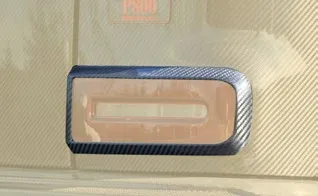
Rear light protection cover for Mercedes G-class W463A Gronos


Rear Light Protection Cover for Mercedes G-Class W463A Gronos
The W463A's rear light clusters are tall, vertically oriented units that occupy the upper corners of the tailgate and rear quarter panel — a position that makes them simultaneously prominent in the rear elevation and vulnerable to impact from following vehicles in tight traffic. The factory rear lamp housings are exposed acrylic-faced units without external protection. The Rear Light Protection Cover from the Mansory Body Kit for Mercedes G-Class W463A Gronos addresses both the visual and practical dimensions of this zone — it is a carbon-fibre surround that frames the rear lamp cluster's outer and lower edges in visible carbon, providing a degree of impact protection against low-speed following-vehicle contact while integrating the Gronos programme's material language at the rear-corner zone that flanks the tailgate and completes the W463A's rear elevation specification.
Construction & Materials
The Rear Light Protection Cover is a carbon-fibre overlay frame that mounts around the rear lamp cluster's outer perimeter. The cover retains the full rear lamp aperture — brake, tail, indicator, and reversing lamp faces remain unobstructed — and frames the cluster outer and lower edges with a 20–30 mm carbon face width. The inner profile of the frame is machined to a close clearance fit over the OEM rear lamp housing's mounting flange, seating firmly against the flange without rattle or movement. Mounting is via 3M VHB adhesive pads at the frame's inner contact face, with no mechanical fasteners penetrating the rear panel or lamp housing.
- Material: 3K twill prepreg carbon, autoclave 120 °C / 4 bar
- Cover frame width: 20–30 mm around the outer and lower cluster perimeter
- Lamp aperture: fully retained — brake, tail, indicator, and reversing light faces remain unobstructed
- Mounting: 3M VHB adhesive pads at inner frame contact face — no penetration of rear panel or housing
- Clearcoat: dual-layer UV-stable gloss lacquer on outer face; satin/matte on request
- Weight per cover: approximately 55–80 g per cover — negligible
- Supplied: pair (LH and RH rear lamp positions)
Design & Visual Function
The rear lamp cluster on the W463A defines the corners of the rear elevation — two tall, rectangular units that flank the tailgate and the spare wheel. Adding a carbon frame to these clusters creates a visual parallel to the carbon headlight surrounds at the front face, establishing a programme coherence between the front and rear face corner treatments. A W463A specified with carbon headlight covers at the front and carbon rear lamp surrounds at the back reads as a vehicle where every corner has received the same Mansory material intent — a full perimeter Gronos treatment that is visible from any approach angle.
The protection function of the cover frame is secondary to its visual role but real: the 20–30 mm carbon border around the lower and outer cluster edges intercepts low-energy contact from reversing-vehicle proximity events and carpark corner grazing that would otherwise scuff or crack the OEM acrylic lamp face. The carbon frame's laminate absorbs these low-energy impacts elastically in most cases and is much easier to replace — if a cover is damaged — than the OEM lamp housing assembly, which requires full electrical disassembly and a replacement housing from the dealer.
Compatibility & Fitment
Rear Light Protection Cover fits Mercedes-Benz G-Class W463A 2018 to present, G63 AMG and G500/G550. The rear lamp housing outer flange geometry is the same across LHD and RHD body configurations. Post-2024 facelift W463A: the revised LED graphic cluster updated the internal lamp segment pattern but retained the same outer housing flange geometry — these covers fit all W463A production years. Not compatible with pre-2018 W463 rear lamp geometry.
Installation & Reversibility
Installation time is 10–15 minutes per cover. IPA-clean the OEM rear lamp housing's mounting flange outer face, apply the VHB pads to the cover's inner contact face, position the cover frame over the housing flange with the aperture centred over the lamp face, and press firmly for 30 seconds. Allow 24 hours for full VHB development. Removal with a plastic pry tool at the frame's rear edge does not damage the lamp housing. The cover is fully reversible.
Pairing within the Mansory Gronos programme
The rear lamp cover pairs with the rear-face components that complete the W463A's rear elevation. The Rear Door Panel provides the large carbon field at the door face between the two lamp clusters — the lamp covers frame the field's upper corners. For spare wheel zone framing, the Spare Wheel Cover II completes the rear-face carbon programme at the centreline between the lamp clusters. For rear-pillar continuity above the lamp clusters, the D-Pillar Cover II extends the Gronos carbon programme from the lamp cover upward to the D-pillar face and roofline.
Maintenance & Durability
The rear lamp frame's outer face is exposed to rear-hemisphere solar radiation from low-angle afternoon and morning sun that hits the rear face directly. Ceramic sealant applied to the frame face every 6–8 weeks provides UV protection and reduces the road-grime adhesion that accumulates on the rear face at lower-speed following-traffic distances. The VHB adhesive interface should be checked annually by pressing the frame edges — a hollow sound or flex under finger pressure indicates a VHB zone has released and requires re-bonding through the frame's removable spring-clip access. Inspect the frame's inner face contact at the lamp housing flange for any road salt accumulation between the frame and the housing flange surface that could wick moisture under the VHB pads over time.
The rear lamp frame's outer face receives afternoon and morning low-angle solar radiation that hits the W463A's rear face at an oblique angle — sunlight entering at under 30° of elevation strikes the rear face with a high surface-area exposure per unit of solar energy, which concentrates heat at the dark carbon clearcoat more rapidly than high-elevation midday sun. During extended parking in direct sun with the vehicle facing away from the sun, the rear lamp frame can reach surface temperatures of 60–70 °C on a summer afternoon. At these temperatures, the VHB adhesive remains within its operating range, but the clearcoat benefits from a protective sealant layer to prevent UV photochemical degradation in the resin surface layer. Apply a UV-blocking ceramic sealant rated for ≥200 °C operating temperature on the rear-face components before the first summer parking season.
The inner face of the cover frame — the surface in contact with the rear lamp housing flange — accumulates road spray that enters the gap between the frame inner face and the flange. This trapped spray contains dissolved road salt that deposits as the moisture evaporates, forming a mineral crust at the frame-to-flange interface. At the annual inspection, remove the cover by releasing the VHB with a plastic pry tool, clean the housing flange face and the cover inner face with IPA, and re-apply fresh VHB pads before refitting. This annual renewal of the VHB at the rear lamp frame interface removes any accumulated mineral crust and restores the full adhesive bond strength across all contact zones.
Lead Time & Warranty
Lead time for the Rear Light Protection Cover pair is 1–2 weeks from order. 12-month warranty against delamination, clearcoat adhesion failures, VHB bond failures, and dimensional fitment errors at the lamp housing flange interface.
FAQ
Q: Does the carbon cover obstruct any of the rear lamp's individual light functions?
A: No. The cover frames the outer and lower cluster edges only — the full lamp face aperture (brake, tail, indicator, reversing functions) is retained without obstruction.
Q: Will the cover affect the W463A's rear proximity parking sensor zone?
A: The rear parking sensors on the W463A are mounted in the rear bumper panel, not in the rear lamp housing. The lamp cluster cover does not affect any sensor functionality.
Q: Does this cover protect against shopping trolley contact damage?
A: The 20–30 mm carbon border provides meaningful protection against low-energy corner contacts at carpark speeds. However, the cover is a protective frame rather than a full-face shield — impact directly to the lamp face would still reach the OEM acrylic. The cover's primary value is at the housing perimeter where most carpark contacts occur.
Q: Can I specify the rear lamp cover in matte to complement a matte exterior wrap?
A: Yes — satin/matte clearcoat is available on the rear lamp cover outer face. Matte carbon framing against a matte body wrap creates a coherent all-matte rear-face specification.
Confirm W463A build year and specify finish with the Hodoor Mansory team: Contact us via WhatsApp +44 7488 818 747 or [email protected].