Rear bumper splitter Mansory carbon for Rolls-Royce Cullinan Coastline


Rear Bumper Splitter - Cullinan Coastline
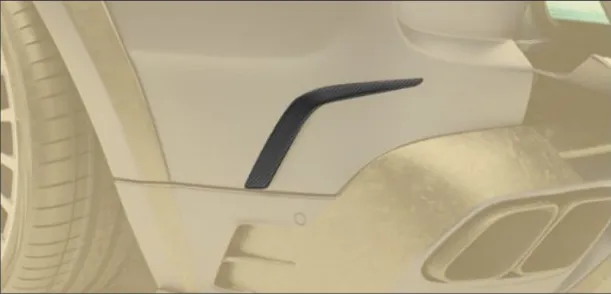
The Mansory Rear Bumper Splitter for the Rolls-Royce Cullinan Coastline is the carbon element that finishes the lower rear silhouette of the car - a sculpted blade that wraps under the bumper, frames the diffuser line and gives the tail visual depth without ever raising its voice. Within the broader Mansory Body Kit for Rolls-Royce Cullinan programme it sits directly below the rear bumper protective bar, finishing the lower geometry with a tasteful coachbuilt edge. The Cullinan is a 5.34 m, 2.66-tonne luxury SUV powered by a 6.75-litre twin-turbocharged V12 - everything Mansory adds at the rear has to read as Rolls-Royce first, performance edition second, and this splitter is calibrated to that rule. Owners who specify it want the lower bumper to feel resolved rather than added-to, and on cars with the air-suspension lift mode active, the splitter still keeps approach and departure clearances civilised.
Construction & Materials
The splitter is laid as a single bonded carbon component using Mansory's preferred autoclave-cured prepreg system, with internal ribs that tie the leading edge to the upper mounting flange so the part keeps its shape across full thermal range. The wall section is engineered for the role - thicker where the splitter projects below the bumper line, thinner across the rebated upper face where it nests against the OEM lower diffuser frame. Finish is bespoke: most Coastline owners specify the Mansory deep-gloss lacquer pulled into the same colour register as the rear bumper protective bar above it, so the two parts read as one continuous carbon arc; a smaller subset choose exposed weave with a hand-polished satin clear that catches the light at low angles.
- 3K twill weave on outer face, 2K plain weave on inner reinforcement plies for stiffness without bulk
- Autoclave prepreg cure - typical cycle around 120 deg C / 6 bar - controlled fibre alignment along the leading edge
- Wall thickness 2.4-3.6 mm, ribbed upper flange to resist deflection at motorway speeds
- Component mass approximately 2.6-3.1 kg depending on lacquer build and reinforcement spec
- Stainless threaded inserts moulded into the carbon backbone, marine-grade fasteners, captive nuts on the upper flange
- Finish menu: Mansory deep-gloss lacquer (paint-matched or contrast), satin lacquer, hand-polished exposed weave with UV-stable clear
- Optional inner shadow line in matte black for cars where the owner wants the splitter to recede visually
- UV-stable topcoat across all finishes - the splitter sits low and catches reflected sunlight off the road surface, so UV protection is not optional
Design & Visual Function
Visually the splitter does the same job a base moulding does on bespoke cabinetry - it gives the lower volume a defined edge and a shadow gap. On the Cullinan that matters because the rear bumper is tall and the OEM lower diffuser line, while well-resolved, can read as flat in profile photographs and from the pedestrian eye-line of a hotel forecourt. The carbon splitter introduces a horizontal cut that lets light fall away into the lower diffuser cavity and aligns its outboard edges with the rear-bumper-protective-bar above so the tail reads as one continuous carbon band rather than two unrelated additions.
Aerodynamically the splitter is honest about its scope. It is not a track-day component. What it does, modestly, is manage the vortex shedding that the broad Cullinan rear surface generates at sustained motorway speeds - the leading edge encourages the lower air column to stay attached slightly longer before it spills under the diffuser, which trims a small amount of low-frequency turbulence noise inside the rear cabin. The dominant role remains visual; the 6.75-litre twin-turbo V12 has more than enough surplus to render any drag delta meaningless. What matters is that the splitter does not disturb the V12's exhaust signature or the Cullinan's signature waftability at low speed.
Geometry-wise the splitter has been designed to sit low without inviting trouble. Cullinan ride height is adjustable through air suspension, and the lift mode raises the axles enough to clear reverse-camber crests, ferry ramps and cobbled hotel courtyards. The lower lip has been calibrated to match the bar above so that, with lift mode engaged, departure-angle clearance remains within OEM tolerances.
Compatibility & Fitment
This splitter is fitted to the Rolls-Royce Cullinan from 2018 onward, in both Standard and Black Badge specifications, and is intended to live within the Coastline carbon family rather than as a one-off addition. It is engineered around the Cullinan's specific rear bumper geometry, lower diffuser cavity, parking-sensor cluster and rear-camera housing - it will not fit a Phantom or a Ghost. Designed to coexist with the OEM rear-view camera, parking sensors, two-piece tailgate (clamshell) operation, towing-eye access cover and air-suspension self-levelling sensors. It plays directly with the rear-bumper-protective-bar above it, but it is also a logical specification on cars that already wear the rear-decklid-spoiler-exposed and roof-spoiler-exposed parts, since those upper carbon elements are what most clearly demand a finished lower edge to balance the rear silhouette. Coachbuilt cars with the lounge rear seating configuration are no different to fit - the splitter does not interact with the cabin or the boot floor.
Installation & Reversibility
Plan on roughly 2.5-4 hours for installation when the splitter is fitted alongside the rear-bumper-protective-bar and slightly less when fitted on its own. The work is exterior-only: the upper flange of the splitter mounts to the OEM bumper substructure using the existing diffuser-frame fastener pattern, with stainless inserts in the carbon allowing torque-controlled fastening without crushing the laminate. Surface preparation - degreasing, masking the lower bumper edge, gentle scuff of the bonding strip if a structural adhesive bead is being used - is the bulk of the time, and a Rolls-Royce-certified body shop or Mansory-trained installer will be familiar with the routine. Reversibility is good: there are no destructive cuts to the OEM bumper, no permanent splice to vehicle wiring, no impact on the rear-camera or parking-sensor calibration. If the car is later sold and the new owner prefers a more discreet rear, the splitter unbolts and the OEM lower diffuser frame returns visible without remediation. Where a paint-matched finish is specified, an OEM-grade refinish booth and the right primer / clearcoat schedule are essential - this is not a workshop driveway job.
Pairing within the Mansory Cullinan Coastline programme
The splitter is a finishing component, so it is at its best when it has carbon to talk to. The most natural companion is the upper bar it lives below - Rear Bumper Protective Bar - which closes the rear bumper into a continuous carbon arc and gives the tail its full Coastline signature. Owners who are committing to the full rear treatment also typically specify the Rear Decklid Spoiler (Exposed) on the upper tailgate so the carbon language carries from roof line to road. For symmetry around the rear arches and a properly resolved transition out to the wheels, the Air Outtakes Splitter finishes the lower flank where the rear quarter meets the bumper - together those three parts make the rear three-quarter view feel coachbuilt rather than accessorised.
Maintenance & Durability
Carbon care on a low-mounted part is mostly about respecting that it lives close to the road. Wash with pH-neutral shampoo and a clean lambswool mitt; avoid alkaline traffic-film removers, ammonia-based cleaners and stiff brushes - all three will dull lacquered carbon over time and can micro-cloud an exposed-weave clear if used aggressively. A two-layer ceramic coat on the lacquered surface is the sensible default for owners who park outdoors at all; a soft carnauba is fine for show cars that live in climate-controlled storage. The splitter sees the highest rock-chip exposure of any rear carbon part on the car, simply because it sits closest to the surface debris kicked up by the rear axle - we strongly recommend an 8-mil PPF wrap across the leading and lower faces. PPF is invisible on lacquered finishes and only very subtly visible at glancing angles on exposed weave; on a Cullinan that does any school-run, gravel-driveway or motorway use it pays for itself in two seasons. If a chip ever does reach the carbon, a Mansory-trained refinisher can re-laminate and re-clear locally without removing the part - but PPF prevents most of these calls.
Lead Time & Warranty
Build lead time runs 4-8 weeks because every splitter is laid up, cured and finished to the individual order - the carbon spec, the lacquer colour register, the optional inner shadow line, the matched-or-contrast question against the protective bar above are all decided per car. The component carries a 12-month manufacturer's warranty against laminate or finish defects, separate from the workmanship warranty offered by the installing body shop on the fitment itself.
FAQ
Q: Does the splitter fit Standard Cullinan and Black Badge equally?
A: Yes - both share the same rear bumper geometry, lower diffuser cavity, parking-sensor cluster and rear-camera housing, so the splitter fits both without modification. Black Badge cars commonly specify the contrast-lacquer treatment to read against the darkened brightwork.
Q: How does it interact with the Cullinan air suspension and lift mode?
A: It is engineered around the OEM ride-height envelope. With lift mode engaged for ramps, ferry transitions and steep driveways the splitter clears comfortably. On standard ride height it sits closer to road plane and reads as the visual base of the rear silhouette - which is precisely the point.
Q: Can it be fitted without the protective bar above it?
A: Mechanically yes, visually we would urge against it. The splitter is a finishing detail: without the carbon above, the lower edge can read as orphaned. Most owners specify them together so the rear bumper reads as one continuous carbon arc.
Q: Will it affect parking sensors, rear camera or tow-eye access?
A: No - the splitter is engineered around the OEM sensor field, the rear-camera washer line where fitted, and the tow-eye access cover. No recalibration is required and the clamshell tailgate operates exactly as factory.
Q: How vulnerable is it to kerbing or speed bumps?
A: Less than its position suggests, because the air suspension lift mode is generous and the splitter has been geometry-calibrated to live within OEM clearance tolerances. PPF on the leading and lower faces is the recommended belt-and-braces - that, plus engaging lift mode at known transitions, makes daily-use kerbing very rare.
Q: Lacquered finish or exposed weave - which ages better?
A: Both age well when looked after; the deep-gloss lacquer is more forgiving of minor abrasion because it can be re-cleared without disturbing the carbon, while exposed weave with a hand-polished satin clear gives the more bespoke, hand-finished read at the cost of slightly more attentive care. Most Coastline owners choose lacquered for its coachbuilt continuity with the bar above.
The splitter is the last carbon detail at the rear of the car - get it right and the Cullinan Coastline reads as a single, intentional volume from roof to road. Pair it with the protective bar above and the decklid spoiler on the tailgate to complete the rear silhouette in one specification. WhatsApp +44 7488 818 747 or [email protected].