
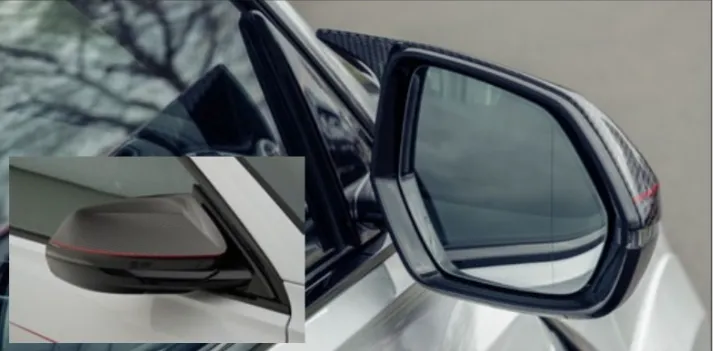
New mirror housing Mansory Carbon for Audi RS Q8


New Mirror Housing Mansory Carbon for Audi RS Q8
The updated revision of the Mansory carbon mirror housing pair takes over the door-mounted aero-side surface of the facelift Audi RS Q8 — the post-2023 Performance generation that introduced revised camera optics, a recalibrated side-assist radar window and the Bang & Olufsen sensor pod on the mirror leg. Inside the wider ''' + parent_title + ''' programme, this housing replaces the OEM body-colour shell with autoclave-cured prepreg carbon while preserving every electrical and electronic function of Audi's flagship 600 hp V8 biturbo SUV-coupe — heated glass, auto-fold servo, blind-spot LED, side-assist radar, kerb-view camera and puddle lamp. It is a small surface in absolute area, but on a 2,315 kg car wearing 22-inch or 23-inch wheels and an aggressive Mansory bumper, the door-line carbon ties the visual story together.
Construction & Materials
Each shell is laminated from prepreg carbon over an internal CNC-machined master that mirrors the OEM Audi mirror cap geometry to within fractions of a millimetre. The lay-up is engineered for the new facelift cutout pattern — the side-assist radar window sits at a slightly different angle on the 2024+ housing than on the original revision, and the kerb-view camera lens has a larger optical clearance to suit the higher-resolution module fitted with the B&O option. The shell is autoclave cured under heat and pressure, demoulded, trimmed on a five-axis router and finished by hand.
- Material: 3K twill prepreg carbon over an EPS / closed-cell core; outer ply weave-aligned to the door body line so the diagonals continue the visual flow from the front fender into the door
- Cure: autoclave at controlled temperature and pressure ramp; full post-cure for dimensional stability under direct summer sun
- Wall thickness: 1.6–2.0 mm in the main shell, locally thicker around the camera bezel and the radar window to lock the cutout geometry
- Weight per pair: approximately 0.78 kg vs roughly 1.45 kg for the OEM body-colour shells — a meaningful unsprung-mass reduction on the door panel
- Mounting: factory clip pattern retained; OEM Audi heated-mirror connector untouched; auto-fold servo loom passes through the original grommet
- Finish: high-build clear lacquer over UV-stable resin, gloss as standard; satin matte clear and Mansory soft-touch raw weave on request
- Edge bevels: rolled visible edge along the trailing lip of the housing — a Mansory signature that lets light catch the carbon weave on door open
- Hardware kit: replacement clips and a small tube of OEM-spec cap-edge sealant included
Design & Visual Function
Mirror housings are the closest carbon part to the driver's eyeline. On the RS Q8 they sit at the boundary between the upper door shoulder and the wheel-arch flare, in direct view of every walkaround and every social-media still. The new revision keeps the original silhouette — the Mansory programme deliberately retains OEM mirror proportions because the side-assist sweep is calibrated to that volume — but reworks the cutouts and the internal mounting plane to suit the 2024+ Performance housing. The kerb-view camera bezel is rebuilt to take the wider lens; the side-assist radar window is angled to match the recalibrated sensor; the lower vent for the heated glass element is preserved to protect the mirror motor.
Visually the part rewards close inspection. The 3K twill is laid so the diagonals continue the line that runs from the front fender carbon panel through the door pull and out to the C-pillar — Mansory weave alignment is not a marketing line, it is a manufacturing rule, and the new housing follows that rule on both sides as a mirrored pair, not two identical shells. The trailing edge carries a hand-rolled bevel that catches reflected light and reads as carbon even at twenty paces; the front nose of the housing remains soft and rounded so it does not shout against the painted door skin.
On a finished facelift RS Q8, the new mirror housing pulls the door surface into the same conversation as the front fender carbon panel and the engine bonnet — three exposed-weave moments along the upper third of the car that lift the eye away from the body-colour mass and onto the Mansory programme. It is the smallest of those three pieces, and arguably the one that does the most work per gram.
Compatibility & Fitment
This housing is engineered specifically for the Audi RS Q8 (4M chassis) facelift Performance generation from 2024 onward — the updated bumper cars with the revised LED matrix headlight signature and the Bang & Olufsen sensor option. Owners of pre-facelift RS Q8 cars (model years 2020–2023) should specify the original mirror housing instead, which is offered as a separate part within the Section A roster: the camera and radar cutouts on the earlier shell are positioned for the original sensor module and will not align to the facelift hardware. Both LHD and RHD cars are supported; the mirrors ship as a left/right pair from a single moulding family. OEM heated-glass connector and auto-fold servo are retained without modification; blind-spot indicator LED window is preserved with its OEM lens; the side-assist radar pass-through is matched to the facelift dielectric window; puddle-lamp aperture is open and unobstructed.
Installation & Reversibility
Mirror housings are one of the most DIY-friendly Mansory carbon parts on the RS Q8. Total time on a flat, dust-free workbench is around 25–35 minutes per side. Fold the mirror in service mode, release the OEM cap from its clip pattern with a soft trim tool starting at the lower outboard corner, transfer the heated-glass and indicator harness to the new shell, seat the new housing into the same clip points and confirm the fold cycle still completes cleanly with the door open. No drilling, no cutting, no resealing. The OEM cap can be refitted later without trace, which protects residual value if the car is sold.
Recommended workflow: lift the RS Q8 to the highest air-suspension setting before opening the doors fully so the lower edge of the mirror cap clears the door-shut line, and work in shade — direct sun on a black mirror motor housing makes the heat-set adhesive on the original cap behave unpredictably. The replacement housing arrives finish-ready; no paint or primer prep is required.
Pairing within the Mansory RS Q8 programme
The new mirror housing belongs to Section A — the genuine Mansory Carbon roster — and pairs naturally with siblings from the same line. The most direct cross-reference is the original revision of the same part, Mirror Housing Mansory Carbon for Audi RS Q8, which suits 2020–2023 pre-facelift cars; the new revision documented here is the post-2023 facelift answer with revised camera and radar cutouts. For sidewall continuity along the door-and-fender line, specify it together with Front Fenders with Logo Mansory Carbon for Audi RS Q8, which carries the same 3K twill alignment and the embedded Mansory logo. To complete the upper-third visual triplet, add the Engine Bonnet Mansory Carbon for Audi RS Q8 — bonnet, fenders and mirror caps then form a coherent carbon ribbon along the car's shoulder line.
Maintenance & Durability
Lacquered carbon on a mirror housing lives a hard life. It sits in the airflow at speed, takes the brunt of fingertip contact during washes, and is the first surface a careless car-park door reaches. Two ceramic-coat layers from new keep the lacquer hydrophobic and slow UV penetration into the resin; an annual top-up keeps the depth of field in the weave alive for years. Avoid ammonia-based glass cleaner overspray onto the housing — ammonia softens lacquered carbon over time and shows as micro-clouding under angled light. Alkaline wheel cleaners that drift up the door from a high-pressure rinse are equally unkind; rinse the door skin with fresh water before any chemical wheel work. Stone-chip damage on the leading edge of the housing is repairable in situ by a competent carbon specialist — the autoclave laminate is structurally generous around the nose for exactly that reason. Expected service life with consistent ceramic-coat care exceeds eight years before any cosmetic refresh.
Lead Time & Warranty
Lead time runs 4–8 weeks from order confirmation. Mansory's autoclave bookings for the RS Q8 facelift housing are scheduled in batches alongside other Section A parts, which keeps weave-batch consistency tight across pairs. Soft-touch matte clear and raw-weave variants add roughly two weeks to lead time. Every housing carries a 12-month warranty against laminate defects, delamination, lacquer failure under normal use and clip-fit anomalies. Contact us before installation if any feature appears off-spec — fitment-stage replacements are handled directly without dispute.
FAQ
Q: Will the new revision fit my 2022 RS Q8?
A: No — the new revision is engineered for 2024+ facelift Performance cars with revised camera and radar geometry. For a 2022 car, specify the original Mirror Housing Mansory Carbon for Audi RS Q8.
Q: Is the side-assist radar still compatible after fitment?
A: Yes. The radar window in the new housing uses the same dielectric pass-through specification as the OEM facelift cap, calibrated for the 2024+ side-assist module. No recalibration is required.
Q: Does the auto-fold function still work?
A: Yes. The OEM auto-fold servo and harness are retained without modification; the housing seats onto the same clip pattern and the fold cycle completes within OEM travel limits.
Q: Can I refit the OEM caps later if I sell the car?
A: Yes. Installation is fully reversible — no drilling, no cutting, OEM caps refit without trace.
Q: How much weight does the pair save versus OEM?
A: Approximately 0.67 kg across the pair — a noticeable saving on a high-mounted body panel and a small but real contribution to door-mass reduction.
Q: Lacquered gloss or raw matte — which holds up better?
A: Lacquered gloss is the more forgiving finish for daily driving; raw matte reads more aggressive but demands stricter ceramic-coat discipline to keep its appearance over time.
Pair the new mirror housing with the front fenders and the engine bonnet to complete the upper-shoulder carbon line on your facelift RS Q8. To order, confirm specification or check current lead time, contact us on WhatsApp +44 7488 818 747 or [email protected].