Mirror II. housing LHD Mansory for Mercedes-AMG S63E


Mansory Mirror 2 Housing LHD for Mercedes-AMG S63E
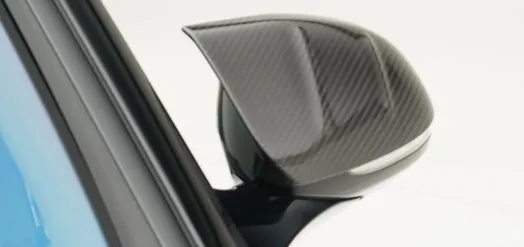
The Mirror 2 housing is a full-replacement carbon door-mirror shell — not a clip-on cover but a complete housing that takes the OEM mirror's electrical heart (motors, glass adjuster mechanism, surveillance camera, side indicator, heater) into a Mansory-engineered carbon outer shell. Variant 2 is the more sculpted of the two housing options in the Mansory programme, with a deeper visible-carbon shoulder and a sharper trailing edge than Variant 1. On a long-wheelbase W223 saloon the door mirror is a primary visual element of the side surface — it sits at eye height and at the threshold between the door and the windscreen, so its character disproportionately shapes how the side of the car reads. The carbon shell replaces a body-painted plastic shell with a lacquered carbon housing that adds visual depth and a refined material story to the door shoulder. It is part of the parent Mansory Carbon Fiber Body kit set for Mercedes-AMG S63E.
Construction & Materials
A full-replacement housing must accept all the electromechanical interior of the OEM mirror at OEM-tight tolerances. The Mansory carbon shell is dimensioned with CNC-machined inner clip pockets that mate to the OEM motor housing carrier, and the cure schedule is tighter than for a clip-on cover.
- 3K 2×2 twill A-side cosmetic skin (forged-look option, 2K plain weave option)
- Pre-preg vacuum-bag autoclave cure at 130 °C, multi-axial fibre orientation
- Wall thickness 1.6–2.0 mm in the show face, 3.0–3.6 mm at the OEM motor-carrier mount points
- Net dry weight 0.27–0.36 kg per side (vs ~0.4 kg for OEM painted plastic)
- CNC-machined inner clip pockets for OEM motor-carrier retention
- OEM surveillance-camera aperture and side-indicator LED slot moulded into the shell
- Heat-stable 2K clear lacquer; OEM mirror-glass clears the carbon's inner cone with 4–6 mm tolerance
- Side-specific (LHD): the housing is mirror-image with Variant 2 RHD if specified separately
Design & Visual Function
Variant 2's deeper sculpted shoulder draws the eye upward along the door mirror — the visible carbon shoulder is a defined line that runs from the windscreen base outward to the mirror's leading edge, which gives the saloon's side surface a kinetic character that a body-painted OEM shell simply does not produce. From three-quarter angles the mirror reads as a deliberate carbon accent integrated into the door shoulder; from directly behind the driver's window the mirror's silhouette is visibly more pronounced than the OEM line, but only by a degree appropriate to a luxury saloon — it does not stray into coachbuilt territory.
The 3K twill is biased so the diagonals run rearward from the leading edge toward the door, suggesting motion away from the cabin and into the side surface. That bias is consistent with the rest of the Mansory exterior programme — front splitter, side-skirt lip, decklid spoiler all share the same kinetic axis — and it is what gives the carbon palette across the saloon a coherent visual logic rather than a collection-of-parts feel.
The OEM AMG-spec surveillance camera (where fitted on AMG Multibeam-equipped cars) projects through a moulded aperture at the lower-front face of the housing; the side-indicator LED slot is a sealed, sloped aperture moulded into the upper-rear face. Neither aperture interrupts the visible carbon weave because the apertures sit on natural panel-shadow edges where the housing's surface curvature already changes.
For AMG Night Package cars, satin lacquer keeps the mirror in the same low-reflectivity register as the AMG-spec blacked-out trim. AMG Carbon Package cars typically choose gloss for visual continuity.
Compatibility & Fitment
Engineered for Mercedes-AMG S 63 E PERFORMANCE (W223), 2023+, saloon — LHD only. RHD cars require the mirror-image housing variant which is supplied separately. The full-replacement housing accepts the OEM mirror motor, glass adjuster, OEM surveillance camera (where fitted), side-indicator LED, and OEM heater. AMG Night Package and AMG Multibeam Active LED Side-camera options are supported. The OEM door-shut line and door-glass seal are unaffected because the housing's inboard return matches the OEM mirror-base profile within ±0.5 mm.
Installation & Reversibility
Plan 35–55 minutes per side. Required tools: Torx and 8 mm sockets for the OEM mirror dismount, plastic trim picks for releasing the OEM glass and motor carrier, isopropyl alcohol, low-tack masking tape. Workflow: dismount the OEM mirror at the door, release the OEM mirror glass (typically a four-point clip at the carrier centre), unbolt the OEM motor carrier from the OEM shell, transfer the carrier to the Mansory carbon shell using the CNC-machined inner clip pockets, route the OEM camera/indicator/heater looms through the moulded apertures, snap the OEM glass back onto the motor carrier, remount the assembled mirror to the door. Reversibility is full — the OEM motor carrier can be returned to the OEM shell at any time without modification of either part.
Pairing within the Mansory Mercedes-AMG S63E programme
Most often paired with the Mirror 1 cover LHD for owners who want a less sculpted register on the opposite-side mirror, with the Sport outtake for front fender for visual continuity at the door shoulder, and with the Logo for grille mask to coordinate the front-mask and side-fender carbon presence.
Maintenance & Durability
Mirror housings collect bug strike, road salt, and bird-strike — the side-of-car position means they are washed every time the car is washed, but the upper-rear face fades fastest because it is the most UV-exposed face on the housing. Apply a UV ceramic top semi-annually. Hand-wash with pH-neutral shampoo and a plush noodle mitt. Avoid the OEM mirror-glass surface contact during housing wash — water with grit at the glass-to-housing seam will scratch the OEM glass over time. Bug residue should be removed with a dedicated bug-removal product within hours rather than days; sustained dwell of bug acid will haze the lacquer over months. Cosmetic-finish lifespan: 8–11 years given the part's UV-exposure profile.
Lead Time & Warranty
Production turnaround: 4–6 weeks. The full-replacement housing requires more dimensional verification than a clip-on cover, and the cure schedule is tighter to maintain the OEM motor-carrier clip-pocket tolerances. Custom finishes (matte, satin, forged-look) extend by roughly one week. Warranty: 12 months against manufacturing defects — delamination, voids, fitment, clip-pocket dimensional accuracy, clear blistering — running from delivery date. Outside warranty: bird-strike etch, parking-cover-rub damage, chip propagation, and damage from incorrect motor-carrier transfer at install. Each housing ships in an individual foam-lined box with the QC photograph documenting weave alignment and clip-pocket dimensional verification under raking light; the OEM motor carrier is not supplied — it transfers from the donor mirror at install.
FAQ
Q: Is this housing compatible with RHD cars?
A: No — this is the LHD housing. RHD cars require the mirror-image variant supplied separately.
Q: Is the OEM AMG-spec surveillance camera retained?
A: Yes. The OEM camera transfers to the Mansory carbon shell through a moulded aperture; OEM functionality is preserved.
Q: Is the OEM heater retained?
A: Yes. The OEM heater carrier and wiring transfer with the OEM motor carrier; cabin button behaviour and OEM heating performance are preserved.
Q: Does the housing's mass affect mirror-vibration at high speed?
A: No. The housing is lighter than the OEM painted plastic shell by roughly 40–60 g, so vibration response is marginally improved rather than degraded.
Q: How does Variant 2 differ from Variant 1?
A: Variant 2 has a deeper sculpted shoulder and a sharper trailing edge; Variant 1 is closer to the OEM silhouette. Owners who want the strongest visual delta from OEM choose Variant 2.
Q: Does the housing affect the side-indicator LED projection?
A: No. The OEM LED slot is moulded into the shell at the OEM angle.
Q: Will the OEM mirror-folding mechanism continue to work?
A: Yes. The OEM motor carrier transfers complete with the folding actuator and limit-switch loom; cabin-button behaviour and folding speed are preserved.
Q: Does the housing affect cabin NVH at high speed?
A: No. The reduced shell mass marginally improves vibration response; cabin acoustics are dominated by the OEM glazing and door seals, neither of which the housing touches.
Pair the Mirror 2 housing LHD with the opposite-side housing or with the more restrained Mirror 1 cover for a coordinated door-shoulder carbon programme. To configure your build, message WhatsApp +44 7488 818 747 or write to [email protected].