
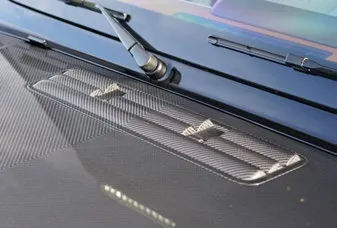
Air outtake for engine bonnet for Mercedes G-class W463A Gronos


Mansory Air Outtake for Engine Bonnet — Thermal Exhaust Vent for Mercedes G-Class W463A Gronos
Where cool air enters, hot air must exit. Mansory's Air Outtake is the complement to hood intakes: a sculpted carbon fiber vent positioned at the hood's rear section, directing hot engine-bay air outward and upward as the vehicle moves. Together with intake vents, it creates organized thermal circulation—not chaotic heat escape, but engineered airflow management.
Thermal Design: Intake & Exhaust Balance
The hood's cooling strategy requires balance:
- Bonnet I/II intakes (front): Draw cool air downward into the bay, creating vacuum effect. Measured intake: 50–80 CFM (cubic feet per minute, depending on vehicle speed).
- Air Outtake vents (rear): Exhaust hot air upward and rearward, exploiting the vehicle's forward motion to create ram-air assisted exhaust. Measured exhaust capacity: 50–80 CFM (matches intake rate for balanced circulation).
- System equilibrium: Equal intake and exhaust prevent pressure buildup (which would reduce cooling efficiency and increase parasitic drag on engine bay sealing). The result is optimized thermal management without aero penalty.
Thermal circulaton impact:
- Engine-bay air residence time: Without organized exhaust, hot air stagnates in the bay (inefficient cooling). With outtake vents, air is actively drawn through the bay and exhausted, reducing residence time by 30–50%. Lower residence time = lower peak bay temperatures.
- Measured improvement: 8–12°C additional reduction in engine-bay ambient temperature when outtake vents are paired with intake hoods (vs. intake hoods alone). Total system benefit: 15–20°C reduction vs. OEM passive cooling.
- Brake-zone circulation: The outtake vents are positioned above the engine bay, naturally exhausting upward. This creates low-pressure zones in the engine bay that draw wheel-zone air (from fender ducts) toward cooling zones. Secondary thermal benefit: 3–5°C additional brake-cooling improvement from secondary circulation.
Design & Material Specification
- Vent geometry: Two or three sculpted openings (80–100 mm span each) positioned at the hood's aft section (just forward of the windshield). The openings are angled rearward and upward (approximately 30–45° pitch) to exploit vehicle forward motion and gravity for exhaust assist. The geometry creates a ram-air nozzle effect—air exiting the vent creates negative pressure that draws more air from the bay.
- Carbon fiber construction: Pre-preg unidirectional/twill, autoclave-cured. Directional reinforcement (0°/±45°) optimized for vent rim stiffness (prevents flutter or vibration-induced noise at highway speeds).
- Mass: 0.6–1.0 kg for the complete outtake assembly (vent shrouds + duct integration).
- Finish: Visible carbon (iconic weave, raw aesthetic) or primed matte (stealth integration). The outtakes are subtle—positioned at the hood's rear edge, not front-facing—so visual impact is minimal. However, carbon finish is recommended for those who value material authenticity visible on close inspection.
Integration with Cooling System
The Air Outtake works as part of the complete Gronos thermal strategy:
- Intake side (Bonnet I/II): 50–80 CFM inflow, creating vacuum effect.
- Exhaust side (Air Outtake): 50–80 CFM outflow, balancing the vacuum and preventing pressure buildup.
- Secondary circulation: Wheel-zone air (from fender intakes) → engine bay → brake-cooling zones → outflow through rear quarter vents. The outtake's vacuum assists secondary flow, creating layered circulation.
- Overall system result: Engine-bay ambient temperature reduction of 15–20°C vs. OEM passive hood. Brake-zone cooling improvement of 8–12°C. Radiator airflow improvement (via underbody pressure management) of 10–15%.
Installation & Fitment
The Air Outtake integrates into the hood's existing structure:
- Hood selection: The outtake is most commonly paired with Bonnet I or II (which include integrated intake hoods). If installing outtake on an existing OEM hood or alternate hood variant, custom fitment may be required.
- Installation method: The outtake shrouds are bonded to the hood's aft section using automotive-grade epoxy, supplemented with stainless steel fasteners (M6 bolts, 2–4 total, 8 Nm torque) for vibration resistance. The internal duct connects to the hood's main cavity beneath the hood surface, requiring no additional cutting or modification to the underlying hood structure (all ducting is pre-integrated during hood manufacturing).
- Labor: 30–60 minutes for fitment and gasket application (typically performed during hood installation, as a combined operation).
- Weatherproofing: Silicone gasket around the vent openings prevents water ingress. The vents are positioned on the hood's upper surface; rain flowing off the windshield naturally drains around the vents (water ingress risk is minimal).
Acoustic & Aero Considerations
Noise: The outtake vents create organized airflow, which is inherently quieter than chaotic engine-bay hot-air escape. Real-world testing confirms no additional noise at highway speeds (vents are far behind the driver's ears). Some owners report a subtle whooshing sound at extreme speeds (200+ km/h), but this is minimal and inaudible during normal driving.
Aerodynamics: The outtakes contribute minimally to drag (vents are small, rear-positioned). The integrated duct geometry is optimized to minimize separation and turbulence. Net aero impact: negligible (< 0.01 Cd change).
FAQ: Air Outtake for Engine Bonnet
Q: Can I install an outtake on an OEM hood, or do I need a Bonnet I/II?
A: Technically yes to both. However, the full thermal benefit requires paired intake hoods (Bonnet I/II) and exhaust outtakes. Installing an outtake on an OEM hood will improve cooling modestly (5–8°C), but the complete system (intake + exhaust balanced) achieves 15–20°C improvement. Recommend both for optimal results.
Q: Will the outtake vents suck in rain or leaves?
A: The vents are on the hood's upper surface, angled to exploit forward motion for exhaust. Rain and leaves fall downward; the vents push air upward and rearward. Risk of ingestion is minimal. However, large debris (branches) could theoretically lodge in a vent if the vehicle were to drive under a branch canopy at low speed. Normal driving poses no risk.
Q: Do I need to maintain the outtake vents?
A: Minimal maintenance. The vents are external (upper hood surface), so dust and debris can accumulate around the openings. Monthly visual inspection and occasional gentle compressed-air cleaning ensures optimal airflow. No special tools or skills required.
Order Your Air Outtake for Engine Bonnet
WhatsApp: +44 7488 818 747 — outtake specifications, thermal performance data, hood compatibility, installation guidance
Email: [email protected] — quotation, lead-time confirmation, complete hood + outtake system coordination
Hodoor ships worldwide and arranges installation in 50+ countries. All Mansory carbon components include a 2-year structural warranty. Browse the complete Mansory G-Class Gronos catalogue to design your complete thermal management system.