
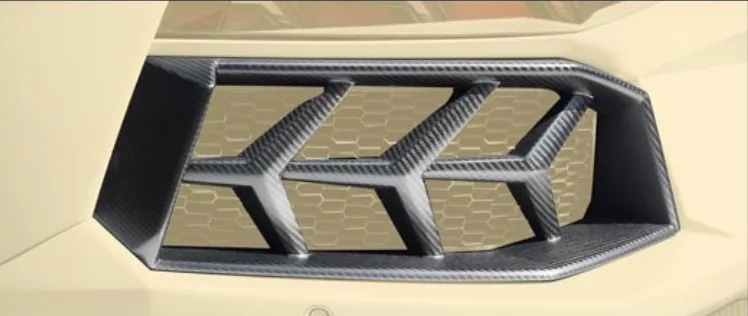
Rear bumper air outtake cover Mansory Carbon for Lamborghini Aventador Competition


Mansory Carbon Rear Bumper Air Outtake Cover for Lamborghini Aventador Competition
The rear bumper air outtake cover (variant I) is a louvred carbon accent panel that wraps the side exit slot on the Aventador rear bumper, channelling spent engine-bay air through a structured weave grille rather than an unfinished plastic cut-out. Within the Mansory Carbon Body Kit for Lamborghini Aventador Competition programme this piece sits at the lateral rear corner where the outgoing flow from the V12 bay meets ambient pressure beside the wheel arch. Owners specify it because the side outlet is the most visible heat-management feature on the Aventador rear, and a raw factory aperture undermines the surrounding carbon language. Variant I delivers the standard footprint that mates flush with both the Mansory rear bumper shell and the OEM Aventador LP, S, SVJ and Ultimae rear ends, on coupe and Roadster bodies, without intruding on ALA 2.0 channelling on SVJ specification cars.
Construction & Materials
The cover is laid up as a single-skin carbon-fibre composite with an integrated louvre array moulded into the panel face. Louvres are angled rearward to encourage extraction rather than ingestion, and weave alignment runs longitudinally along each blade so the twill pattern reads as continuous ribs when viewed from the rear three-quarter. The piece is autoclave-cured against a hard tool to keep the louvre pitch dimensionally tight against neighbouring bumper geometry.
Thermal stability matters here: the panel sits in the path of hot purge air leaving the engine compartment, so the laminate uses a high-temperature epoxy matrix rated to sustained service temperatures well above what a basic clear-coat motorsport panel would tolerate.
- Reinforcement: aerospace-grade 3K twill carbon, 245 g/m squared face ply
- Sub-structure: woven carbon backing with directional fibre under each louvre rib
- Cure: autoclaved prepreg, vacuum-bagged, post-cured for thermal stability around the V12 outlet
- Wall thickness: 1.6 to 1.9 mm at the perimeter, 2.4 mm through the louvre web
- Weight: approximately 0.55 to 0.7 kg per side, depending on lacquer build
- Mounting: factory bumper datum points reused, with supplemental high-temperature double-sided tape and butyl seal at the rear edge
- Finish options: high-gloss UV-stable lacquer, satin matte, or raw 2x2 weave with anti-UV clear
- Edge treatment: hand-deburred louvre slots and micro-radius on the visible perimeter
Design & Visual Function
This is a visual-function part: it does not generate downforce, but it shapes how the side outlet reads as a piece of design language and how the V12 hot-zone gases vent past the body. The Aventador locates its lower side outlet immediately ahead of the rear wheel arch shoulder, and OEM hardware leaves that aperture as a black plastic louvre that contrasts heavily with painted bodywork. Replacing it with a moulded carbon insert pulls the outlet into the same material story as the Mansory rear bumper and diffuser, so the entire rear corner reads as a single carbon panel sequence rather than a paint-plus-plastic compromise.
The louvre count and pitch are tuned so that, viewed from behind the car, the outlet still presents as a clearly vented surface rather than a closed cosmetic blank. Air leaving the engine bay carries thermal mass from the naturally aspirated 6.5-litre V12, and that mass needs an honest exit path. The cover preserves the OEM open area while reframing it; net inlet-to-outlet pressure differential through the bay is essentially unchanged. Weave runs along each louvre vane so light catches the twill from oblique rear angles and the panel retains the dimensional read that flat painted plastic can never match.
Variant I sits at the standard footprint. Variant II expands the outer perimeter to bridge the gap to the rear arch flare, so the size delta between the two is mostly a matter of how far you want the carbon accent to push outboard from the bumper centreline. Owners who want the outlet emphasised but not exaggerated stay with I; owners building a louder rear corner step up to II.
Compatibility & Fitment
The cover fits the Lamborghini Aventador across the LP700-4, LP750-4 SV, S, SVJ and Ultimae generations, in both coupe and Roadster body styles. It mates with the Mansory carbon rear bumper as the natural pairing, and it also retrofits onto the OEM rear bumper as an accent upgrade for owners who are not running the full Mansory rear shell. Pre-SVJ and SVJ rear bumper geometries differ slightly around the outlet aperture and the panel is supplied with the appropriate trim profile for the donor car. ALA 2.0 routing on SVJ runs through the centre and across the wing mast and is not affected by this lateral piece. Parking sensor and reverse-light cut-outs are unchanged because the panel sits outboard of those features. Rear-wheel-steering geometry under the bumper is also untouched, so steering rack travel and wheel-arch clearance remain at factory tolerance.
Installation & Reversibility
Fitment is at the lighter end of the Aventador Competition programme. Plan on roughly 30 to 60 minutes per side once the rear wheel is lifted and the wheel-arch liner is partly retracted to access the bumper rear edge. The cover seats onto factory datum points behind the outlet and is retained by a combination of the reused OEM clip locations and a fresh strip of high-temperature acrylic foam tape around the perimeter, with a butyl seal at the rear edge to prevent water tracking behind the carbon. Surface prep on the donor bumper is critical: the substrate must be solvent-wiped, fully dry and at room temperature before the tape activates, otherwise the panel will lift at the upper edge under heat cycling. Aventador body panels use methacrylate-bonded composites in places, so any adhesive in contact with the bumper substrate is chosen to remain inert against that chemistry. The job is reversible without damage to the OEM panel; removal requires gentle prying with a plastic wedge and a citrus-based adhesive remover for the tape residue. DIY fitment is realistic for an experienced owner, but a Mansory-trained installer or a Lamborghini-certified body shop is recommended if the cover is being installed alongside a full bumper swap.
Pairing within the Mansory Aventador Competition programme
The most natural companion is the matched rear shell at Mansory Carbon Rear Bumper for Lamborghini Aventador Competition, which gives the outtake cover its surrounding carbon canvas and ensures the louvre pitch reads as a deliberate continuation of the bumper geometry rather than a graft. Owners chasing a louder rear corner often step the same panel up to its larger sibling, the Rear Bumper Air Outtake Cover II, which extends the outer perimeter further toward the arch flare. To complete the underside read on the same axis, pair the cover with the Designed Diffuser so the rear face presents as a continuous carbon zone from outlet to undertray fences.
Maintenance & Durability
The louvre face traps brake dust and tyre-spray particulates more readily than a flat panel, so wash technique matters more than on a smooth piece. Use a soft long-bristle detail brush in the louvre slots, pH-neutral shampoo only, and rinse from the leading edge so debris flushes rearward through the vane angle rather than packing into the slot bases. Lacquered carbon survives well under a ceramic coat and benefits from one application annually if the car sees regular sun exposure; alkaline wheel cleaners, ammonia glass sprays drifting onto the panel, and abrasive pads will cloud the clear-coat and can leach pigment from the under-laminate over time. The panel sits adjacent to the V12 hot zone, so heat-soak after a circuit session is normal and the high-temperature matrix tolerates it, but avoid pressure-washing the panel while it is still hot from a session because rapid thermal contrast can stress the lacquer. Stone chips on the leading louvre rib can be touched in with a flowed clear-coat repair pen and flatted back; deeper damage to a vane is best handled by a carbon-trained body shop. Expected service life under reasonable care is well beyond a decade.
Lead Time & Warranty
Lead time is typically four to eight weeks from order confirmation, reflecting Mansory bespoke production cadence and finish-to-order lacquer scheduling. Each piece is hand-finished and weave-matched to the surrounding rear panels if it is supplied alongside a bumper or diffuser order. Warranty is twelve months against manufacturing defects in laminate, finish and mounting hardware.
FAQ
Q: Does this fit a pre-SVJ Aventador as well as an SVJ?
A: Yes. The panel is supplied trimmed for the donor bumper, and both pre-SVJ and SVJ rear-bumper geometries are supported across LP, S, SVJ and Ultimae cars.
Q: Will it work on the OEM Aventador rear bumper, or do I need the full Mansory rear shell?
A: It retrofits onto the OEM bumper as a standalone accent. Owners running stock rear panels often install just this cover plus the diffuser as an entry into the carbon programme.
Q: What is the difference between variant I and variant II?
A: Variant I matches the standard outlet footprint; variant II grows the outer perimeter to reach further toward the arch flare. The louvre architecture is shared; the size delta is a styling choice rather than a functional one.
Q: Does it block engine-bay heat venting?
A: No. The louvre open area is matched to the OEM aperture so net purge flow is preserved. The cover reframes the outlet visually without restricting hot-air exit from the V12 compartment.
Q: Can I order it in raw weave instead of gloss lacquer?
A: Yes. Gloss, satin and raw twill with anti-UV clear are all available; raw weave reads sharper at oblique angles but needs a ceramic coat to stay UV-stable.
Q: Does it interfere with ALA 2.0 on the SVJ?
A: No. ALA channelling runs through the centre rear-wing mast and over the wing surface, not through the lateral side outlet, so this lateral cover sits entirely outside the active aero path.
Pair the variant-I cover with a matched rear bumper and diffuser to lock the rear corner into one continuous carbon read. To order, talk to us on WhatsApp +44 7488 818 747 or write to [email protected].