
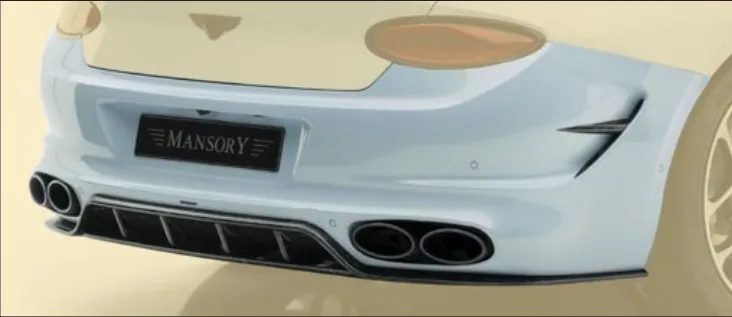
Rear bumper with diffuser II Mansory Carbon for Bentey Continental GT


Mansory Carbon Rear Bumper with Diffuser II for Bentley Continental GT (3W, 2003–2011)
Mansory engineers two rear diffuser configurations for the 3W Continental GT programme. Diffuser I is calibrated for road use — 12° expansion angle, four fins at 110 mm depth — delivering meaningful downforce without demanding track awareness. Diffuser II raises the aerodynamic ante: 16° expansion angle, five carbon fins, 135 mm extraction depth. The result is approximately 35–45% more rear-axle downforce at equivalent speeds versus Diffuser I, at the cost of approximately 15 mm less ground clearance at the lowest fin tip. This is the variant for owners who use the Continental GT at circuit events or high-speed tracks. This component is part of the comprehensive Mansory Carbon Fiber Body Kit Set for Bentley Continental GT programme for the 3W platform.
Construction & Materials
The Diffuser II shares the same 3K twill autoclave prepreg laminate and co-cure manufacturing process as Diffuser I, but the mould geometry differs substantially. The 16° expansion angle requires a deeper mould draw in the lower diffuser section; the additional fifth fin requires more precise layup management to achieve uniform fin thickness across all five ribs in a tighter channel width. Each fin is 1.2 mm thick at the tip — matching Diffuser I — but at 135 mm depth the fin experiences greater bending moment under aerodynamic load, managed through a slightly increased ply count at the fin root transition. The exhaust heat-shield area uses phenolic-modified prepreg rated to sustained 220 °C around the exhaust apertures, preventing resin softening and lacquer discolouration during sustained track driving.
Weight is approximately 6.1 kg — 0.3 kg heavier than Diffuser I's 5.8 kg, and a meaningful saving on the OEM polyurethane fascia at 8.4 kg. Ground clearance at the lowest fin tip at standard air suspension ride height is approximately 105 mm, versus 120 mm for Diffuser I. Normal and high air suspension modes provide adequate clearance for road use; the low mode should be used with awareness of the reduced diffuser-to-road margin at steep ramps or speed humps. Exhaust apertures are CNC-machined to exact specification — W12 6.0L twin-turbo quad-exit or V8 4.0L twin-turbo quad-exit — confirmed at order.
- Weave: 3K twill prepreg, autoclave co-cure, single laminate including all fins
- Diffuser expansion angle: 16° (vs 12° for Diffuser I)
- Fins: 5 carbon ribs, 135 mm extraction depth (vs 4 ribs at 110 mm for Diffuser I)
- Ground clearance: approx 105 mm at lowest fin tip at standard air suspension ride height
- Weight: approx 6.1 kg (vs OEM polyurethane approx 8.4 kg; vs Diffuser I approx 5.8 kg)
- Exhaust heat zone: phenolic-modified resin rated to 220 °C in aperture proximity
- Finish: gloss or satin clear lacquer on diffuser; primer or paint-match option for upper bumper zone
Design & Visual Function
Diffuser aerodynamics operate on the principle of pressure recovery: underbody air, accelerated by the venturi effect between the car's floor and the road, is decelerated and its pressure recovered as it exits through the diffuser. The rate of that pressure recovery is governed in part by the expansion angle. At 16°, the Diffuser II forces a faster, more aggressive pressure recovery than at 12°. In classical diffuser fluid dynamics, steeper expansion angles increase downforce potential but also raise the risk of diffuser stall — where boundary layer separation collapses the suction effect. This is where the fifth fin plays an active aerodynamic role: by dividing the diffuser into narrower channels, each fin acts as a flow divider that reduces the effective hydraulic diameter of each channel, helping maintain attached flow even at the aggressive 16° angle and suppressing stall onset. At circuit speeds of 160–200 km/h, the Diffuser II generates approximately 25–40 kg of additional rear-axle downforce compared to OEM — measurable in higher cornering speeds, better rear-end stability under trail braking, and reduced rear lift on high-speed straights. By comparison, Diffuser I generates approximately 18–28 kg at the same speed range. The Diffuser II's advantage is most pronounced at the upper end of that range, where the steeper angle extracts more from the faster-moving underbody airflow.
Visually, the five fins at 135 mm create long carbon shadows visible beneath the car from directly behind — from a following car on circuit, the structured fin array reads unmistakably as a functional aerodynamic device. On dark body colours the diffuser blends into the lower rear while fin faces catch light at acute angles; on lighter body colours the carbon provides strong dark contrast anchoring the base of the rear. The chamfered exhaust cut-outs integrate into the fin array: the outermost fins frame the outer exhaust apertures symmetrically, while the three central fins occupy the space between the inner pairs. The Diffuser II's lower visual mass should be balanced by upper-rear aero — Mansory recommends pairing with a biplane wing or decklid spoiler to prevent a visually bottom-heavy rear.
Compatibility & Fitment
Fits the Bentley Continental GT first generation, 3W chassis, 2003–2011, covering both the coupé and the GTC convertible — the rear bumper fascia mounting architecture is identical across both body variants. Engine compatibility: W12 6.0L twin-turbo (quad exhaust) and V8 4.0L twin-turbo (quad exhaust on 3W). Exhaust aperture CNC dimensions are specified at order — W12 or V8. Not compatible with the second-generation Continental GT (D2A platform, 2011-onward), which uses a different rear architecture. At standard air suspension height the lowest fin sits approximately 105 mm from the road — adequate for normal road use. Drivers with non-standard lowering modifications should verify actual clearance at their minimum intended ride height before fitting. Parking distance control sensors reinstall in their factory positions.
Installation & Reversibility
Installation follows the same sequence as Diffuser I: OEM rear bumper removal, retention of the OEM bumper beam, PDC sensor transfer to the Mansory fascia, and refitting — 2–3 hours at a competent body shop. The one additional step specific to Diffuser II: a post-installation ground clearance check at the lowest fin tip in the car's lowest intended ride mode before the first drive. This is particularly relevant for cars with non-standard suspension modifications. A minimum of 100 mm clearance at the lowest fin in the lowest intended setting should be confirmed. The Diffuser II is fully reversible — all OEM mount points are unchanged, and the original rear fascia can be reinstalled without any body modification. A Mansory-trained installer is recommended for paint-matched upper bumper zone units.
Pairing within the Mansory Continental GT 3W Programme
The Diffuser II's aggressive downforce performance is best complemented by the upper-body aero programme for balanced front-to-rear aerodynamic distribution. The natural companion for maximum rear contribution is the Mansory biplane performance wing with decklid spoiler combination, which adds substantial upper-body rear downforce to match the Diffuser II's lower-body contribution. For a less overtly aggressive visual while retaining the downforce performance, pairing with the engine bonnet II extends the performance-oriented language from front to rear. Owners upgrading from the Diffuser I gain a direct swap: same bumper beam mounting, same PDC sensor positions, same installation procedure — no body preparation required. For GTC convertible owners, pairing with the rear spoiler for GTC or performance wing for GTC provides the upper-rear aerodynamic and visual counterbalance suited to the convertible body style.
Maintenance & Durability
The steeper 16° angle and deeper 135 mm fin extraction mean the diffuser channels are longer and narrower than those of Diffuser I, increasing the tendency for debris accumulation — road stones, salt, and organic matter. Owners should inspect the channels periodically and clear accumulated debris before it compacts and causes abrasion to fin faces. The phenolic exhaust zone retains its 220 °C heat tolerance throughout the component lifespan. For ceramic coating, a foam applicator reaches the full depth of the 135 mm fin channels adequately. At circuit use, fuel splash from pit lane should be rinsed promptly from the lacquered carbon — petrol and its additives are mild solvents that attack clear lacquer over prolonged contact. Post-session wash-downs are the simplest mitigation. Carbon laminate lifespan: permanent. Clear lacquer lifespan in exhaust proximity under track-use thermal cycling: 8–10 years before recoating may be warranted.
Lead Time & Warranty
Clear-lacquered units: 3–5 weeks from order confirmation. Paint-matched upper bumper zone: add 1–2 weeks. Exhaust aperture specification — W12 or V8 — must be confirmed at order; aperture CNC geometry cannot be changed after production begins. 12-month warranty against manufacturing defects — delamination, dimensional fitment failure, lacquer faults attributable to manufacture — measured from delivery. Thermal discolouration of the lacquer in the exhaust proximity zone under normal sustained operating conditions is not a warranty defect; the phenolic resin system is specified to handle this thermal environment.
FAQ
Q: What distinguishes Diffuser II from Diffuser I?
A: Three parameters differ: expansion angle (16° vs 12°), fin count (5 vs 4), and depth (135 mm vs 110 mm). The result is approximately 35–45% more rear-axle downforce at equivalent speeds. The trade-off is approximately 15 mm less ground clearance at the lowest fin tip and a more aggressive visual appearance.
Q: Can I run Diffuser II on a road car?
A: Yes. At standard air suspension height, 105 mm of fin clearance is adequate for normal well-surfaced roads. Engage the low suspension mode with awareness of this margin — raise to normal height before steep speed humps. Most owners use normal or high suspension settings for regular driving.
Q: Does the 5-fin arrangement require exhaust modification?
A: No. The fifth fin occupies lateral space between the exhaust aperture pairs, away from all OEM hardware. Exhaust tip positions and bumper beam bracket geometry are unchanged. Non-standard exhaust configurations with oversized tip diameters should be specified at order for pre-confirmed aperture dimensions.
Q: Is the Diffuser II suitable for the GTC convertible?
A: Yes. The 3W rear fascia architecture is identical across coupé and GTC — same bumper beam, same body mounts. The diffuser does not interact with the soft-top mechanism.
Q: How does Diffuser II interact with the front splitter aerodynamically?
A: Mansory calibrated the Diffuser II expansion angle against the front bumper splitter rake to achieve near-neutral aerodynamic balance at motorway speeds. Running the Diffuser II without the front bumper yields a modest rear-biased balance — functional but less resolved than the full front-and-rear package.
Configure your Diffuser II specification — expansion angle, fin depth, exhaust aperture, and lacquer finish — via WhatsApp +44 7488 818 747 or [email protected].