
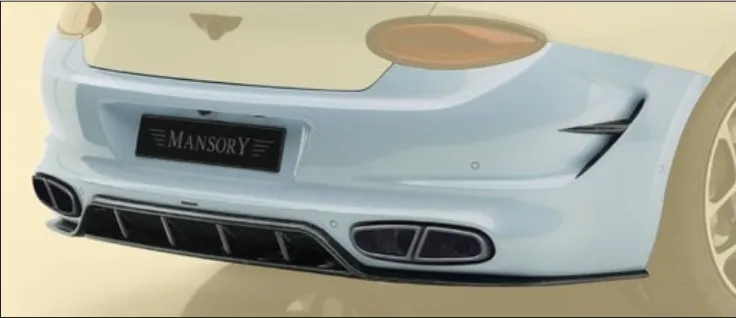
Rear bumper with diffuser I Mansory Carbon for Bentey Continental GT


Mansory Carbon Rear Bumper with Diffuser I for Bentley Continental GT (3W, 2003–2011)
The Bentley Continental GT's OEM rear fascia is a smooth polyurethane shell with no aerodynamic geometry: underbody airflow falls off the trailing edge without managed pressure recovery. The Mansory Carbon Rear Bumper with Diffuser I integrates a four-fin underbody diffuser that expands the flow area at the rear of the car, decelerates escaping underbody air, and recovers static pressure — reducing rear lift and generating consistent rear-axle downforce not present in OEM form. This component is part of the Mansory Carbon Fiber Body Kit Set for Bentley Continental GT. Diffuser I is the road-oriented variant of the rear aero programme: engineered for measurable aerodynamic function while preserving the visual character of the Continental GT as a grand tourer. Fits the 3W chassis coupé and GTC convertible, 2003–2011.
Construction & Materials
The rear bumper with integrated diffuser is among the largest single-piece carbon components in the Mansory 3W programme. Upper bumper skin and lower diffuser fin section are co-cured as a single structural laminate in a split autoclave mould — the fins are integral to the cured part, not bonded separately. Autoclave processing eliminates void content to below 2 percent, ensuring structural and cosmetic consistency across the visible 3K twill weave exterior face. The concave inner geometry of the diffuser section requires precise taper angles and controlled tooling release agent to extract cleanly post-cure.
Wall thickness is distributed by function: 2.0 mm at the bumper beam mounting interface, 1.5 mm across body panel zones, and 1.2 mm at the diffuser fins. Exhaust apertures are CNC-machined after cure — W12 twin-turbo quad-pipe (105 mm per pair) or V8 twin-turbo quad-pipe configuration, specified at order. The complete unit weighs approximately 5.8 kg against the OEM polyurethane fascia at approximately 8.4 kg: a saving of roughly 2.6 kg at the rear.
- Weave: 3K twill prepreg, autoclave co-cure, upper bumper and diffuser as single laminate
- Wall thickness: 2.0 mm at bumper beam interface, 1.5 mm body panel zones, 1.2 mm diffuser fins
- Diffuser fins: 4 vertical carbon ribs, 110 mm depth, 12° expansion angle
- Exhaust apertures: CNC-cut to W12 quad-pipe OEM dimension (105 mm per pair) or V8 — specify at order
- Weight: approx 5.8 kg vs OEM polyurethane approx 8.4 kg (saving approx 2.6 kg)
- Finish: gloss or satin clear lacquer, UV-stable two-component system
- Mounting: OEM bumper beam retained, stainless M8 hardware, PDC sensors reinstalled in OEM positions
Design & Visual Function
The Continental GT has a largely flat undertray that generates rear lift as underbody flow detaches at the trailing edge without managed expansion. The Mansory Diffuser I creates four channels beneath the rear fascia, each bounded by carbon fin ribs 110 mm deep at a 12° expansion angle. As underbody flow enters these channels, the expanding cross-section decelerates the air and raises its static pressure, restoring it toward ambient before exit and reducing the underbody-to-upper-surface pressure differential. At 100 km/h this generates approximately 10–18 kg of additional rear-axle load, scaling with velocity squared — at 200 km/h the effect is four times greater. When paired with the Mansory carbon front bumper with front lip, the front splitter and rear diffuser together correct the Continental GT's native uncorrected rear lift and balance front-to-rear downforce distribution.
Exhaust heat management is a structural requirement. The W12 twin-turbo routes four large-bore exhaust tips close to the lower fascia. Standard epoxy prepreg begins to soften above approximately 120 °C. The Mansory Diffuser I uses phenolic-modified prepreg in zones within approximately 80 mm of each exhaust aperture, maintaining structural integrity to approximately 220 °C — adequate margin for the Continental GT's exhaust system under normal operating conditions. Aperture edges are chamfered and clear-lacquered in the same UV-stable system as the rest of the panel, presenting as designed detail rather than functional cut-outs.
In OEM form the Continental GT rear end has no lower structural differentiation or aero treatment below the exhaust tips. The Diffuser I adds a recessed carbon fin array creating visual depth and structural rhythm across the lower rear. From behind, the five channels divided by four carbon ribs communicate mechanical intent. The fin zone creates a visual anchor at the rear corners that balances the front lip's visual weight and gives the Continental GT's rear end a purposeful completeness it lacks in standard form. Gloss carbon contrasts strongly on light body colours; satin reads as understated technical detail on dark colours.
Compatibility & Fitment
Designed for the Bentley Continental GT 3W chassis, 2003–2011. Fits both coupé and GTC convertible — the rear fascia below the boot lid is the same pressed-steel structure on both body styles. Engine coverage: 6.0-litre W12 twin-turbo and 4.0-litre V8 twin-turbo (3W facelift), both quad-exhaust configurations; exhaust aperture diameter differs and must be specified at order. NOT compatible with the second-generation Continental GT (D2A platform). Up to four PDC sensors reinstall in factory positions; tow hook access cover is retained. Symmetric geometry fits LHD and RHD.
Installation & Reversibility
Rear bumper replacement is a 2–3 hour body shop task, simpler than the front as it involves no parking camera transfer on most market specifications. Procedure: remove trunk liner corner trim to access bumper beam bracket fixings; disconnect and extract PDC sensors; disconnect lower bumper support rods; disengage upper bumper clips at boot aperture seal rail; lift away OEM fascia. Install the Mansory Diffuser I by reversing this sequence — the unit aligns to the unchanged OEM bumper beam mounting geometry. Stainless M8 hardware replaces OEM push-pin fasteners at the beam interface. PDC sensors press into pre-bored OEM-spacing holes. Panel gaps set using existing bumper beam adjustability; no body modification is required. Factory chrome exhaust surrounds locate into CNC-cut apertures using the OEM clip system. OEM rear fascia is fully reinstatable at any time. Paint-matched units require colour preparation by a body shop prior to fitting.
Pairing within the Mansory Continental GT 3W Programme
The rear bumper with Diffuser I is the rear anchor of the Mansory aero programme. At the sill line, the Mansory carbon side skirts connect front and rear aero elements along the lower body. For coupé owners wanting rear aero without a prominent wing, the Mansory rear decklid spoiler is the natural companion above the boot lid. For maximum rear downforce, the Mansory biplane performance wing pairs with the Diffuser I for the most aggressive 3W rear aero configuration. GTC convertible owners have the Mansory rear spoiler for GTC, engineered around the soft-top housing. At the front, the Mansory carbon front bumper with front lip completes the aerodynamic transformation at both horizontal extremities.
Maintenance & Durability
Two specific durability threats apply to this panel: exhaust thermal exposure and tyre spray debris. Exhaust-proximity zones use phenolic-modified prepreg rated to 220 °C — adequate for the W12's thermal environment under sustained high-speed conditions. Lacquer yellowing in the exhaust-adjacent zone can develop over 8–10 years rather than the 10–14 years typical of other carbon panels; re-lacquering with heat-stable two-component clear coat restores appearance without structural consequence. The lower diffuser fins are in the tyre spray zone — ceramics coating applied to fin lower faces adds chip resistance and simplifies cleaning. Rinse fins after winter use to remove road salt residue; the carbon laminate itself is inert to salt and water.
Lead Time & Warranty
Clear-lacquered units (gloss or satin): 3–5 weeks from order confirmation. Paint-matched upper bumper section: additional 1–2 weeks. Exhaust aperture specification — W12 or V8 — must be declared at order; this CNC parameter cannot be changed after production begins. 12-month Mansory warranty against delamination, surface-visible laminate voids, dimensional fitment failure against OEM bumper beam geometry, and lacquer manufacturing defects not caused by impact. Lacquer yellowing in the exhaust-proximity zone under normal thermal exposure is not a warranty claim against the structural laminate.
FAQ
Q: What is the difference between Diffuser I and Diffuser II?
A: Diffuser I (this SKU) is the road-biased configuration — 4 carbon fins at 12° expansion angle, balanced for road clearance and the Continental GT's touring aesthetic. The Diffuser II has a steeper fin angle, greater visual aggression, and stronger aerodynamic effect — suited for owners prioritising track-day use. Both are identical in construction quality, mounting method, and exhaust heat shielding specification.
Q: Does the diffuser require modifications to the OEM exhaust system?
A: No. The CNC-cut apertures are engineered to the OEM exhaust tip positions and angles — no rerouting, shortening, or modification is required. Factory chrome exhaust surrounds reinstall directly into the Mansory apertures. Aftermarket exhaust systems with tip diameters outside OEM specification should be discussed at the time of ordering.
Q: Is the carbon diffuser safe at sustained high exhaust temperatures?
A: Yes. Zones within approximately 80 mm of the exhaust apertures use phenolic-modified prepreg rated to 220 °C — adequate margin above the outer-surface temperature of the Continental GT's exhaust tips under sustained high-speed conditions. Standard epoxy prepreg covers structural zones away from the exhaust. Prolonged contact of a heat-concentrating exhaust wrapper directly against the fascia is outside the intended thermal environment and not covered under warranty.
Q: Does the Diffuser I fit the GTC convertible?
A: Yes. The rear fascia of the 3W coupé and GTC are dimensionally identical below the boot lid line. GTC-specific Mansory rear components — the GTC rear spoiler and cover of folding roof for GTC — address the differences above the fascia line.
Q: How much weight does the carbon bumper save?
A: The OEM polyurethane rear fascia is approximately 8.4 kg; the Mansory autoclave carbon unit is approximately 5.8 kg — a saving of roughly 2.6 kg at the rear. Combined with the carbon front bumper and the carbon engine bonnet, the Mansory programme delivers meaningful mass reduction at the car's extremities, improving rotational inertia characteristics.
Specify your Mansory carbon rear bumper with Diffuser I — engine variant (W12 or V8) and preferred finish — via WhatsApp +44 7488 818 747 or [email protected].