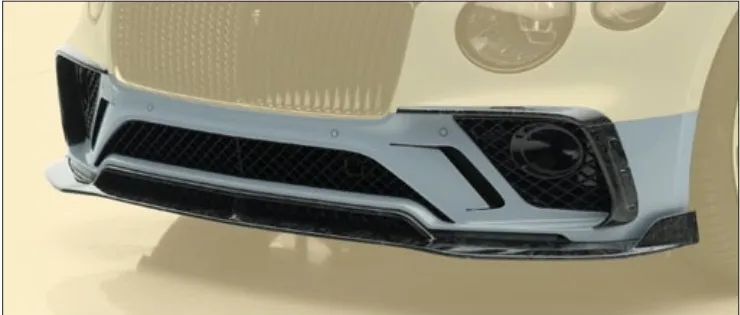
Front bumper with front lip Mansory Carbon for Bentey Continental GT


Mansory Carbon Front Bumper with Front Lip for Bentley Continental GT (3W Chassis, 2003–2011)
The Mansory carbon front bumper with integrated splitter lip is the aerodynamic foundation of the Mansory Carbon Fiber Body Kit Set for Bentley Continental GT — the complete 3W widebody programme that transforms the GT into a track-capable grand tourer with measurable aerodynamic intent. The splitter lip restructures the nose geometry to generate negative front-axle lift: the leading edge accelerates underbody airflow, anchoring the front axle at motorway and track speeds. Brake cooling ducts integrated into the lower aperture deliver targeted airflow to the ventilated discs. The fascia replaces the OEM polyurethane unit with autoclave prepreg carbon, reducing front mass while adding functional aero shaping absent from the production car.
Construction & Materials
The front bumper fascia is manufactured from 3K twill weave prepreg carbon fibre, autoclave-cured at 120 °C under 6-bar consolidation pressure. Autoclave curing eliminates micro-voids that form in vacuum-bag-only processes, producing a fibre-to-resin ratio above 60% by volume. The resin is aerospace-grade epoxy with a post-cure glass transition temperature above 130 °C — structural stability under sustained high-speed thermal load. Zone mapping divides the bumper into structural zones (bumper beam interface flanges, fog light housing pockets, PDC sensor mounting areas) and thinner aero vane sections including the splitter leading edge. Orientation plies rotate 0°/90° in structural zones, with ±45° plies in the splitter vane for torsional stiffness against underbody turbulence.
Structural bumper beam interface areas run 1.8–2.5 mm wall thickness to handle mounting loads without cracking the fascia. The splitter vane is 1.2 mm high-modulus carbon — sharp-edged for aero efficiency and stiff enough to resist flutter at speed. Total assembly weight is approximately 4.2 kg, against 6.8 kg for the OEM polyurethane fascia — a 2.6 kg reduction at the front of the car. The integrated splitter lip is bonded using structural film adhesive in a secondary cycle, creating a monolithic structure rather than a bolted-on lip that could flex under aerodynamic loading.
- Weave: 3K twill prepreg, autoclave cure at 120 °C, 6-bar pressure
- Finish: gloss clear lacquer or satin matte lacquer — both UV-inhibited two-component lacquer
- Structural wall: 1.8–2.5 mm in bumper beam interface zones
- Splitter vane wall: 1.2 mm high-modulus carbon, 18 mm rake angle from horizontal
- Weight: approx 4.2 kg (vs 6.8 kg OEM polyurethane fascia)
- Mounting: OEM M8 bolt pattern retained, stainless hardware included, no chassis mods
- Finish option: primer-only for factory Bentley colour-code match (supplied to body shop)
Design & Visual Function
The splitter geometry is the aerodynamic core of this bumper. The integrated lip sits at an 18 mm rake angle from horizontal, creating a localised high-velocity, low-pressure zone beneath the front splitter plane at speed. The pressure differential between the stagnation zone above the splitter and the accelerated airflow beneath produces negative front-axle lift. At 100 km/h, the splitter generates approximately 8–14 kg of additional front-axle downforce compared to the flat OEM fascia, scaling with the square of velocity. At 160 km/h, this rises to approximately 20–35 kg — meaningful on the 2,400 kg GT in terms of steering response and front-end composure. The geometry is engineered with matched front splitter and rear diffuser coefficients so that the car gains balanced pitch stability when the full 3W programme is fitted.
Brake cooling duct integration is among the most functional differences from the OEM unit. The 1st-generation OEM front bumper has no dedicated forward-facing brake cooling inlets — callipers and ventilated discs rely entirely on incidental wheel arch airflow. The Mansory bumper incorporates twin forward-facing brake cooling inlets at the inboard lower corners of the main grille aperture, directing ram-effect air to the front brake assemblies. Front disc temperatures at a track day can exceed 600 °C without active cooling, approaching the upper limit of OEM pad compounds and the vapour-lock threshold of brake fluid. The wider lower aperture also increases cooling air volume reaching the heat exchanger stack, providing supplementary radiator airflow to offset the thermal load of the twin-turbocharged W12 at sustained high speeds.
Visually, the widened lower fascia sets the nose width to match the extended front fenders of the 3W widebody programme. The exposed 3K twill weave on the splitter lower sections provides the signature Mansory graphic, registering as a strong visual contrast against Bentley deep metallics and solid blacks — Beluga, Magnetic, and Moonbeam are particularly effective pairings. The central grille opening is precision-shaped to accept the 31-lamels chromed Mansory grille as an exact fit, with the bumper shell defining the perimeter geometry that the grille panel seals against.
Compatibility & Fitment
This bumper is engineered for the Bentley Continental GT 1st generation (3W chassis, 2003–2011), including the Continental GTC convertible — the front fascia dimensions are identical between coupé and convertible body styles, as both share the same 3W front subframe forward of the A-pillar. Engine compatibility covers the 6.0L twin-turbo W12 (CWB variants, 552–610 hp) and the 4.0L twin-turbo V8 (CST late-cycle facelift, 500–521 hp) — all OEM cooling aperture requirements are accommodated in the Mansory lower grille design. NOT compatible with the 2nd-generation GT on the D2A platform (post-2011): nose geometry and splitter plane diverge substantially between generations. LHD and RHD vehicles are both supported by the symmetric fascia shell. PDC parking sensors, fog lights, and front parking camera provisions all transfer from the OEM unit at factory positions.
Installation & Reversibility
A complete front bumper swap is a 3–4 hour job for a certified body shop. The procedure begins with front wheel arch liner removal to access inner bumper retainer clips, followed by underfloor splash guard disconnect and PDC sensor harness extraction. Fog lights transfer to the new fascia before final fit. The OEM bumper beam is inspected and retained — the Mansory carbon fascia mounts to the same M8 bolt pattern with stainless steel hardware supplied. Panel gap specification is 3.5 mm ± 0.5 mm to the bonnet leading edge and front fenders. The original OEM fascia is completely undamaged in a correct removal and can be stored for reinstatement without permanent modification to the car. Paint-matched orders arrive primer-ready for direct colour coat application at the body shop.
Pairing within the Mansory Continental GT 3W Programme
The front bumper flows directly into the Mansory carbon side skirts, which continue the low-line stance rearward along the full sill length. Within the front aperture, the bumper shell accepts the 31-lamels chromed Mansory grille, replacing the OEM 9-horizontal-bar pattern with 31 vertical chrome bars. The carbon aesthetic is completed by the Mansory carbon engine bonnet, extending the 3K twill surface from the bumper fascia across the full front deck. The Mansory carbon front fenders with stripe complete the widebody stance, ensuring the broader nose matches the widened fender line established across the full 3W platform.
Maintenance & Durability
Use only pH-neutral automotive shampoo on lacquered carbon — never ammonia-based cleaners or alkaline wheel products, as these attack the two-component lacquer binder. Avoid abrasive clay bars on clear-coated sections. A 9H-rated ceramic coating provides 3–5 years of UV-stable hydrophobic protection, outperforming carnauba wax which requires monthly reapplication and offers negligible UV resistance. UV-inhibited lacquer is standard on all Mansory carbon units; without protection, lacquer yellowing typically begins at 10–14 years of unprotected UV exposure. The carbon laminate itself has no practical fatigue lifespan under normal use. Avoid directing high-pressure washing at the splitter trailing edge joint from below. Stone chips at the lower lip edge should be addressed with spot UV-stable lacquer within six months to prevent moisture tracking beneath the lacquer surface. Ammonia, acetone, and fuel splash must not contact lacquered surfaces.
Lead Time & Warranty
Clear-lacquered units: 3–5 weeks from order confirmation. Paint-matched units add 1–2 weeks for colour preparation. All Mansory components carry a 12-month warranty against manufacturing defects from confirmed delivery date — covering delamination, void formation, bonding failures at the integrated splitter joint, and dimensional fitment tolerances outside ± 0.5 mm. Warranty does not extend to damage from road debris, kerb contact, incorrect installation, or chemical exposure.
FAQ
Q: Does the front bumper fit both the coupé Continental GT and the GTC convertible?
A: Yes — the 3W front fascia is dimensionally identical across coupé and convertible body styles. The front subframe and bumper beam geometry are shared; only rear-end components differ between the two body styles. PDC sensor positions, fog light mounting, and grille aperture dimensions are identical on both.
Q: What is the measured downforce from the integrated splitter at highway speeds?
A: At 100 km/h, the 18 mm splitter rake generates approximately 8–14 kg of additional front-axle negative lift compared to the flat OEM fascia, scaling with velocity squared. At 160 km/h, this rises to approximately 20–35 kg. On the 2,400 kg GT, the effect is perceptible as improved turn-in precision and reduced front-end float — most apparent when paired with the rear diffuser variants in the Mansory 3W programme for balanced pitch stability.
Q: Can I spec this in satin finish to match a factory Bentley satin wrap?
A: Yes. Satin matte lacquer is a standard finish option — the same autoclave 3K twill laminate receives a satin two-component lacquer with the same UV inhibitor package as the gloss variant. A third option is primer-only finish for body shops applying your specific Bentley factory colour code — Beluga Black, Glacier White, Magnetic, Moonbeam, and the full extended Bentley palette are feasible as paint-matched orders. Specify your preferred finish at order confirmation.
Q: Will the wider lower opening affect the W12 cooling package?
A: The Mansory front bumper is designed around the 3W underbonnet cooling layout — all OEM apertures and ducting clearances are maintained and in most respects improved. The sculpted lower splitter section increases the approach velocity of ambient air to the heat exchanger stack. PDC sensor brackets, fog light mounting points, and parking camera provisions are all factory-position compatible. No modifications to OEM cooling pipework or radiator mounting are required.
Q: Is the OEM bumper damaged during removal, and can it be resold?
A: The original OEM front fascia is completely undamaged in a correct removal — no cutting, drilling, or irreversible modification is required. The OEM unit can be stored as a reversibility option, sold to another 3W owner, or retained for seasonal use. Removal takes approximately one hour for a trained technician using a 10 mm socket set and trim-clip tools.
Specify your Continental GT front bumper with front lip via WhatsApp +44 7488 818 747 or [email protected] — include your car's model year and paint code for a tailored quotation.