
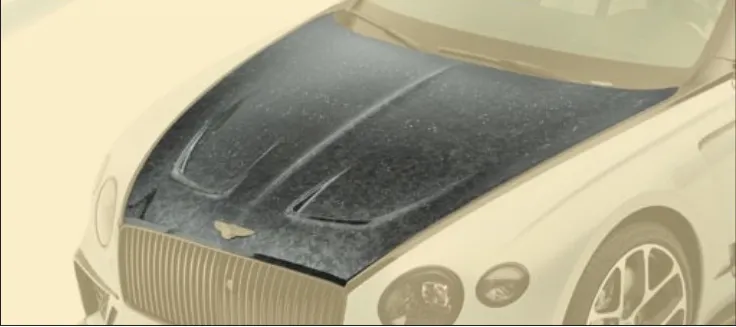
Engine bonnet Mansory Carbon for Bentey Continental GT


Mansory Carbon Engine Bonnet for Bentley Continental GT (3W Chassis, 2003–2011)
The Bentley Continental GT 3W chassis places the 6.0L W12 twin-turbo between the front axle and the firewall, beneath a long, low bonnet extending from windscreen base to grille. This concentrates enormous thermal output in a contained underbonnet volume. After spirited driving followed by idling, engine bay air temperatures can reach 60–80 °C — the OEM aluminium bonnet provides no passive extraction. Mansory's carbon replacement adds a forward vent aperture that exploits the pressure differential between the stagnation zone at the bonnet leading edge and the lower-pressure zone at the vent exit, extracting hot air continuously and passively. The bonnet is part of the Mansory Carbon Fiber Body Kit Set for Bentley Continental GT — the complete 3W programme.
Construction & Materials
At approximately 1,680 mm long and 1,440 mm wide, this is the largest single-piece carbon panel in the 3W programme — a surface area that demands genuine structural engineering beyond a simple skin. Mansory uses a two-piece inner-outer sandwich construction. The outer face is autoclave-cured 3K twill prepreg for full fibre consolidation and surface quality. The inner structure is vacuum-infused woven carbon, fabricated separately and bonded to the outer face after individual cure. Structural ribs in the inner layer are positioned at OEM hinge brackets and the bonnet latch, concentrating stiffness exactly where the bonnet is loaded. The vent aperture is CNC-cut after full cure, with perimeter reinforcement to prevent fibre separation at the edge. A carbon louvre insert completes the vent assembly.
The OEM Continental GT aluminium bonnet weighs approximately 14–16 kg. The Mansory carbon equivalent is approximately 8–10 kg — a saving of approximately 6 kg from the longitudinal nose extremity, the point of maximum leverage on polar moment of inertia. The vent aperture is positioned forward of the W12 intercooler stack to maximise extraction of post-intercooler heat. Vent angle directs exiting air upward and rearward, clear of the downforce zone above the front axle.
- Outer face: 3K twill prepreg, autoclave cure, gloss or satin clear lacquer
- Inner structure: vacuum-infused woven carbon, structural ribs at OEM hinge and latch positions
- Weight: approx 8–10 kg (OEM aluminium approx 14–16 kg — saving ~6 kg)
- Vent: one forward aperture, CNC-cut, reinforced perimeter, carbon louvre insert
- Vent position: forward of W12 charge-air intercooler stack, extracting post-intercooler heat
- Mounting: OEM hinge positions retained, bonnet catch retained, safety cable compatible
- Gas struts: OEM attachment position differs on carbon inner — new brackets supplied in kit
Thermal Function & Visual Design
The aerodynamic logic is direct. At road speed, the bonnet leading edge is a stagnation point — the highest-pressure zone on the car's exterior. Rearward of the stagnation zone, as air accelerates over the bonnet surface, static pressure drops below ambient. At approximately 40% along the bonnet chord, where the Mansory vent is positioned, surface pressure has fallen below the elevated engine bay pressure. This creates the extraction differential: high pressure in the engine bay, lower pressure at the vent exit above the bonnet surface. Hot air exits passively, with no moving parts and no parasitic load. At sustained highway cruise, this translates to approximately 8–14 °C reduction in underbonnet air temperature — improving charge-air density, reducing thermal stress on ancillaries, and limiting heat soaking of the intercooler air-side during stops following a motorway run.
Visually, the carbon bonnet transforms the most prominent exterior surface of the car. The bonnet occupies the majority of the front three-quarter view from any external angle. In 3K twill clear lacquer, the outer face reads as deep uniform dark in diffuse light; in direct sunlight, the diagonal weave reveals its geometry as a rotating reflective pattern that changes character with viewing angle. The vent aperture and carbon louvre insert communicate the engineering function visually — it is self-evidently purposeful. The bonnet is manufactured to OEM geometry, maintaining ±1 mm panel gap to front fenders and windscreen surround. For owners with Mansory carbon front fenders, the bonnet is calibrated against OEM fender geometry, which the Mansory fenders replicate at OEM dimensions, ensuring a flush, consistent interface.
Compatibility & Fitment
Compatible with the Bentley Continental GT 1st generation, 3W chassis, 2003–2011 — both coupé and GTC convertible (bonnet geometry is identical between body styles). Fits the W12 6.0L twin-turbo and the late-cycle V8 4.0L twin-turbo. Strictly 3W-specific — NOT compatible with the 2nd-generation Continental GT D2A chassis. All OEM bonnet features retained: hinge positions, safety catch, pull-cable mechanism, and pedestrian impact zones are all replicated in the carbon inner structure. Speed models with the active bonnet vent: the Mansory carbon bonnet replaces the active system with the passive aperture — the always-open vent provides continuous passive ventilation, and the active vent mechanism is discontinued in this configuration. LHD and RHD share identical bonnet geometry.
Installation & Reversibility
A bonnet swap on the 3W Continental GT is a 2–3 hour body shop procedure requiring two people for the panel lift. Procedure: bonnet prop removal, wiring loom disconnect if bonnet-mounted (Speed model active vent sensor), hinge bolt removal, OEM panel clear, new carbon bonnet positioning, hinge bolts hand-tight, gas strut bracket installation using supplied new brackets (the OEM strut attachment position is not replicated in the carbon inner structure), strut attachment, bonnet close to latch, panel gap adjustment at hinge fasteners, final torque. The OEM aluminium bonnet is undamaged throughout and fully restorable at any time. Professional body shop installation recommended for the panel gap adjustment step; Mansory-trained installer for paint colour-matched versions.
Pairing within the Mansory Continental GT 3W Programme
The engine bonnet is the crown of the Mansory front-end programme. It pairs with the engine bonnet II as an alternative SKU — the II variant carries a more aggressive vent specification. Owners should evaluate both before ordering; the two are distinct panels and cannot be interchanged after delivery. For the complete front-end carbon ensemble, the bonnet pairs with the front bumper with front lip and the carbon side skirts — together these three panels transform every external surface from nose to midpoint. The front fenders with stripe extend the conversion to every panel from bumper to A-pillar. The Mansory bonnet logo and carbon mirror housings complete the exterior carbon programme.
Maintenance & Durability
The autoclave prepreg outer face and clear lacquer require standard lacquered carbon maintenance, with one specific addition: the vent aperture. The vent interior — louvre insert and aperture perimeter — should be inspected annually. Road debris accumulates against the vent leading face at speed; clean with a soft brush and pH-neutral shampoo after motorway driving. If micro-delamination appears at the CNC-cut edge after years of thermal cycling and stone impact, a small application of UV-stable clear lacquer arrests it. Hinge pivot areas in the carbon inner structure should be checked every 18 months for surface cracking; local reinforcement by a carbon specialist is straightforward if required. Carbon conducts heat less readily than aluminium — approximately 5–10 W/m·K across the fibre plane versus approximately 160 W/m·K for aluminium — providing an intrinsic thermal barrier benefit at the panel surface. Clear lacquer service life: 10–14 years. Carbon substrate: permanent.
Lead Time & Warranty
Clear-lacquered bonnets: 4–5 weeks from order confirmation. Gas strut brackets are included. Paint-matched outer face — any Bentley factory colour code, vent surround retaining clear-lacquered carbon — adds approximately 2 weeks. 12-month warranty from delivery against delamination of inner or outer faces, structural rib failure at hinge or latch positions, vent aperture edge delamination, and lacquer manufacturing defects. Hinge fatigue from incorrect installation torque is excluded; installation to Mansory's specified torque values is a warranty condition.
FAQ
Q: How much does the carbon bonnet reduce engine bay temperatures?
A: In road testing, the Mansory bonnet vent reduces underbonnet air temperature by approximately 8–14 °C at sustained highway cruise. The effect is most pronounced in the scenario typical of enthusiast driving: a motorway run followed by urban traffic or a stationary period, where the OEM bonnet allows heat to soak back without extraction. The Mansory vent continues to extract heat at low speeds via the residual bonnet-to-ambient pressure differential. On track use with sustained full-throttle W12 output, thermal creep in the charge-air system is reduced during prolonged high-speed sections.
Q: Does the bonnet vent affect the OEM hood insulation?
A: The OEM bonnet carries a heat and sound insulation pad bonded to its inner face. The Mansory carbon bonnet uses a Thinsulate-equivalent heat-barrier liner bonded to the carbon inner face in its place. The OEM pad is not transferable due to inner face geometry differences. Additionally, carbon conducts heat less readily than aluminium — approximately 5–10 W/m·K across the fibre plane versus approximately 160 W/m·K for aluminium — providing an intrinsic thermal barrier independent of the liner.
Q: Does the bonnet fit both W12 and V8 variants without modification?
A: Yes. The outer shell and inner structure are identical for both engine variants — the 3W bonnet geometry was not revised between the W12 and late-facelift V8. The vent position is calibrated for the W12 underbonnet heat signature, but the V8 twin-turbo also benefits from the passive ventilation. No engine-specific modification or separate order required.
Q: Can I order the bonnet in a Bentley factory body colour?
A: Yes — supplied in primer-ready finish for body shop colour application, or with the factory colour pre-applied by Mansory. In both cases, the vent surround retains clear-lacquered carbon as a visual distinction. Add approximately 2 weeks for paint-matched variants.
Q: How much weight does the carbon bonnet save over OEM aluminium?
A: Approximately 6 kg — the OEM aluminium bonnet is approximately 14–16 kg, the Mansory carbon is approximately 8–10 kg. This mass is at the nose extremity of the car at bonnet height, giving maximum leverage on polar moment of inertia. Combined with carbon front fenders (~1.3 kg per side) and the carbon front bumper (~2.6 kg saving), the front-end carbon programme produces a perceptible improvement in steering response and front-end agility.
Transform the most prominent exterior panel of your Continental GT — enquire about the Mansory carbon engine bonnet via WhatsApp +44 7488 818 747 or [email protected].