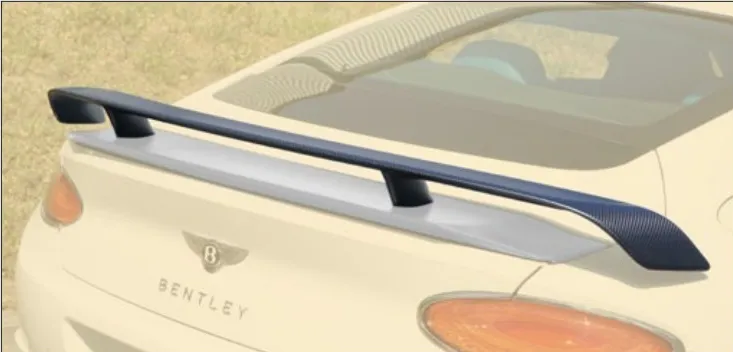
Biplane performance wing Mansory Carbon for Bentey Continental GT


Mansory Biplane Carbon Performance Wing for Bentley Continental GT (3W Coupé, 2003–2011)
The Mansory biplane carbon performance wing is the maximum-downforce rear aero solution for the Bentley Continental GT coupé — first generation, 3W chassis, 2003 to 2011. It is part of the comprehensive Mansory Carbon Fiber Body Kit Set for Bentley Continental GT programme. The engineering rationale is straightforward: two stacked aerofoil elements working in concert generate significantly more downforce than a single element of equivalent span, because the slot between the two foils accelerates airflow over the upper element's suction surface, delaying boundary layer separation and allowing a higher effective camber to be exploited before aerodynamic stall. For a 2,400 kg Continental GT running its 6.0 L W12 twin-turbo at motorway and circuit speeds, high-speed stability is the defining factor between a confident grand touring experience and a nervous, lift-prone one. This wing changes that equation definitively — replacing passive aerodynamic indifference with a tuned, mechanical downforce signature at every speed above 120 km/h.
Construction & Materials
The biplane wing is the most structurally demanding component in the Mansory 3W programme. Each foil element is an aerofoil-section carbon shell with an internal carbon rib structure — not a hollow skin. The two elements are mounted on carbon endplates that anchor to the boot lid structure via stainless steel leg inserts. The prepreg specification uses high-modulus 3K twill for the outer shell, unidirectional (UD) carbon tape for the main spar running spanwise through each foil, and a closed-cell foam core inside each element to resist twisting loads. Both elements are autoclave-cured at 120 °C and 6 bar as separate components, then assembled onto the endplates and leg structure after cure with calibrated torque values at each joint.
Upper element spans approximately 1,100 mm with a 180 mm chord. The lower element shares the 1,100 mm span with a 120 mm chord. Slot gap between elements: 55 mm, set by endplate geometry and not field-adjustable. Total height above boot lid at neutral-angle setting: approximately 340 mm. Complete assembly weight: approximately 3.8 kg.
- Upper element: 3K twill prepreg shell, UD spar tape, foam core, autoclave cure
- Lower element: same construction, 120 mm chord, mounted on carbon endplates below upper
- Endplates: 3K twill prepreg, 6 mm wall, keyed to both wing elements
- Leg structure: UD carbon tube legs on stainless adjustable inserts
- Span: 1,100 mm per element; total height 340 mm above boot lid at neutral
- Weight: approximately 3.8 kg complete assembly
- Attack angle: upper element adjustable ±4° from neutral via leg mount slots in 2° increments
Design & Visual Function
The 55 mm slot between the two elements functions as a high-velocity duct. The lower element's pressure field accelerates airflow over the upper element's suction surface, enabling the upper element to operate at a higher angle of attack before flow separation — the same principle as a slotted flap system on a high-lift wing. The net result is a combined lift coefficient substantially higher than either element could achieve alone. At 160 km/h, the twin-element wing generates approximately 55–75 kg of rear-axle downforce — versus approximately 18–28 kg from the decklid spoiler alone, and approximately 30–50 kg from the decklid spoiler combined with Diffuser I. At 200 km/h, rear downforce rises to approximately 85–110 kg. For a 2,400 kg grand tourer at track days or alpine passes, this is the difference between a car that pushes wide at the rear in high-speed sweepers and one that remains composed and neutral.
The visual transformation is equally significant. The twin carbon aerofoils change the GT coupé's silhouette more dramatically than any other individual component in the 3W programme. From the rear three-quarter, the stacked aerofoils frame the bodywork and communicate the car's aerodynamic intent unambiguously. The carbon endplates add structural visual mass at each side. From directly behind, the two-element stack creates a layered graphic that a single-element wing cannot replicate.
The wing is delivered in gloss or satin clear-lacquered carbon. The carbon-on-paint contrast reads as deliberate across all body colours. On Beluga black the wing reads as dark carbon against dark paint; on Glacier White or light metallics the 3K weave creates a strong graphic. Attack-angle adjustment allows the visual rake of the upper element to be calibrated alongside performance preference.
Compatibility & Fitment
Designed exclusively for the Bentley Continental GT coupé — first generation, 3W chassis, 2003–2011. Not for the GTC convertible (the open-top car has its own performance wing for GTC). Not compatible with the second-generation D2A platform. Fits all 3W coupé engine variants: W12 6.0 L twin-turbo and V8 4.0 L twin-turbo (late facelift). Installation requires boot lid drilling at four points per the Mansory installation guide. Not compatible with running the standalone decklid spoiler simultaneously — both share the boot lid trailing edge zone. Owners wanting a decklid element combined with the biplane wing should specify the integrated biplane wing with decklid spoiler SKU.
Installation & Reversibility
Installation is a 3–4 hour body shop operation. Mansory provides a precision drilling template locating four leg insert positions on the boot lid. After drilling, stainless grommet inserts are pressed and bonded into the boot lid skin to create a reinforced load path. Leg bolts are M10 stainless, torque-specified to manufacturer values. Attack-angle adjustment is post-installation via 6 mm hex key at each leg's slot; lock nuts must be re-torqued after any change — approximately 15 minutes per side. The modification is not reversible without visible repair to the four drill holes — treat this as a permanent change to the boot lid panel. Professional body shop installation is strongly recommended.
Pairing within the Mansory Continental GT 3W Programme
The biplane wing generates maximum benefit in an aerodynamically balanced car. At the rear, the natural companion is the rear bumper with Diffuser II, which generates underbody downforce to complement the wing's upper-body contribution. At the front, the wing's rear downforce is balanced by the front bumper with integrated splitter — running maximum rear downforce without a matching front contribution shifts the aerodynamic balance rearward and produces understeer at speed. The side skirts manage underbody flow between axles, while the engine bonnet completes the frontend carbon programme. The mirror housings and front fenders with stripe round out the full exterior transformation.
Maintenance & Durability
The autoclave prepreg construction with UV-stable clear lacquer handles full weather and aerodynamic loading without structural degradation under normal conditions. Inspect both foil elements annually using the tap-test method for subsurface delamination — hollow-sounding areas should be referred to a carbon repair specialist before further high-speed use. Post-hailstorm inspection is specifically recommended, as hailstone impact can cause internal delamination not visible from outside. Do not use either wing element as a handhold. The stainless attack-angle hardware should be checked annually for fretting or thread wear in road-salt environments. Ceramic coating of both upper aerofoil faces is strongly recommended to extend lacquer service life beyond the standard 10–14 year clear period.
Lead Time & Warranty
Clear-lacquered assembly: 4–6 weeks from confirmed order. Paint-prep consultation available on request for colour-matched finishes. 12-month warranty against manufacturing defects from delivery date — covering delamination from laminate voids, structural laminate failure under normal aerodynamic loads, and fitment failures from dimensional manufacturing error. Damage from incorrect installation (mislocated drill holes, under-torqued fasteners, impact) is not a manufacturing defect and falls outside warranty scope. Professional installation is strongly recommended.
FAQ
Q: Does the biplane wing require boot lid drilling?
A: Yes — four holes of 12 mm diameter at Mansory-specified positions. This is the only structurally rated attachment for the aerodynamic loads generated at speed. Adhesive mounting is not available: the load path requires a mechanical connection through the boot lid structure. The drilling is irreversible without panel repair — treat this as a permanent modification to the boot lid.
Q: How much does the wing affect the car's top speed?
A: The biplane wing adds approximately 12–18 kg of aerodynamic drag at 200 km/h. For a 552 hp W12 Continental GT, this reduces theoretical top speed by approximately 8–12 km/h from the OEM 318 km/h figure — bringing the ceiling to approximately 305–310 km/h. The stability and downforce gained at 160–200 km/h offers far more practical value than this marginal top-speed reduction.
Q: Is the attack angle adjustment meaningful for road driving?
A: Yes. The lower end (−2° from neutral) reduces drag for extended motorway driving. The upper end (+4°) maximises downforce for circuit use. Many owners set a middle position. Adjustment requires a 6 mm hex key at each leg's slot — approximately 15 minutes per side — followed by re-torquing the lock nuts.
Q: Will the wing conflict with the boot lid opening mechanism?
A: No — the boot lid opens by hinge pivot at its forward edge; the wing mounts at the rear and travels with the lid when opened. The boot lid opens fully with the wing fitted. The 340 mm wing height requires adequate clearance in low-ceiling garages — verify this before specifying.
Q: Can I run the standard decklid spoiler alongside the biplane wing?
A: Not in standard configuration — both components occupy the boot lid trailing edge zone and are alternative rear aero choices. The solution for owners wanting both is the integrated biplane wing with decklid spoiler SKU, engineered as a unified system.
Specify the Mansory biplane carbon performance wing for your Continental GT coupé — discuss attack angle preference and finish via WhatsApp +44 7488 818 747 or [email protected].