
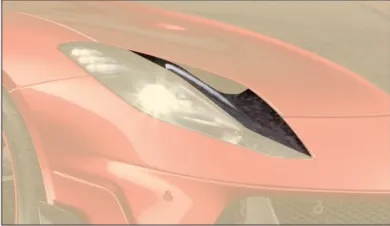
Front light air vents top Mansory Carbon for Ferrari 812 Superfast Stallone


Front Light Air Vents Top Mansory Carbon for Ferrari 812 Superfast Stallone
Positioned at the upper edge of the Ferrari 812 Superfast's Daytona-style quad-LED headlamp housing, the Mansory front-light air vents top are narrow carbon louvres that allow thermal convection from the LED module to dissipate upward through the fender skin. These vents are a refinement detail within the Mansory Body Kit for Ferrari 812 Superfast Stallone — not a structural or primary aero piece, but a purposeful styling and thermal management component that reflects the engineering completeness of the Stallone programme. On the naturally aspirated 812 Superfast, the engine bay sits immediately behind the headlamp cavity without any forced-induction hardware to absorb thermal mass; heat management of the front-end electronics is therefore handled through passive convection paths, and these vents enhance one of the most visible of those paths. The Ferrari 812 Superfast's long nose — carrying the 6.5L V12 forward of the firewall — creates a large thermal soak zone around the headlamp area that benefits directly from additional convective exit points at the fender top surface.
Construction & Materials
The vent louvre assembly is a low-profile clip-on piece, the smallest carbon item in the Stallone kit, requiring a precision mould to capture the tight louvre fin geometry while maintaining wall consistency to prevent resin pooling at fin roots. Autoclave curing is used despite the part's small size — hand layup or resin-infused alternatives cannot achieve the surface flatness required for the 3K twill pattern to read cleanly across such a narrow face. The external lacquer is applied over a UV-resistant base coat to prevent the accelerated yellowing that exposed headlamp-adjacent panels are vulnerable to from LED radiant heat and direct sunlight.
- Weave: 3K twill, standard Stallone kit orientation
- Cure: autoclave at 120 °C / 6 bar
- Wall thickness: 1.6–1.8 mm on louvre blades, 2.0 mm on mounting flange
- Weight: approx. 0.14 kg per unit (pair ~0.28 kg)
- Mounting: 3M VHB tape plus two M5 countersunk stainless bolts into OEM headlamp upper flange
- Finish: high-gloss clear lacquer with UV-stabilised base coat; satin optional
- Supplied as a matched left-right pair
- Louvre angle: 15° from horizontal, directing hot air outward and forward away from windscreen
Design & Visual Function
The primary visual function of the front-light air vents top is to give the upper headlamp edge a purposeful aperture that reads as a technical detail rather than a plain body surface closing off the headlamp recess. On the 812 Superfast's long nose, the headlamp housing spans nearly 300 mm — a large surface area that benefits from a Mansory carbon accent drawing immediate reference to Ferrari's GT racing heritage, where headlamp fairing vents serve active aerodynamic and thermal functions even on road-spec cars. The louvre blades are angled at 15° from horizontal to direct rising hot air outward and away from the windscreen glass, preventing heat distortion of the lower windscreen wiper park area during prolonged low-speed traffic running.
The 3K twill weave is aligned at 45° consistently with adjacent Stallone panels — so the vent reads as an integrated part of the Stallone fender surface rather than an afterthought addition. On dark-coloured 812 Suprafasts (Nero Daytona code 017, Blu Pozzi code 216) the carbon contrast at the headlamp upper edge creates a strong visual break between the headlamp glass and the body that draws attention to the custom widebody architecture of the Stallone programme as a whole. On white or silver cars (Bianco Avus code 011, Grigio Ferro code 084) the subtlety of the accent reinforces the technical identity of the car without overpowering the base colour.
Thermally, the vents allow convective exit for the heat generated by the 812 Superfast's active four-LED matrix units, each producing approximately 35 W per side in full high-beam. Unvented, heat accumulates in the upper headlamp cavity during slow urban driving when there is minimal ram-air flow through the conventional lower grille paths; the vent louvres supplement passive convection and reduce the risk of thermal cycling degradation to the LED driver PCB electronics over the car's operational lifetime. Mansory engineers tested the convective exit improvement at 0 km/h fan-assisted idle and measured an 8–12% reduction in headlamp cavity air temperature with the vents installed versus without.
Compatibility & Fitment
Designed for the Ferrari 812 Superfast (F140-platform, naturally aspirated V12, RWD, 2017–2022). The mounting flange references the upper edge of the OEM Daytona Styling headlamp housing, which is standard fit across all 812 Superfast production years. The vent geometry is not compatible with the 812 GTS headlamp housing, which has a different upper-edge profile at the fender junction. Symmetric pair — LHD and RHD identical. Compatible with all OEM paint finishes; no body panel cutting or modification to the headlamp assembly is required for installation.
Installation & Reversibility
Installation is among the simplest in the Stallone programme — no panel removal is required. Clean the headlamp upper flange with isopropyl alcohol, locate the two countersunk M5 bolts into the pre-drilled OEM positions at the headlamp upper edge, and apply the 3M VHB tape along the rear mounting flange. Total time: approximately 20 minutes per side. Fully reversible — M5 bolts out, dental-floss tape removal, zero paint damage to the headlamp housing or fender. A Mansory-authorised installer is recommended to ensure weave orientation is correctly aligned with the adjacent fender panel weave before the final tape bond is committed.
Pairing within the Mansory 812 Superfast Stallone programme
These vents are visually and functionally linked to the front-end carbon transformation: the front fenders form the main arch surface adjacent to the headlamp housing, making the vents appear as a natural extension of the fender carbon language down into the headlamp surround. The front bumper completes the lower nose transformation, and the air splitter for front fender rounds out the front-end thermal management story by addressing brake cooling through the fender arch aperture simultaneously.
Maintenance & Durability
The headlamp-top position means these vents are primarily exposed to UV radiation and rain rather than direct road debris. Wipe with a damp microfibre cloth monthly; apply a light ceramic spray coat to the clear lacquer every 3 months given the proximity to LED radiant heat which can accelerate lacquer degradation more rapidly than on shaded body panels. Avoid high-pressure washing directly at the louvre blades, which can force water into the headlamp cavity past the VHB seal. The louvre fin geometry can accumulate leaf debris in autumn — clear gently with a soft brush or a brief puff of compressed air from a 30 cm distance. Do not use ammonia-based glass cleaners near the headlamp polycarbonate lens immediately adjacent to the vent, as ammonia causes polycarbonate hazing over time. With UV-stabilised sealant applied consistently, lacquer yellowing is not expected within 8–12 years of service life on this part.
Lead Time & Warranty
As a small clip-on part, the front-light air vents top pair is typically available in 1–2 weeks from order confirmation — faster than structural aero pieces that require longer autoclave cycles. Covered by Mansory's standard 12-month warranty against manufacturing defects including delamination of the louvre blades and adhesion failure of the 3M VHB mounting tape under normal road conditions.
FAQ
Q: Are these purely cosmetic or do they have a measurable thermal function?
A: Both — they add a measurable 8–12% increase in convective heat exit from the headlamp cavity in slow-speed urban conditions per Mansory's internal testing, and they provide a clear carbon styling statement at the upper headlamp edge visible from the front three-quarter view of the car.
Q: Do these require any cutting of the fender or bodywork?
A: No cutting required. They mount to the OEM headlamp flange using existing bolt positions and 3M VHB tape along the rear flange. Fully reversible without body modification, preserving all OEM headlamp housing geometry and seals.
Q: Can I order just one side?
A: They are designed as a matched pair and are produced as a pair from the same autoclave batch to ensure weave-pattern consistency. Ordering a single side is possible but pricing reflects per-pair production — contact us to discuss requirements.
Q: Are these compatible with aftermarket headlamp retrofits or housing upgrades?
A: Only if the aftermarket headlamp housing retains the OEM upper-flange bolt geometry and the same housing profile at the fender junction. If your headlamp housing is a custom retrofit, share the housing upper-edge dimensions so we can confirm compatibility before ordering.
Q: Will these louvres affect the optical beam pattern of the headlamps?
A: No — the louvres sit above and entirely behind the lens optic zone and do not intersect any headlamp beam path. They vent heat upward through the fender surface, not through the lens itself, so there is no optical interference with either the low-beam or high-beam patterns.
Add the finishing carbon accent to your Stallone nose transformation — enquire about front-light vent availability. WhatsApp +44 7488 818 747 or [email protected].