
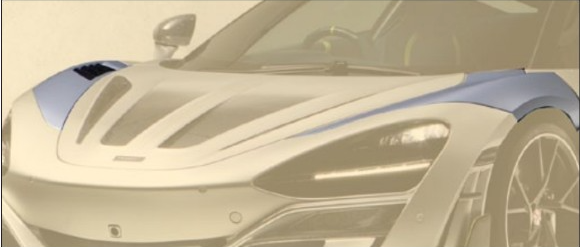
Front fenders Mansory Carbon for McLaren 720S


Mansory Carbon Front Fenders for McLaren 720S
The Mansory carbon front fenders sit on the most exposed quarter of the 720S — the panel that wraps the front wheel arch, meets the dihedral-door cut, and ties the nose architecture into the side profile. They replace the OEM aluminium front wings on Coupe and Spider with autoclaved carbon-fibre panels finished to match the rest of the Mansory Carbon Fiber Body kit set for McLaren 720S. Within the Mansory programme for the M840T 4.0 V8 BiTurbo car, the front fenders are the panel that pulls the carbon language out of the front bumper and pushes it down the flank toward the side set, sitting against a body that already runs a Monocage II carbon tub underneath. Owners who specify them are usually building the front aero trio in one go: front bumper, fenders, side set.
Construction & Materials
Each fender is laid up as a single-skin carbon panel with localised reinforcement where the OEM mount points and the headlight bezel land. Mansory uses prepreg carbon, autoclaved under heat and pressure, with a wall thickness chosen to match the bending stiffness of the OEM aluminium wing while saving mass. The wheel-arch lip and the door-shut edge are doubled up to handle stone strikes and the small flex that occurs when the dihedral door swings up against its hinge stop.
The visible weave is aligned with the adjacent Mansory front bumper and side set so the carbon pattern reads as one continuous flow from the bumper corner, across the fender top, and into the sill. This is the panel where weave mismatch is most visible, so the moulds are cut to keep the twill rotated identically across all three panels.
- 3K twill carbon prepreg, autoclave cured under controlled ramp
- Wall thickness in the 1.4–1.8 mm range with ribs around the wheel-arch lip
- Estimated saving ~2.0–2.6 kg per pair vs the OEM aluminium wings
- Deep-gloss UV-stable lacquer standard; satin and exposed-weave matte available on request
- Mount points mirror OEM bolt pattern — no chassis drilling, no Monocage II contact
- Wheel-arch liner clearance preserved for the OEM plastic liner and brake-duct routing
- Brake-cooling vent geometry replicated where the OEM carries one, no airflow restriction
- Edge sealing and chip-resistant coat applied along the leading lip behind the front bumper
Design & Visual Function
The 720S front wing is a complicated panel. It has to wrap a tall wheel arch, meet the front bumper at a precise crease, and run cleanly into the dihedral-door cut without distorting the door's swing radius. Mansory's carbon version preserves all of those geometry breakpoints exactly, then changes the surface — instead of painted aluminium, you get a deep weave that behaves differently under direct sun and under low garage light. In daylight the weave reads as fine grid; under tungsten the lacquer flares and the panel reads almost wet.
Functionally, the fenders work with the front bumper to define airflow toward the front-axle radiators and brake-cooling ducts. The 720S runs carbon-ceramic rotors as standard, and those need consistent cold airflow at low speed and at sustained track pace. The Mansory fenders keep the OEM duct path intact behind the wheel-arch liner, so the brake-cooling channel is unaffected. Where the OEM fender carries a vent, the Mansory panel reproduces that aperture with the same draft angle and cross-section, and the carbon edge is finished cleanly so it does not chip when stones come up off the front tyre.
Visually, the part finishes the front aero trio. With OEM aluminium wings, the Mansory front bumper looks like a part that has been dropped onto a painted car. With carbon fenders alongside, the front clip reads as one engineered surface. Pair this with the Mansory side set and the entire flank between the front wheel and the rear quarter is consistent carbon — the language Mansory built the 720S programme around.
Compatibility & Fitment
McLaren 720S Coupe and Spider, 2017 through 2023, on cars equipped with the M840T 4.0 V8 BiTurbo and the seven-speed SSG transmission. The fenders are NOT compatible with the 765LT — the Long Tail uses a longer front clip and different wing geometry, so a 720S fender will not align with a 765LT front bumper or door cut. Active aero hardware on the 720S — the deployable rear wing hydraulics and the front Active Lift system that raises the nose ~5 cm for ramps — is unaffected by the front fenders. OEM parking sensors, headlight washer apertures, side-marker lights and the OEM wheel-arch liner all carry over. Dihedral-door geometry is untouched: the fenders sit against the door cut but do not modify it, so the door's hinge and swing path remain OEM. The Monocage II carbon tub is the chassis structure underneath; the Mansory fenders are bolt-on body panels and add nothing structural.
Installation & Reversibility
Plan around 4–6 hours per side for a careful installation. The front bumper is removed first, the headlight is unbolted and pulled forward, the wheel-arch liner is dropped, and the OEM aluminium wing comes off. The Mansory carbon fender goes on the same OEM mount points with corrosion-isolating washers between the carbon and the steel sub-structure to avoid galvanic contact. Panel gaps to the front bumper, door, and bonnet are set with shims; the headlight is reset against the new fender shoulder; the wheel-arch liner goes back behind the carbon. The whole job is reversible — OEM aluminium wings re-fit on the same mounts if a future buyer prefers stock. Recommended installer is a McLaren-certified body shop, particularly because the front bumper has to come off and that brings parking sensors and the front Active Lift feed into play. Edge sealing along the leading lip and a layer of paint protection film over the wheel-arch lip are recommended at install — this is the first panel to see tar, chips, and brake dust, and PPF behind the wheel buys a lot of life off the lacquer.
Pairing within the Mansory 720S programme
The front fenders sit at the centre of the front aero trio with the Mansory carbon front bumper and the Mansory carbon side set — those three panels share weave alignment and finish run, so specifying them together gives the cleanest visual flow from nose to sill. Owners who want the rear of the car to read in the same carbon vocabulary commonly add the Mansory carbon rear fender air intake, which mirrors the front-fender carbon language at the rear quarter. If the front bumper is being replaced anyway, the fenders are the natural same-shop add-on.
Maintenance & Durability
Lacquered carbon on a panel this exposed lives or dies on its first season. The leading lip behind the front bumper takes road tar and chips off the front tyre, the wheel-arch lip catches gravel, and the panel sits in the splash path of the front wheel — so the maintenance question on the fenders is mostly about chip protection and surface chemistry. Use pH-neutral shampoo, soft mitts, two-bucket method, and a dedicated wheel-well brush for the inner lip. Avoid alkaline cleaners, ammonia-based glass sprays anywhere near the lacquer, and abrasive sponges. A ceramic coating on the visible carbon helps with bug acid and bird-bomb etch; carnauba is fine but needs more frequent reapplication. Paint protection film is strongly recommended along the leading lip and on the upper shoulder of the fender where the door cut meets the wing — those two zones are where chip damage shows first. If a chip does break the lacquer and reach the weave, the repair workflow is a sand-blend, weave-match, re-lacquer in a body shop that has done lacquered carbon before — not the same skill as paint repair on an aluminium wing, and worth budgeting for. Carbon-ceramic brake dust is hot and abrasive, so the inner fender lip and the wheel-arch liner area should be inspected at every service.
Lead Time & Warranty
Mansory builds the 720S carbon parts in batches and lead time runs typically 4–8 weeks from order, longer if a non-standard finish (satin, raw weave, mixed weave) is requested. The fenders carry a 12-month warranty against manufacturing defects — delamination, weave fault, lacquer failure under normal use. Stone-chip damage, track-incident impact, and damage from incorrect cleaning chemistry are not covered, which is why the chip-protection film is worth specifying at install.
FAQ
Q: How much weight comes off the car?
A: Roughly 2.0–2.6 kg per pair compared to the OEM aluminium wings. Not a track-relevant number on its own, but it stacks with the rest of the carbon programme.
Q: Will the fenders fit a 765LT?
A: No. The 765LT uses a different front-clip geometry and the panels do not interchange. These fenders are for 720S Coupe and Spider only.
Q: Does anything change behind the fender — brake ducts, liner, sensors?
A: No. The wheel-arch liner re-fits OEM, the brake-cooling duct path is preserved, and any OEM fender vent is reproduced with the same cross-section. Side-marker lights and parking sensors carry over.
Q: Is the front Active Lift affected?
A: No. Active Lift is a suspension function — it raises the nose by lifting the front axle, not by moving the fender. The fenders are passive body panels and have no interface with the lift hydraulics.
Q: What happens if I chip the lacquer in the first month?
A: Small chips on the leading lip can be sealed and stabilised; deeper chips that reach the weave need a body shop with carbon-repair experience to sand-blend, match, and re-lacquer. PPF on the leading lip and over the upper shoulder is the cheapest way to avoid the question.
Q: Can I keep one OEM aluminium wing if only one is damaged?
A: Technically yes, but the weave on the carbon side will not match the painted wing on the other side under sun. Owners almost always do the pair.
Pair the front fenders with the Mansory front bumper and side set to finish the front aero trio in one weave run. To configure finish, confirm fitment for your VIN, and book installation, message WhatsApp +44 7488 818 747 or write to [email protected].