
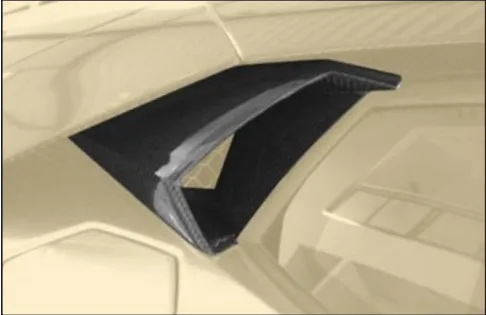
Air intake - side window Mansory Carbon for Lamborghini Aventador Competition


Mansory Carbon Air Intake — Side Window for Lamborghini Aventador Competition
The side-window air intake is one of the most architectural pieces in the Mansory Carbon Body Kit for Lamborghini Aventador Competition programme. Where most carbon trim sits low on the bumpers or high on the bonnet, this part lives on the shoulder of the car — that narrow sail-panel ribbon between the trailing edge of the scissor door and the leading edge of the rear quarter, framing the slim engine-bay glass that lets onlookers peek at the naturally aspirated 6.5-litre V12. Aventador Competition owners specify it to tighten the side-glass graphic, line up the weave with the C-pillar shoulder and sharpen the visual cue that tells everyone the V12 sits behind the cabin, not under a long bonnet. The piece is fully compatible with scissor-hinge travel and ALA 2.0 mast geometry on SVJ.
Construction & Materials
The Mansory side-window intake is built as a thin-wall sail-panel skin with reinforced bonding flanges. Mansory laminates the visible face with 3K twill prepreg, cures the part in autoclave at high pressure to keep the weave perfectly flat across the long, gently curved C-pillar, then finishes with UV-stable lacquer or — on request — a soft satin clear that lets the door-line shadow play across the cloth without specular flare. The bonding flange is reinforced with a 2x2 plain-weave inner ply for stiffness around the engine-bay window aperture, so the part does not flex when the door is opened or when the rear quarter panel sees thermal expansion from V12 heat soak.
- Visible-face weave: 3K twill prepreg, with optional 2x2 plain or forged carbon on bespoke order.
- Cure: autoclave prepreg, ~6 bar, controlled ramp to keep the long curved face wrinkle-free.
- Wall thickness: ~1.6–2.0 mm on the visible skin, ~2.4–2.8 mm at bonding flange.
- Weight per side: ~0.45–0.6 kg (vs ~0.9–1.1 kg OEM painted plastic shoulder trim).
- Mounting: factory mount points + double-sided structural acrylic tape and methacrylate adhesive on bonding ribs.
- Finish: high-gloss UV-stable lacquer; satin or raw-weave-look on bespoke build.
- Hardware: stainless dowel pins for indexing on OEM body datums, no visible fixings on the sail panel.
- Sold per side: left and right mirror-cut to keep weave bias symmetrical across the car.
Design & Visual Function
Aventador shoulder geometry is one of the most recognisable lines in modern supercar design — a sharp crease running from the door cut up over the engine-bay glass and down to the rear haunch. The Mansory side-window intake follows that crease exactly, but where the OEM panel is body-coloured plastic with a flat surround, the carbon part adds depth: the weave reads horizontally along the door-line and rotates fractionally as it climbs the C-pillar, drawing the eye toward the engine bay. Walk around the car and the weave catches light in two distinct phases — flat shadow when viewed from the front three-quarter, glittering twill from the rear three-quarter. That bi-phase reflection is exactly what Mansory weave alignment is engineered for.
Visually the part frames the slim side glass that Lamborghini built into the engine-bay cover so the V12 is visible from outside. The carbon surround tightens that aperture, gives it a darker border and makes the brushed cam covers underneath read more strongly. On Roadster builds, where the targa panels stow ahead of the firewall, the carbon shoulder line meshes with the carbon roof-cover surfaces to create a continuous weave band from A-pillar to rear deck — a Mansory hallmark.
Aerodynamically the part has a secondary role. On certain Aventador build configurations the side-window aperture works as a low-pressure draw — pulling warm air out of the engine bay rather than pushing intake air in — and the carbon trim is shaped so that its trailing edge does not interrupt that flow path. ALA 2.0 channel preservation on SVJ is unaffected because the side-window line sits well outboard of the central rear-wing duct.
Compatibility & Fitment
Designed for Lamborghini Aventador LP700-4, LP750-4 SV, S, SVJ and Ultimae, both coupé and Roadster body styles. The mounting flange uses the factory C-pillar datums and is dimensioned to retain the OEM Lamborghini engine-bay glass without modification — neither the laminate edge bond nor the rubber surround needs to be disturbed. Scissor-hinge cinematic travel is preserved: when the door rotates upward, the trailing edge of the door clears the leading edge of the carbon trim by the factory specification with no shaving or relief work. The part also retains all OEM Aventador parking-sensor and proximity-sensor wiring runs in the C-pillar harness, and respects the methacrylate bond line that Lamborghini uses to attach the rear quarter to the CFRP monocoque.
Installation & Reversibility
Estimated bay time: 1.5–2.5 hours per side for an experienced installer, including OEM trim removal, surface prep on the body shoulder, dry-fit, adhesive cure and detail clean-up. Tools required: plastic trim wedges, isopropyl alcohol for substrate degrease, methacrylate adhesive in mating pairs, structural acrylic tape, masking film for the surrounding paintwork, infrared thermometer to verify cure ramp on cool days. The OEM shoulder trim is removed by releasing the inner door-frame clip line and easing the painted plastic off its dowel posts; the dowel posts are reused as indexing references for the carbon piece. The carbon trim is offered up dry, indexed to the dowels, taped along the upper crease, then bonded with methacrylate on the inner flange. Cure time at 20 °C is around 90 minutes to handling strength and 24 hours to full strength.
The install is fully reversible. The methacrylate bond peels cleanly off OEM paint when warmed gently with a heat gun and worked with a plastic wedge — paintwork is not disturbed if the technician follows Mansory's recommended dwell sequence. The OEM shoulder trim can be refitted to the same dowel posts, restoring the car to factory cosmetic state. Recommended installer: Lamborghini-certified body shop or a Mansory-trained technician for paint-adjacent body-mounted carbon work.
Pairing within the Mansory Aventador Competition programme
The side-window intake is most often specified together with other shoulder- and side-of-car carbon parts so the weave reads as one continuous band. The natural pairings are with Replacement Air Intake — rear immediately aft, with the Side Skirts below the door cut, and with the Mirror Housing ahead of the door — the four parts together form a horizontal weave ribbon that wraps the entire side of the car from mirror to rear haunch. Match the lacquer finish across all four for the cleanest result; mixing gloss with satin on adjacent parts breaks the visual line.
Maintenance & Durability
Lacquered carbon on the sail panel sees more vertical UV exposure than carbon on the lower bumpers, so a ceramic coating with strong UV inhibitors is the recommended protection layer over the factory lacquer. Hand-wash only, two-bucket method, pH-neutral shampoo. Avoid alkaline traffic-film removers, ammonia-based glass cleaners overspray, and any abrasive sponge near the weave — these are the three most common killers of lacquered carbon. The shoulder of the Aventador also collects insect strikes during fast driving, and dried bug protein is acidic; rinse and remove within 24 hours to keep the lacquer from etching.
The engine-bay heat zone radiates into the underside of the side-window trim. The Mansory laminate is engineered for that thermal load, but heat-soak after a hard drive is real, so do not park the car under intense sun immediately after a track session — let the V12 bay cool with the engine cover venting first. Lifespan of the lacquer with sensible care is 8–12 years. Stone-chip repair is carried out with edge-feather sanding, lacquer touch-in and machine polish; severe chips are sent back to Mansory for re-laminate.
Lead Time & Warranty
Lead time 4–8 weeks from confirmed order, in line with all Mansory bespoke carbon production. Each pair is laid up and cured to order, with weave alignment verified against the customer's chassis number where the build is part of a wider Aventador Competition kit. Warranty is 12 months against manufacturing defects in the laminate and lacquer, covering delamination and clear-coat failure under normal road use.
FAQ
Q: Does the part change with SVJ vs LP / S geometry?
A: The C-pillar sail panel is shared in form across the Aventador family, so the carbon trim fits LP700-4, S, SV, SVJ and Ultimae from the same mould. SVJ-specific pieces are the rear bumper and rear-wing area, not the side-window line.
Q: Will the OEM engine-bay glass be reused?
A: Yes. The Mansory part is dimensioned around the factory glass aperture and frames it; the glass and its rubber surround are not removed during install.
Q: Does the carbon trim restrict scissor-door opening?
A: No. The trailing edge of the door clears the leading edge of the trim by factory specification at full rotation. No shaving or relief work is needed.
Q: Can I have raw weave instead of lacquered?
A: Raw-weave-look (matte sealed) is available as a bespoke build option, ordered up-front. Converting from lacquered to raw after manufacture is not recommended, because the lacquer cannot be cleanly stripped without damaging the weave bias.
Q: Does it work on Roadster builds with the targa panels stowed?
A: Yes. The side-window line is unaffected by targa-panel position, and the weave alignment is engineered to read correctly against the carbon roof-cover surfaces when the soft top is in place.
Q: How much weight is saved per pair?
A: Around 0.6–1.0 kg total for the pair, vs OEM painted plastic shoulder trims. The benefit is mostly visual — the carbon signature on the C-pillar is the headline, the mass change is a side benefit.
Pair the side-window intakes with a rear bumper carbon set and matching mirror housings to land a coherent shoulder-to-haunch weave line. WhatsApp +44 7488 818 747 or [email protected].