
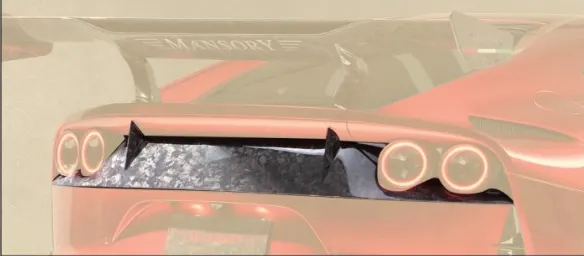
Rear panel Mansory Carbon for Ferrari 812 Superfast Stallone


Rear Panel Mansory Carbon for Ferrari 812 Superfast Stallone
The rear quarter panel is the connecting surface between the Ferrari 812 Superfast Stallone's widened rear arch and the bumper assembly below — a zone that must reconcile the 42 mm-wider body geometry with the thermal demands of the V12's naturally aspirated exhaust and the aerodynamic profile of the rear diffuser. Mansory's carbon rear panel resolves this transition in a single autoclave-cured piece that replaces the OEM plastic rear quarter valance, eliminates the stepped junction that would otherwise appear at the arch-to-bumper interface, and contributes to the rear zone's heat-shield function. Within the Mansory Body Kit for Ferrari 812 Superfast Stallone, the rear panel is often the finishing element of the Stallone rear build — the component that resolves the geometry and makes the rear of the car read as a unified programme design.
Construction & Materials
The rear panel is manufactured from pre-preg carbon fibre cured at 125 °C and 3 bar in Mansory's autoclave. The outer visible surface carries 3K twill weave at ±45°, finished in UV-stable gloss clear lacquer. The inner face — which sits adjacent to the V12's exhaust system — uses a heat-resistant epoxy resin rated to 200 °C continuous service, adequate for the 150–180 °C ambient temperatures present at panel proximity in the rear bumper zone. A reflective ceramic heat-shield film bonded to the inner laminate at the exhaust-adjacent zone provides an additional thermal barrier.
The panel's two critical profiles — the wheel-arch outer edge and the lower bumper interface — are machined from a master fixture referenced to the Stallone's chassis coordinate system, ensuring gap consistency within ±1.0 mm at both interfaces across production batches. Left and right panels are mirror-image pieces supplied as a matched pair from the same autoclave batch to guarantee consistent weave tone between the two sides. Wall thickness throughout is 2.4 mm, combining heat-barrier capacity with structural resistance to rear tyre grit spray across the full tyre contact arc.
- Outer face: 3K twill at ±45°, UV-stable gloss clear lacquer
- Inner face: heat-resistant epoxy resin (continuous 200 °C rated)
- Exhaust-adjacent zone: ceramic heat-shield film bonded to inner laminate
- Cure: autoclave 125 °C / 3 bar — void content <1 %
- Wall thickness: 2.4 mm throughout
- Supplied as matched left-right pair from the same autoclave batch
- Finish: gloss UV-stable clear lacquer; matte on request
Design & Visual Function
The rear panel's design purpose is visual resolution: it closes the geometry between the widened arch and the bumper so that the Stallone's rear quarter reads as a factory-engineered surface rather than an aftermarket assembly. The outer contour follows a single ruled surface from the arch lip to the bumper flange with no compound curvature change — ensuring the panel's highlight line (the bright reflection strip that curved surfaces produce in raking light) is continuous and uninterrupted. On a programme built around tight panel gaps and exposed carbon, a clean highlight is the technical difference between a resolved design and a visually assembled appearance.
The panel's inner face also functions aerodynamically: it forms the outer wall of the air path between the rear tyre and the bumper's thermal ducts, presenting a smooth formed surface to this cavity. This smooth wall reduces turbulent wake formation at the rear corner, improving flow quality entering the rear bumper's heat-duct apertures. A secondary benefit is the reduction in low-frequency cabin buffeting at sustained motorway speeds — the acoustic resonance that the OEM plastic valance's cavity geometry generates in this zone on unmodified 812 Supefasts.
When the rear panel is in place alongside the rear kit, rear spoiler or wing, and grills, carbon is present at every significant rear-body surface — arch extension, quarter fill, bumper face, diffuser, and boot-lid aero device. The completeness of this carbon coverage matters particularly from the three-quarter rear, which is the 812 Superfast's most photographically admired viewing angle. A Stallone build without the rear panel leaves the quarter zone as painted bodywork — visible as a gap in the programme's surface consistency from this angle.
Compatibility & Fitment
Designed for the Ferrari 812 Superfast Stallone in conjunction with the Mansory rear kit, which provides the bumper-interface flange to which the panel's lower edge attaches. Not intended for the OEM rear bumper — the lower-edge profile is specifically shaped to the Mansory rear kit geometry. LHD and RHD equally served by the mirror-image pair. Both the standard stainless and optional Inconel titanium exhaust systems are accommodated without modification to the heat-shield geometry.
Installation & Reversibility
The rear panel pair installs in 2–3 hours for a professional bodyshop. Each panel attaches at its arch interface via three M6 bolts to wheel-arch liner positions, at its lower edge via two M6 bolts to the rear kit's upper flange, and at its forward edge via a small 3M VHB bond to the quarter-panel painted surface. Final panel gap is adjusted using the slotted arch-interface bolt holes before tightening to 8 Nm. The forward VHB bond can be heat-gun released without paint damage when done professionally.
Pairing within the Mansory 812 Superfast Stallone Programme
The rear panel pairs inherently with the Mansory Rear Kit, to which its lower edge attaches. Above the panel, the Mansory Rear Wing adds high-speed boot-lid downforce above the rear assembly's profile. The panel's heat-shield inner surface works directly alongside the Rear Bumper Air-Outtake Grills, whose extraction function the panel's smooth inner face supports by reducing turbulent ingestion losses at the bumper cavity inlet.
Maintenance & Durability
Maintain the outer surface with pH-neutral shampoo and microfibre; apply ceramic coating annually. Rear tyre grit spray is the primary threat to the outer lacquer at the arch-adjacent zone — clear PPF on the forward quarter of each panel before first road use is strongly recommended. Inspect the inner heat-shield film at each annual service for signs of lifting. Re-torque the arch-interface bolts annually to verify they have not loosened through vibration. Lacquer yellowing begins after 8–12 years under normal road use.
Lead Time & Warranty
Rear panel pairs ship within 4–6 weeks of order confirmation as matched left-right pairs from the same autoclave batch. The 12-month Mansory manufacturing warranty covers delamination, void formation, and dimensional non-conformance. Exhaust heat damage from non-standard exhaust modifications falls outside warranty scope.
FAQ
Q: Can the rear panel be fitted without the Mansory rear kit?
A: No — the panel's lower-edge profile is specifically shaped to mate with the Mansory rear kit's upper flange. Using it with the OEM bumper would leave an unresolvable gap at the lower interface without custom fabrication. The rear panel is always specified alongside the rear kit.
Q: Does the ceramic heat-shield protect adequately against the V12's exhaust temperatures?
A: Yes. The V12's naturally aspirated exhaust generates approximately 150–180 °C ambient at panel proximity — within the continuous-duty rating of both the heat-resistant epoxy resin and the ceramic shield film. The panel is designed for normal road and track use with either the standard or Inconel exhaust system.
Q: Are the left and right panels supplied as a pair or available individually?
A: They are supplied as a matched pair from the same autoclave batch to ensure consistent weave tone. For service replacement after damage, individual panels can be supplied — contact Mansory to check current batch stock for visual consistency with an undamaged surviving panel.
Q: How is the panel-gap tolerance at the arch interface maintained across production batches?
A: Mansory references all rear panel production to a chassis-based master fixture. Panels from different batches are interchangeable within ±1.0 mm at both interfaces — within OEM tolerance standards for this body zone. The slotted arch-interface bolt holes allow fine adjustment within this tolerance range during installation.
Q: Does the rear panel change the available rear tyre clearance at the arch?
A: No. The rear panel fills the quarter-valance zone between the arch lip and the bumper; it does not alter the arch lip's inner geometry or tyre clearance. Tyre clearance at the rear arch is determined by the rear kit's arch-extension dimension, which is independent of the panel's outer contour.
Complete the Stallone rear build at Mansory Body Kit for Ferrari 812 Superfast Stallone. Contact WhatsApp +44 7488 818 747 or [email protected] for pricing and delivery scheduling.