
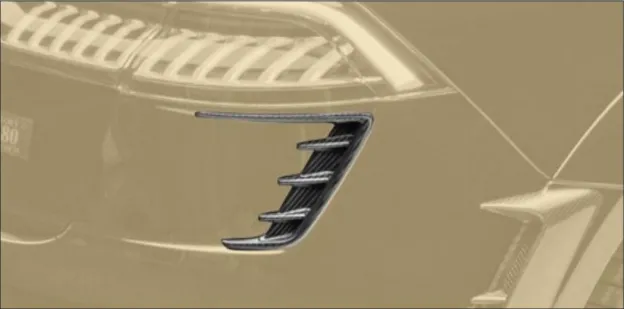
Rear bumper splitter Mansory Carbon for Audi RS Q8


Rear Bumper Splitter Mansory Carbon for Audi RS Q8
The rear bumper splitter is the carbon insert that mounts inside the rear bumper diffuser zone of the Audi RS Q8 4M, framing the OEM exhaust outlets and finishing the underbody airflow path that began at the front splitter. It belongs to the Mansory Carbon Fiber Body kit set for Audi RS Q8 and is the single most photographed surface from behind a Mansory-converted RS Q8: it sits between the tailpipes, runs across the lower bumper, and visually narrows the bumper while widening the appearance of the rear track. On a 2,315 kg performance SUV-coupe powered by a 4.0 TFSI biturbo V8 with 48V mild-hybrid assist, this part has to handle hot exhaust gases washing past at idle, kerb risk on inclined driveways, and constant temperature cycling between cold starts and motorway cruising.
Construction & Materials
The splitter is laid up from genuine Mansory prepreg in the factory's autoclave programme. Layup orientation is engineered for the part's specific loading: the underside, which is closest to exhaust heat and stone strikes, runs additional plies and a heat-tolerant resin system, while the visible upper face is pure show-grade twill. Geometry is CNC-trimmed against the same master that produces the bumper recesses on a finished Mansory-converted RS Q8, so every cutout - exhaust outlets, parking-sensor holes, optional trailer-hitch hatch, mud-flap relief - lines up without rework.
- 3K twill prepreg outer skin with optional 2K plain-weave or forged-look on request
- Autoclave cure at controlled temperature and pressure for void-free lamination
- Wall thickness 2.0-2.6 mm, locally thicker around exhaust cutouts and the diffuser leading edge
- Component weight approximately 2.4-3.1 kg depending on twin vs quad-exhaust variant
- Mounting via OEM bumper bolts, factory clip locations, and 3M VHB along the upper transition seam
- Two-stage UV-stable lacquer (gloss standard; matte clear and satin available)
- Heat-tolerant resin system rated for sustained exhaust-tip proximity
- Pre-fitted brackets for OEM rear PDC sensors retained as factory parts
Design & Visual Function
Visually, the rear splitter is what closes the Mansory grammar on the RS Q8. The wide-body programme pushes the rear haunches outward and the rear-decklid spoiler stretches the cabin line; without a matched lower diffuser insert, that work would terminate against an OEM bumper. The Mansory carbon splitter resolves the lower edge with deep vertical strakes, exposed weave running parallel to the road, and an aggressive lower lip that visually drops the car's centre of gravity. The OEM rear bumper of the RS Q8 already has a sculpted diffuser shadow line; this part replaces the painted plastic centre with structural carbon and extends the strake geometry outward toward the wheel arches.
Functionally, the splitter manages the transition where underbody airflow exits the car. On a high-speed run the underbody is faster than the freestream above the roof; that low-pressure flow has to expand back to ambient as it leaves the diffuser, and a clean Venturi expansion - which is what the strakes promote - reduces base drag and rear-axle lift. For a 2.3-tonne SUV at 250+ km/h this is not academic: the V8 biturbo can hold that speed, the air suspension is calibrated for it, and the rear-axle planting effect from a properly profiled diffuser splitter complements the rear-decklid spoiler's downforce contribution. The strakes also straighten flow that would otherwise tumble around the rear wheels and cause boundary-layer noise.
The splitter accommodates both the standard twin tailpipe layout and the central quad-exit configuration of the body-kit-II programme. Cutouts are profiled to leave a uniform gap around each tip so heat soak does not transfer to the carbon, and the leading lip of each cutout is rolled to avoid soot deposition trapping on a sharp edge. With twin-exit cars the central section of the splitter remains continuous; with quad-exit conversions the central quad outlets sit recessed in their own zone and the splitter frames them with vertical fences.
Compatibility & Fitment
Compatible with the Audi RS Q8 4M chassis, model years 2020 onwards, including both the pre-facelift run (2020-2023) and the facelifted Performance variant (2024+). The 2024 facelift adjusted the rear bumper geometry slightly - principally the diffuser shadow line and the bumper-to-tailgate seam - and the splitter is offered in two trims to match. Specify the model year and exhaust configuration at order. OEM rear parking-distance-control sensors are retained through pre-cut openings; the optional trailer-hitch coupling, where fitted, retains its OEM removable cover plate behind a matched aperture in the splitter; the rear fog light remains in its OEM bumper position, untouched by this part. LHD and RHD cars use the same component - the splitter is symmetrical about the longitudinal axis.
Installation & Reversibility
Installation is a body-shop operation rather than a driveway job. The OEM lower bumper centre section is removed first, which on the RS Q8 means raising the air suspension to its highest off-road mode for working clearance, supporting the bumper, and disengaging the lower clips and bolt strip. PDC sensors transfer with their factory wiring loom intact. The carbon splitter is then dry-fitted to verify cutout alignment to the actual exhaust tips on the customer's car (necessary because OEM exhaust position varies fractionally between builds), test-fitted with the trailer-hitch cover and the mud-flap relief if specified, and only then bonded and bolted in. Total skilled labour is around 3-4 hours including the dry-fit and the suspension cycle. Reversibility is good: the part bolts to OEM mount points and is bonded along the upper seam only with reversible structural tape; the OEM bumper centre can be refitted if needed.
Pairing within the Mansory RS Q8 programme
Within the genuine Mansory carbon line, the natural rear-end pairing is with the Rear decklid spoiler Mansory Carbon: the spoiler manages the upper trailing edge and the splitter manages the lower diffuser exit, and together they balance the rear-axle aero load that the air suspension and rear-wheel steering are tuned around. The visual pairing extends to the Body kit II middle exhausts Mansory Carbon - the configuration with central quad outlets, where the splitter frames the four titanium tips as a single sculpted feature. Owners who prefer the silver-emblem aesthetic round out the rear with the Rear logo panel with silver logo, which carries the same carbon weave from below the rear glass down across the tailgate.
Maintenance & Durability
Carbon parts in the rear diffuser zone live a harder life than panels higher up the car, because they sit in the spray cone behind the rear wheels and inside the heat shadow of the exhaust tips. Apply a UV-stable ceramic coating soon after installation - this is the single most effective measure to prevent the lacquer from yellowing under cycled heat and sun. Wash with pH-neutral shampoo only; alkaline wheel cleaners migrate downward in the rinse and will haze lacquered carbon over a season. Keep solvents and tar removers away from the surface. Stone chips along the lower lip are inevitable on driveway approaches; small chips can be sealed with an OEM-grade lacquer touch-up to stop water ingress and arrest propagation through the weave, and visible damage can be re-laquered or, in heavier cases, the affected section can be reskinned in a body shop without removing the part. Lifespan with reasonable care is well into the second decade of ownership.
Lead Time & Warranty
Lead time is typically 4-8 weeks. Standard 3K twill in gloss lacquer ships fastest; matte and satin clears, 2K plain weave, and forged-look variants run at the longer end. The part carries a 12-month warranty against manufacturing defects in the laminate and finish; impact damage from kerb strikes and stone chips is excluded but can be repaired within the same workflow.
FAQ
Q: Will it fit my pre-facelift 2021 RS Q8 and a 2024 RS Q8 Performance?
A: Yes, but they are different parts. Specify your model year at order so the correct bumper-geometry match is shipped.
Q: Twin-exit OEM exhaust or central quad-exit conversion?
A: The splitter is supplied in either configuration. Confirm your exhaust layout when you order; the quad-exit version is the natural visual partner to the body-kit-II middle-exhausts programme.
Q: Are the rear parking sensors retained?
A: Yes. Pre-cut openings hold the OEM sensors at their factory angle so PDC and the surround-view system continue to operate without recalibration.
Q: I have a factory tow-bar with the removable cover. Does this still work?
A: Yes. The splitter has a matched aperture so the OEM trailer-hitch cover lifts away in the usual manner and the hitch deploys cleanly.
Q: Will exhaust heat damage the carbon around the tip cutouts?
A: No. The cutouts are sized for a uniform gap around each OEM tip and the laminate uses a heat-tolerant resin system in that zone. Sustained idling does not transfer enough heat to discolour the lacquer.
Q: Can the splitter be repaired after a kerb strike?
A: Light scuffs and lacquer chips are touch-up jobs. Heavier damage along the lower lip is a re-skin and re-lacquer in a carbon-capable body shop. Either route is faster and cheaper than replacement.
The rear bumper splitter is what tells a Mansory-converted RS Q8 from behind. Pair it with the rear decklid spoiler and the rear logo panel for a complete rear-end refresh. Order or ask questions via WhatsApp +44 7488 818 747 or [email protected].