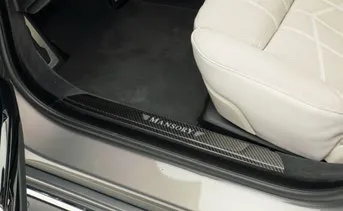
Entrance panels with logo Mansory for BMW XM


Entrance panels with logo Mansory for BMW XM
The Mansory entrance panels with logo provide the threshold branding statement of the Mansory Carbon Fiber Body kit set for BMW XM without the LED illumination circuit of the illuminated variant — making them the specification choice for owners who prioritise the premium carbon tread surface and visible Mansory logotype inset at the sill face without the electrical installation complexity. On the BMW XM G09, the door sill entrance panels are the highest-traffic interior touch surface: every occupant contacts the tread face twice per journey (entry and exit), and the panel's material quality communicates the build specification at the threshold between exterior ambition and interior refinement. These panels replace the BMW XM's factory sill panels in 3K twill carbon fiber, with a satin-brushed stainless steel Mansory logotype plate inset flush into the tread face, providing permanent daytime brand display without requiring any electrical connection. The S68 twin-turbo V8 PHEV powertrain in the XM — delivering 644–748 hp through M xDrive AWD — warrants a threshold that communicates equivalent material seriousness in the non-illuminated configuration.
Construction & Materials
The entrance panel body uses the same 3K twill carbon fibre closed-section construction as the illuminated variant: 200 g/m² outer drape autoclave-cured at 120 °C over an aluminium mandrel, with a 3 mm aluminium substrate plate bonded between the CFRP skins across the tread width to prevent deflection under occupant foot load. The tread face carries a satin-polished finish on the 2K polyurethane clear coat, reducing the specular glare that a high-gloss tread surface produces under cabin lighting and improving scuff-mark concealment between detail sessions.
The Mansory logotype plate is a precision laser-cut 0.8 mm stainless steel sheet, brushed to a satin 240-grit finish, set flush into a CNC-routed recess in the tread face that is exactly 0.8 mm deep. The flush inset geometry eliminates any step at the logo plate edge that could create a raised edge trip hazard on the sill or a water-trapping channel in wet-entry conditions. The stainless plate is bonded with a structural epoxy specifically formulated for metal-to-CFRP bonding, with a cure schedule that produces a peel strength of 4.2 MPa — well above the shear load the plate experiences from boot-sole contact during sill entry.
- Panel body: 3K twill carbon fiber, 200 g/m², closed-section autoclave cure 120 °C
- Tread substrate: 3 mm aluminium plate between CFRP skins — deflection resistance
- Tread finish: 2K polyurethane clear coat, satin specification to reduce glare and scuff visibility
- Logo plate: 0.8 mm laser-cut stainless steel, 240-grit satin brush finish
- Logo recess: CNC-routed 0.8 mm deep — flush flush logo installation, no raised edge
- Logo adhesive: structural metal-to-CFRP epoxy, 4.2 MPa peel strength
- Weather seal: 3 mm EPDM gasket on panel perimeter — splash ingress barrier
- Hardware: OEM-position clip nuts, 2× M6 stainless studs per panel at front face edge
Design & Visual Function
The 240-grit satin stainless logotype plate creates a material-contrast visual within the carbon tread face that reads differently under different cabin light sources. Under the BMW XM's warm ambient cabin lighting, the satin metal surface reflects a diffuse luminous area that stands out from the dark carbon weave without glare. Under direct overhead garage lighting (6,500 K fluorescent), the stainless surface produces a cool-white plane against the carbon's warm-grey diagonal, reversing the apparent tonal relationship and demonstrating the programme's material depth to detail-conscious viewers.
The absence of the LED driver module and wiring harness of the illuminated variant simplifies the panel's installation and eliminates any ongoing electrical maintenance concern, making this the lower-complexity option for owners who want the carbon and branding quality of the Mansory programme without the welcome-sequence integration. The panel is visually indistinguishable from the illuminated variant when viewed in normal daylight entry conditions — the PMMA acrylic insert of the illuminated version and the stainless plate of this version are both set flush in the tread face and read as a bright metal inset in daylight. The distinction is only apparent when the car is in a darkened environment and the welcome lighting sequence activates.
Satin-finish tread panels are recommended for XM owners specifying the car in lighter interior colour packages — pale leather, two-tone combinations, or Moonstone Grey interiors — where a high-gloss carbon tread face would create a high-contrast material discontinuity at the threshold. The satin tread integrates more harmoniously with light-tone interior environments while retaining the carbon fibre material identity of the programme.
Compatibility & Fitment
Confirmed fitment: BMW XM G09 2023-onwards, all trim variants. A set of four panels covers all door openings. The clip-nut and M6 stud positions replicate the OEM sill panel mounting geometry at all four door positions — LHD and RHD configurations are identical as the XM's sill structure is symmetric. The panels are compatible with the deployable running board option; the running board's retracted geometry clears the panel rear flange. These non-illuminated panels do not require any OEM connector engagement — the panel installs and removes without any electrical interface, making the installation and reversal simpler than the illuminated variant.
Installation & Reversibility
Installation time is 1.5–2 hours for all four panels, shorter than the illuminated variant by approximately 45 minutes because no harness routing or connector work is required. Procedure: remove OEM sill panels by releasing clip nuts with a flat trim tool; if the OEM panels have an electrical connector (factory illuminated sill), cap the connector with the supplied protective cap before seating the Mansory panel; position the Mansory panel on the OEM clip positions; engage the M6 studs; no electrical connection required. Fully reversible: OEM panels reinstall at the same positions without modification.
Pairing within the Mansory BMW XM programme
The non-illuminated entrance panels pair with the Door logo lights for front door Mansory for BMW XM to create an entry-zone brand presence that has ground-level LED projection below the door and a static carbon-and-stainless sill panel at the threshold — without requiring the illuminated panel LED circuit above. This pairing is often the preferred specification for owners who want LED welcome effects but do not want the complexity of illuminated sill panels. For the interior material extension beyond the threshold, the Velour floor mats — nubuck edging Mansory for BMW XM provides the cabin floor treatment that the sill panels transition into at the foot of the entry step.
Maintenance & Durability
The satin carbon tread face requires the same maintenance protocol as the illuminated variant's tread, with the additional benefit that satin surfaces reveal scuff marks less obviously than gloss finishes. Apply a SiO₂ liquid ceramic coating to the tread face at installation and refresh every 6 months for vehicles used daily. The stainless steel logotype plate's satin finish can develop fingerprint marks from direct hand contact during entry — wipe with a damp microfibre cloth after each interior detailing session. Avoid abrasive polishing on the stainless surface — the 240-grit directional satin finish is part of the panel's aesthetic specification, and aggressive polishing will change the surface direction and reflectivity permanently. The EPDM perimeter gasket should be cleaned of accumulated road salt with a neutral pH cleaning solution at each major wash service to prevent chemical attack on the rubber compound.
Lead Time & Warranty
Lead time for the non-illuminated entrance panel set is 2–3 weeks from confirmed order — shorter than the illuminated variant as the LED driver module assembly step is omitted. The 12-month warranty covers CFRP tread-face delamination, stainless logo plate adhesion failure, void formation in the panel body, and EPDM gasket adhesion separation. Satin clear-coat wear from normal boot-sole contact is a consumable maintenance item and is not covered under the manufacturing warranty.
FAQ
Q: Can I upgrade from the non-illuminated to the illuminated panels later?
A: Yes — the illuminated entrance panels are a drop-in replacement at the same OEM mounting positions. The non-illuminated panels do not pre-route any wiring, so the upgrade requires routing the LED harness leads at the time of the illuminated panel installation — approximately 30 minutes of additional installation work compared with a direct illuminated-panel installation from scratch.
Q: Is the stainless logo plate secure enough to remain flush under heavy foot contact?
A: The 4.2 MPa structural epoxy bond between the stainless plate and the CNC-routed recess provides substantial resistance to shear loading. The flush inset geometry means foot contact forces are directed parallel to the bond plane rather than in peel, which is the most favourable loading direction for epoxy adhesives. Under normal footwear contact, the bond is engineered to last the vehicle's service life without adhesion failure.
Q: Are the panels available with a carbon-weave logotype instead of the stainless plate?
A: A carbon-logotype variant — where the Mansory lettering is formed as a raised carbon relief in the tread face rather than a separate plate inset — is available as a bespoke order. The carbon-relief logo is produced by the CNC mandrel tool and requires a separate tool setup, adding approximately 4 weeks to the lead time. Contact our team to discuss this specification.
Q: Will the non-illuminated panels fit over the factory deployable running board structure?
A: Yes — the panel rear-flange profile is identical to the illuminated variant's, which is engineered to clear the running board's retracted geometry. When the running board deploys, it extends below the sill panel face and does not contact the Mansory panel. Confirm your running board specification with our team if you have aftermarket running boards with non-OEM retraction geometry.
Upgrade the threshold of your BMW XM with Mansory carbon and stainless sill panels. Enquire now: WhatsApp +44 7488 818 747 or [email protected].